Can DOBOT LUMO remember where you put something after you move it?
DOBOT says LUMO stores long-term memory locally by default. A moved object shows how a home robot could prove that its memory helps without getting in the way.
You ask for a small box of batteries. Yesterday it sat on a shelf in the hallway. This morning someone moved it to a drawer. A robot that remembers the old location can start looking quickly. What it does when the box is missing tells you whether that memory is useful.
DOBOT presented LUMO at its October 20, 2026 robotics conference in Frankfurt. Its November 11 press release recapped the European event and positioned the robot for home companionship, research and education, and commercial services. DOBOT says the robot uses its DobotWAM foundation model and stores long-term memory locally by default. The public event materials describe the platform and its intended uses without giving a home shipping date or publishing household task success rates. DOBOT event · DOBOT announcement · DOBOT press release
A moved object is a useful test for an assistive robot because it asks for more than recall. The system needs to recognize that its record is old, decide whether it may look elsewhere, and ask for clarification before acting on a guess. You can use the same questions to evaluate demonstrations and future hands-on trials.
A robot needs to compare the remembered place with the room
DOBOT says DobotWAM combines vision, language and action modeling with three-dimensional spatial information, robot motion constraints and feedback from real environments. In a practical task, those elements have different jobs. A request names the desired item, perception checks what is present, and the motion system has to reach and move within the available space. Memory can narrow the first search. The robot still needs fresh information to decide what to do.
Consider a tabletop or lab evaluation with two harmless objects. On the first trial, the same blue box sits where an operator put it earlier. On the second trial, move it to another visible, permitted surface and leave a similar box in the original spot. Ask for the first object using identical wording. In the second trial, record whether the robot confirms the object before acting and whether it offers a question when the identification is uncertain. These are proposed tests. DOBOT's published material does not show how LUMO would handle this sequence.
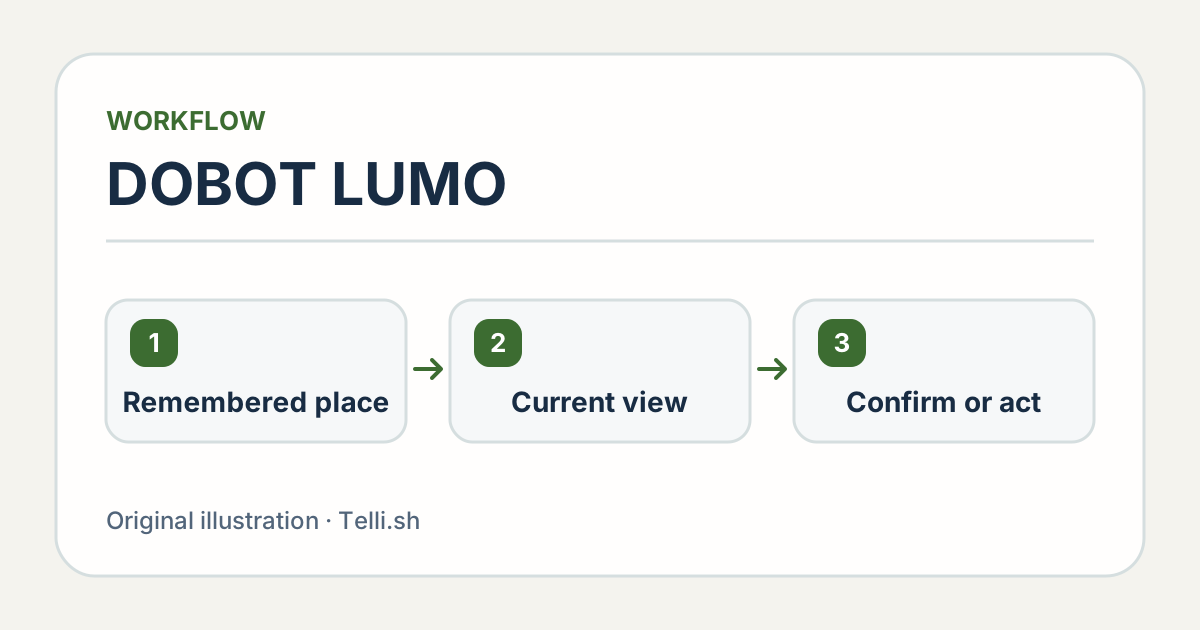
Memory suggests where to start. The current scene determines the next step. Original illustration by Telli.sh.
The easiest success to recognize is a confirmed item delivered to the right place. The most informative failure can be a sensible pause. If the box is gone and the robot says it found a similar item but needs your help, you learn how it represents uncertainty. If it moves whatever was in the remembered place, you have found an identity check that needs improvement. A pause can reduce the work needed to repair a bad guess.
Homes are particularly good at producing old information. A person tidies a shelf, a visitor leaves a bag in the corridor, or a child closes a door that is usually open. A robot can use a location as a starting point without treating it as a fact. A useful trial records whether old observations expire, how the robot communicates that it needs a fresh check, and whether a new observation changes its next attempt.
Local storage and control over memory are different questions
DOBOT's event coverage says long-term memory is stored locally by default. That answers one question about the default location of a category of data. A household still needs to know what the robot saves, who can inspect it, how long it persists, and what happens when someone clears it. A networked product may also have other data flows such as support or updates. Those need their own documentation or tests before anyone makes assumptions about them. DOBOT conference recap
Start with a distinction a resident can understand. Remembering where a shared tool normally sits is one behavior. Remembering private routines, regular guests or facts inferred from conversation is another. Decide in advance whether the test should use only explicitly recorded details. In a shared space, ask how the system handles a resident who wants to correct a memory that another resident added. The details matter even when the memory never leaves the device.
Try the simplest useful deletion check on hardware you are allowed to test. Add a disposable test memory using a documented interface and verify that the robot can retrieve it. Delete the test memory, restart the device according to the instructions, and repeat the same request without providing the old information. In a second case, ask whether a corrected fact survives the restart and replaces the older one. If those functions are unavailable in the demo, record them as evaluation questions for a later trial.
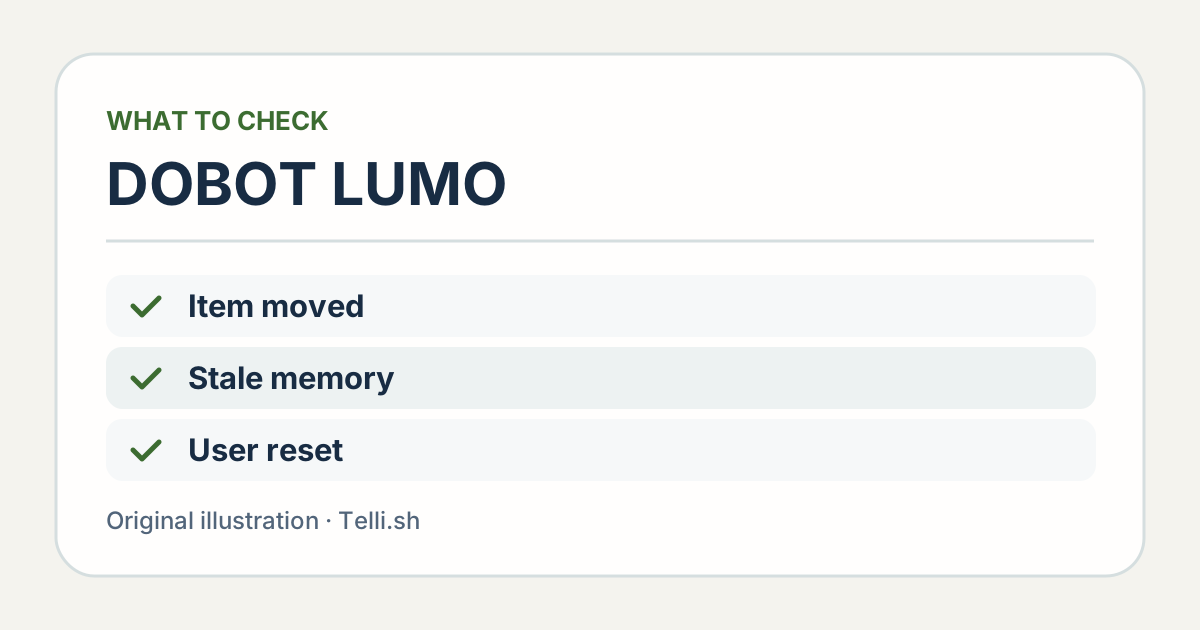
A move tests whether memory can be updated. A reset tests whether it can be removed. Original illustration by Telli.sh.
| Scenario | Expected behavior in a useful trial | Observation to record |
|---|---|---|
| Box remains in the same place | Verify the item and complete the approved task | Correct item and number of prompts |
| The box moved and a similar one replaced it | Compare current evidence with the saved location and ask when unsure | Wrong-item attempts and recovery |
| The test memory was cleared | Treat the old location as unknown unless it has been observed again | Whether the old detail reappears |
| A shared area is temporarily blocked | Respect the boundary and ask for a clear next step | Safe stop and number of interventions |
The company also describes using visual and voice input to infer human intentions and emotions. A household trial can ask a narrower and more measurable question. When two speakers give different instructions or a request is ambiguous, can the robot ask for clarification and wait? A correct clarifying question is easier to assess than a claim about how well a machine understands someone’s feelings.
A shared room needs visible permissions
A remembered location can outlast permission to look there. In a controlled test, place the item in an area the robot may use, record the location, and then mark the area unavailable through the documented controls. Ask for the same item. A useful outcome is an explanation that the robot needs another accessible location or help. The memory can stay accurate while the authorization changes. Both facts should be visible to the operator before the robot takes another action.
A home example makes that permission question easy to understand. A shared basket may be available to everyone while a person's desk is not. When the object is moved to the desk, the old memory should lead to a fresh check of the shared basket, not a search of the room. Test with dummy objects and designated areas. The evaluation asks whether the system respects the boundary and whether people can correct it without reconfiguring the whole task.
Look for the same boundary between household members. If one person can teach a location, ask who can review and update it. A test household can assign one role to the operator and one to a guest. Try a location correction from each role and record whether it is accepted, rejected, or sent to the operator for confirmation. Try the same role difference with a deletion request. These are questions to bring to a demonstration until DOBOT publishes enough detail for an operational check.
Where a memory is only useful for one room or one task, give it that scope in the test. The robot should not carry a classroom observation into a later household evaluation simply because the item shares a name. Ask what a reset actually clears and whether the operator can start a clean session. A research team can then repeat the same test with a different setup and know that the comparison does not inherit a previous observation.
The controlled environment should come first
The Frankfurt release says the event featured 18 live solutions across embodied intelligence, industrial automation and education. That is an event-wide count. It does not say LUMO performed 18 household tasks. LUMO was presented alongside PULSA and the CRH series, which DOBOT describes as industrial robots. Their published speed, payload and safety figures belong to those products. Keep LUMO's capabilities tied to the sources and demonstrations that actually describe it. DOBOT press release
The way to learn more is to start with a harmless task in a supervised area that follows the product documentation and operator controls. A light test item, a permitted surface and an experienced operator make the results easier to interpret. Avoid letting the first pilot stand in for the whole home. A successful retrieval in a prepared area gives you a baseline for comparing changes in lighting, object placement and other normal conditions.
Ask about support for pausing and resuming before introducing any changes. Try an ambiguous instruction with the robot in a safe ready state. Have the operator verify that the system waits or follows its documented stop procedure, and check whether it remembers the intended task when the operator explicitly restarts it. A pause is an ordinary part of an assisted workflow. Good recovery means that the person can tell what the robot is about to do after that pause.
Measure how much help the robot needs
For a first evaluation, write down the expected outcome before each attempt. Include the item and the permitted search area. Mark a trial as complete only when the correct item reaches the intended place and the operator confirms the result. Keep attempts that end in a clear request for help separate from those that time out or attempt the wrong task. A single success percentage hides the situations where a person can recover quickly.
Record the number of interventions and the time spent by the operator. If a person has to spend two minutes explaining the room before each retrieval, compare that effort with the value of the action in the actual setting. Ask whether the system improves after you correct a location, then repeat the unchanged case and the moved case. Those two repetitions reveal whether it learned a useful fact or merely succeeded once.
A lab might prioritize repeatability after resetting the setup. A commercial service trial might prioritize safe handoff to staff when an item is unavailable. A household can prioritize clear permission and low setup effort. These readers can use the same outcome categories while setting different acceptance thresholds. Match the test to the intended setting before comparing systems.
The most valuable follow-up to the launch will be a documented comparison across ordinary conditions. How many attempts completed independently? How often did an operator have to redirect the search? What happened when the robot could not identify the object or when stored information had to be removed? Product photos and staged demos can show the form and intended tasks. Answers to these questions will show the kind of assistance a buyer can expect.
If the demonstration only permits one run per task, ask the operator to repeat the changed-location case rather than add a more elaborate scene. A repeated miss, or a recovery after a single correction, is more revealing than two unrelated successes. Record the software version and the starting room state where the operator can share them. That context helps later readers compare a lab demo and a household trial without treating them as the same evidence.
Forgetting well can matter as much as remembering
A helpful robot should get faster when the environment stays familiar and become more cautious when it changes. The box in the drawer is a simple test of that judgment. A system that can say “I need a fresh look” or “I no longer remember that location” gives a person a clearer role in the interaction. Those responses will tell us as much about a home robot as a smooth first retrieval.
Sources
- DOBOT Frankfurt event and LUMO showcase, October 20, 2026
- DOBOT European conference recap and LUMO description
- DOBOT issuer press release, November 11, 2026
To keep observations, test results and decisions in a searchable record, create a Telli.sh account.