Digit's next test is another warehouse: why GXO's two-site expansion matters
GXO and Agility plan Digit deployments in North Carolina and Tennessee for early 2027. What a second warehouse tests, which operating figures matter and how to read the Digit 5 timeline.
Original editorial diagram by Ken Jo, based on the sources listed below.
A robot moving one container is a demonstration. A robot moving containers inside a working warehouse becomes part of somebody else's operation. Moving the same kind of work into another building adds a further question: how much of the first deployment can actually be repeated?
On October 26, 2026, logistics operator GXO and humanoid developer Agility Robotics announced plans to expand Digit to GXO facilities in Statesville, North Carolina, and Lebanon, Tennessee. Deployments are expected to begin in early 2027 with Digit 4, with a later transition to Digit 5 when it becomes commercially available. GXO announcement.
That makes this a useful moment to examine what commercial progress in humanoid robotics looks like. The story is about repeating a bounded material-handling job, connecting it to existing automation and supporting it across locations. Here are the operating questions the expansion raises, the limits of the published figures and a practical way to assess a warehouse robotics proposal.
A second building tests everything around the robot
The underlying task sounds straightforward: pick up a tote, move it and place it where the next part of the process expects it. A tote is a reusable container used to move items through a facility. The task becomes valuable when the transfer happens reliably within the rest of the operation.
An illustrative second site can differ in conveyor position, available space, work arrival patterns or the way staff handle exceptions. Even if the container looks familiar, those surrounding conditions affect how the work fits together. A successful deployment therefore includes the interfaces around the movement, not only the movement itself.
Our take: the next warehouse is a portability test for the operating system around the robot. Can the team reuse the integration, training and support approach? Can it recognize which parts need to change? Those questions reveal whether a deployment is becoming a repeatable service or remains a one-off engineering project.
A contract expansion is a meaningful commercial signal because an existing customer has chosen to continue the relationship. It does not reveal every operating metric behind that decision. Readers should look for the next layer of evidence: what happens when the additional sites begin working and the local conditions become real.
The existing job connects humanoids to other automation
GXO and Agility's relationship began with a late-2023 proof of concept and led to a June 27, 2024 multi-year Robots-as-a-Service agreement. The companies described Digit working at GXO's Flowery Branch, Georgia, site alongside other automation. The October 2026 update says Digit moves totes and places them on conveyors there. Original agreement, expansion announcement.
This is a useful description because it names a handoff. The robot's value depends on accepting material from one part of the process and delivering it in a condition the next part can use. A smooth isolated movement has limited operational meaning if it leaves the conveyor waiting or creates a queue upstream.
Consider an illustrative flow in which another machine delivers a container to a transfer point. The humanoid must be available when work arrives, recognize whether the transfer is ready and complete its part without creating confusion about ownership of the container. If the next station is blocked, the system needs a defined response rather than an improvised action.
Another illustrative scenario is a period of uneven demand. A robot may have very little work for part of a shift and face a concentrated arrival pattern later. The relevant question is whether the process meets its required service level across that pattern, including the periods when the robot is waiting, charging or receiving support.
These examples explain why integration deserves attention equal to locomotion and manipulation. The useful unit is a completed material transfer accepted by the surrounding process. That unit gives the deployment team something concrete to measure.
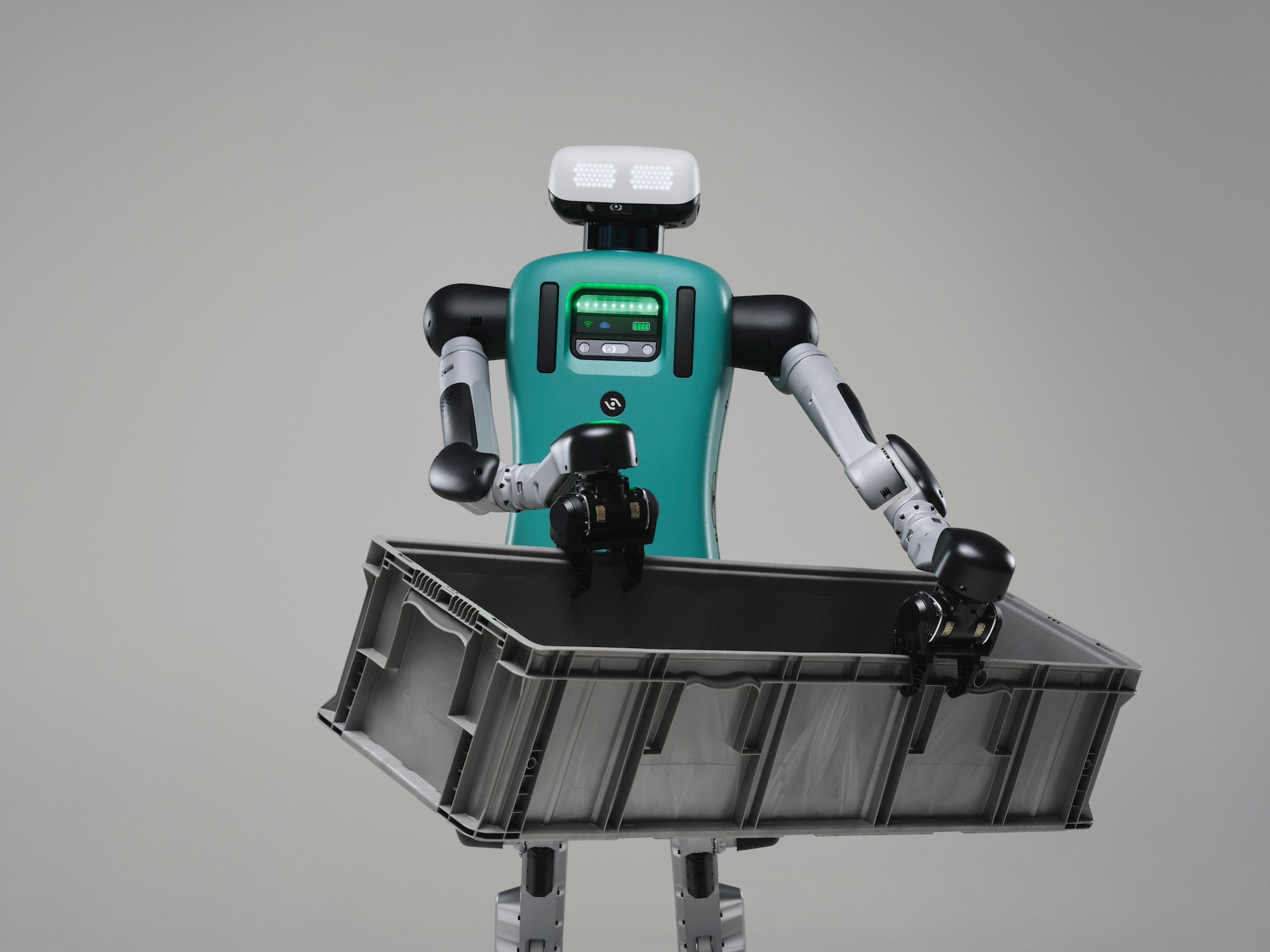
Courtesy of Agility Robotics, official press kit. This studio photograph shows Digit holding a tote; it is not a photograph of the planned GXO sites or evidence of their operating performance.
The two published operating figures have different denominators
The October 26 announcement reports that Digit has moved more than 100,000 totes at Flowery Branch. It also reports more than 65,000 hours of real-world operation across commercial operations and customer programs. Both are statements from the companies, and they describe different populations of work.
The first figure is a cumulative count at one site. The second aggregates operating experience across a broader set of activities. Dividing the tote count by the hour count would produce a number, but it would not establish the warehouse's throughput because the numerator and denominator do not refer to the same operation.
The distinction is practical. A cumulative count helps show that the work extends beyond a single demonstration. Throughput requires a defined period and a matched task count. Availability requires its own definition of when the robot was expected to be available and which interruptions count against that expectation.
A reader evaluating a deployment should also ask what “completed” means. Does a count include an attempted transfer that required a person to finish it? How are damaged containers, retries or rejected placements recorded? These are proposed questions for evaluating reported metrics, not claims that any particular failure occurred at GXO.
| Measure | What it can help explain | What must accompany it |
|---|---|---|
| Completed transfers | How much useful work was accepted | Task definition, location and observation period |
| Availability | Whether the robot was ready when required | Scheduled operating time and interruption rules |
| Human interventions | How much support the workflow needs | What counts as an intervention and time spent |
| Recovery time | How quickly work resumes after a problem | Event types and the relevant process impact |
| Cost per accepted transfer | Whether the complete service is economical | Integration, service, support and operating costs |
This table proposes an evaluation framework. It does not fill in missing numbers for the GXO deployment. The published milestones make the next questions more interesting; they do not make those questions unnecessary.
Digit 4 deployment and Digit 5 availability are separate milestones
The expansion starts with a specific hardware generation. GXO's two additional sites are expected to begin with Digit 4 in early 2027. Migration to Digit 5 is conditional on that product becoming commercially available, so the announcement should not be read as confirmation that Digit 5 is already operating broadly in those facilities.
Agility unveiled Digit 5 on September 15, 2026. In its October 26 commercial update, the company said early customer access was expected in the first half of 2027, with general availability targeted for the end of 2027. These are company plans and targets, distinct from the announced early-2027 GXO start. Commercial update.
That timeline creates a useful planning question for a prospective customer. Which job can the currently available system perform, and which benefit depends on a future generation? A proposal should make that separation clear enough that an operator can evaluate present value without silently assuming every roadmap item arrives on time.
The migration itself is another project. A new robot generation can require renewed checks of the physical interface, process behavior and staff procedures. Even if a vendor provides a path between generations, the receiving operation needs to know which assumptions remain valid and which need to be tested again.
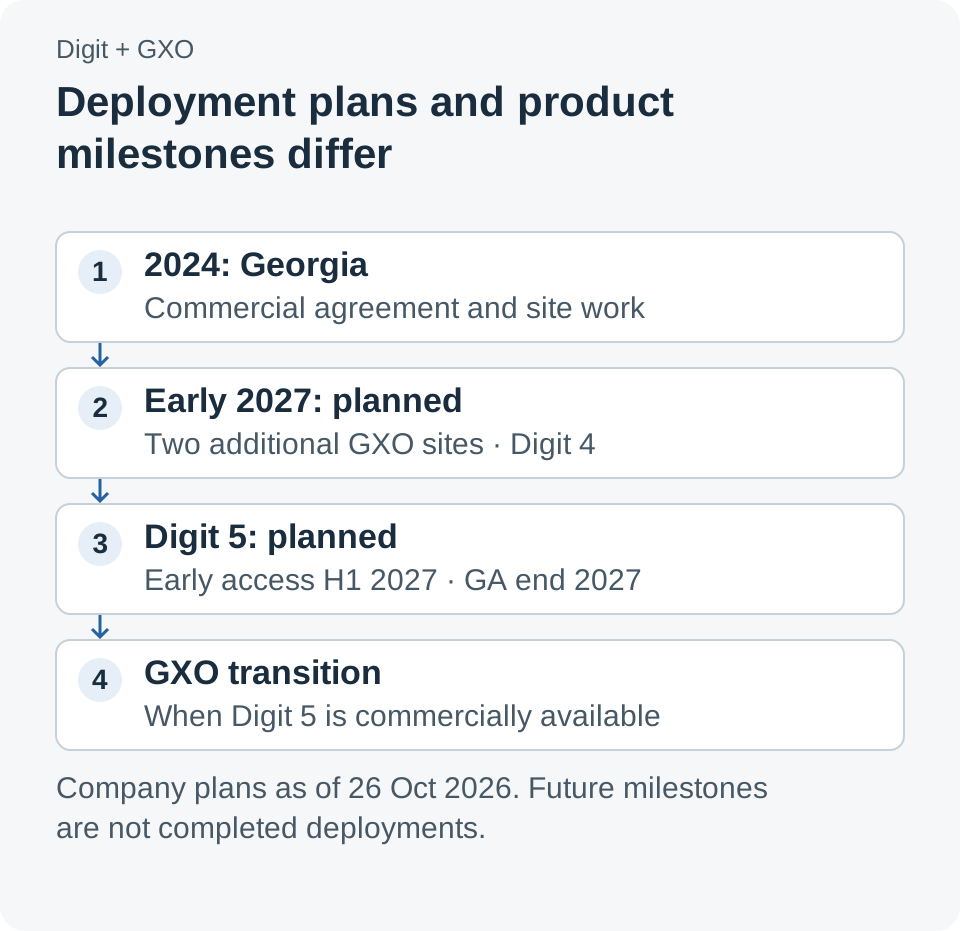
The expanded GXO deployment is planned to begin with Digit 4. The later Digit 5 transition depends on commercial availability; projected milestones are not completed deployments.
Safety claims become useful when tied to the actual worksite
Agility's September 15 announcement describes Digit 5 as designed for work near people, with human detection, safety cues and independent safety control. Those are vendor-described elements of the next generation's architecture. They should be evaluated in the context of the intended workflow and deployment conditions. Digit 5 announcement.
For a warehouse team, the practical concern is how people and machines share the process. Staff need a clear understanding of operating areas, interruptions and the approved way to resume work. A product description alone cannot specify those details for every facility layout and task.
An illustrative exception is a container arriving in an unexpected condition. The operating procedure should identify who handles the exception and how the task is brought back into a known state. The goal is to make an interruption understandable to the people working nearby and responsible for the process.
Keep evaluation responsibilities visible. The operator, integrator and vendor need an agreed process for site-specific review, training and acceptance. A useful pilot produces evidence about those arrangements alongside evidence about the robot's ability to complete its assigned movement.
A service contract needs a definition of useful work
Robots-as-a-Service can place the relationship around an ongoing service rather than a one-time equipment purchase. The 2024 GXO agreement establishes that commercial model for this partnership. The published announcements do not disclose a universal price or enough site-level cost data to calculate a return on investment for other operators.
A prospective customer should therefore begin with the service boundary. Which tasks are included, which conditions must the site provide, and who responds when the system cannot complete the work? A clear answer makes it possible to compare proposals on the same basis.
For an illustrative cost model, divide the complete cost of the evaluated period by the number of transfers the operation accepted. Include the costs that actually apply to the proposed arrangement, such as integration, service, site preparation and support effort. The formula is straightforward; the difficult part is choosing consistent inputs and observing them honestly.
Also consider where time is saved and where work is added. A repeated lifting task may move away from a particular role while monitoring, exception handling or maintenance work remains elsewhere. The useful comparison is the complete process with its new responsibilities, rather than an isolated robot cycle compared with an isolated human movement.
This does not require dismissing the commercial significance of the expansion. It gives that significance an operational interpretation: the partnership has progressed far enough for another deployment commitment, and the next sites will create more evidence about repeatability.
A first assessment should follow one material-handling task
For an operator exploring humanoid automation, the starting point is a defined workflow. A broad ambition to “automate the warehouse” makes the success criteria too vague. One material transfer with a recognizable beginning and end provides a much stronger basis for discussion.
- Describe the task and its boundaries. Identify the container, start point, destination and the event that counts as accepted completion.
- Measure the current process. Record demand patterns, completed work, interruptions and support effort over a relevant period before comparing alternatives.
- Map the handoffs. Identify the systems and people supplying work, receiving it and handling exceptions. Include the conditions under which work must pause.
- Confirm the product and timeline. Separate currently available capabilities from planned hardware, software or availability milestones in the proposal.
- Agree on site evaluation and responsibilities. Establish the appropriate safety review, training, service support and acceptance process for the intended task.
- Run a bounded pilot with matched measurements. Use the same definitions for baseline and trial results, including intervention and recovery effort.
- Decide what can be repeated elsewhere. Record the reusable elements and the site-specific changes before expanding to another location.
The final step is easy to overlook. A pilot can meet its own goals while depending on an unusually convenient layout or intensive support. Recording those conditions helps a second site understand what it is adopting and what work remains.
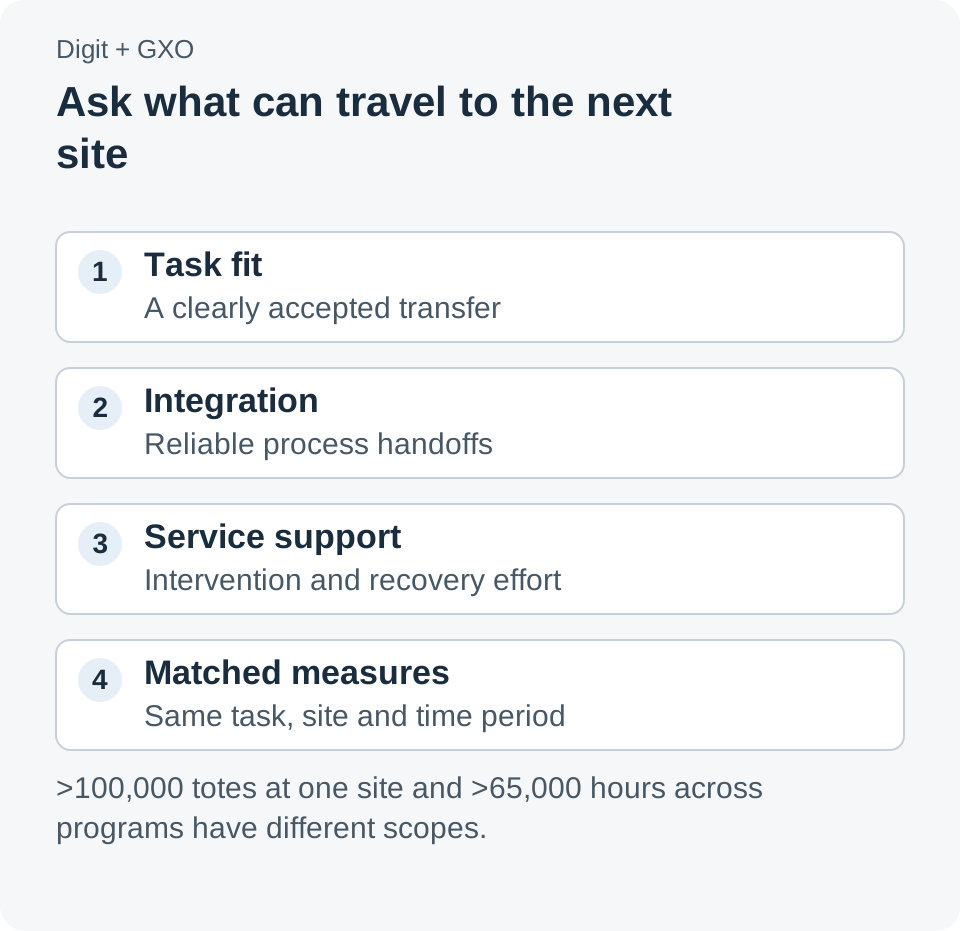
A proposed assessment for a repeated deployment: task fit, integration, support and matched operating measures. These criteria are analytical guidance, not reported GXO pilot results.
Manufacturing capacity and customer expansion answer different questions
Agility describes RoboFab as a 70,000-square-foot facility designed for annual production of up to 10,000 robots. The wording matters: designed capacity describes what the manufacturing facility is intended to support, not the number of robots already shipped or operating. The October 26 update also discusses deployment and service infrastructure.
For a customer, a factory's potential output is only one part of scale. Robots must reach a site, integrate into a process and receive support over time. The practical capacity of a robotics business includes those activities as well as assembly.
The GXO expansion is interesting because it exercises several of those requirements together. It connects an existing commercial relationship to new locations, a defined initial generation and a future transition plan. Watching how those commitments become operating deployments will be more informative than treating any single headline number as the whole story.
The next warehouse is where a robot becomes repeatable infrastructure
Digit's commercial progress is increasingly about the work around a recurring physical task: integration, support, acceptance criteria and the ability to transfer an approach between sites. GXO's planned expansion gives that proposition a concrete next test in two more facilities.
The question to follow is whether the useful parts of the first deployment can travel with the robot. When they can, a successful installation becomes the beginning of a repeatable operating capability.
Sources
- GXO's partnership-expansion announcement and Agility's corresponding announcement, October 26, 2026: sites, planned rollout and reported operating totals.
- Original GXO–Agility commercial agreement, June 27, 2024: Robots-as-a-Service and the existing warehouse workflow.
- Digit 5 unveiling, September 15, 2026: next-generation design and intended capabilities.
- Agility commercial update, October 26, 2026: early-access and general-availability targets, manufacturing and support plans.
- Agility official press kit, checked October 27, 2026: product photograph.
Operational counts are attributed to the announcing companies. Illustrative scenarios, measurement criteria and the proposed pilot procedure are analysis; no warehouse visit, independent throughput measurement or ROI calculation was performed for this article.
Telli.sh recommendation: Keep deployment discussions, site observations and the reasoning behind a pilot decision together for later review. Create a Telli.sh account to organize your research notes.