Block's Dessa asks what a voice model can learn before it reads
Dessa is a speech-only research preview from Block. Its full-duplex demos raise practical questions about timing, accuracy and what natural conversation proves.
Say “That is fine” with relief, then say it with a long pause and a flat voice. The words stay the same. The conversation changes.
Block introduced Dessa on October 23, 2026, presenting a model trained from human conversation without text or a pretrained model. The company behind Square and Cash App describes it as a full-duplex speech system: it can listen while speaking. The announcement is a research preview, with public recordings and limited safety-research access, rather than a generally available voice API.
The interesting question is what happens when timing and vocal expression become part of the model's learning material from the start. This article explains that distinction, gives a practical way to listen to the demos and considers three kinds of work where conversational behavior would matter. Our take: the next useful voice system needs to handle the space between words as carefully as the words themselves.
Hero: an original editorial illustration of speech and conversational timing. It does not depict a Dessa installation or a measured audio trace.
Speech contains information that a clean transcript can leave behind
A transcript is useful because it turns a conversation into something you can search, quote and inspect. But a transcript normally gives the reader a narrower representation than the original recording. Emphasis, timing, overlap and nonverbal sounds can affect how a sentence should be interpreted.
Consider an illustrative scheduling conversation. Someone says, “Thursday works,” then immediately adds, “wait, after lunch.” A useful assistant needs to preserve the correction and avoid treating the first clause as a completed instruction. The timing of the correction matters because it arrives while the system may already be preparing a response.
Another example is a brief acknowledgment. “Mm-hm” can mean “I am still listening,” rather than “I want to take over the conversation.” A system that treats every sound as a new full turn can make the interaction tiring. A system that ignores every short interruption can miss an actual correction.
This is the conversation rhythm problem: deciding when to continue, wait, acknowledge or yield. It is not solved merely by giving a synthesized voice a more expressive sound. The system also has to make choices about the flow of the exchange.
The researchers behind Moshi, published in 2024, explicitly treated overlapping speech and interjections as limitations of segmented turn-taking pipelines. Their work is useful context because full-duplex dialogue predates Dessa. The distinctive claim in Block's announcement is the speech-only training approach, which should be evaluated separately from the broader category of simultaneous listening and speaking.
Three questions prevent three different capabilities from being confused
“Voice-native” can describe several different things. It can refer to training data, the information passed between runtime components or the timing of an interaction. A model can make progress on one dimension without settling the others.
The following table separates those dimensions. It is a conceptual comparison for reading product announcements, not a benchmark ranking or a complete account of any model's internal implementation.
| Question | What it asks | What it does not establish by itself |
|---|---|---|
| What trained the model? | Whether the learning process used speech, text or both | Accuracy on a particular task or language |
| What does the runtime process? | Whether audio reaches a model directly or is mediated through other representations | How gracefully the system handles interruption |
| Can input and output overlap? | Whether the system can listen while producing speech | Whether it interprets emotion or intent correctly |
Block's Dessa page, checked October 27, 2026, places its claim on all three dimensions: speech-only learning, audio-to-audio interaction and full-duplex timing. Those are the team's descriptions. They do not provide a published score for the quality of every conversation a user might have.
Moshi illustrates why the distinctions help. Its paper describes a full-duplex speech-text system built from a text language-model backbone. That is a different learning path from the one Block describes for Dessa, while still addressing overlapping spoken dialogue. Calling every voice system a transcription pipeline would erase that difference.
For a product team, the practical response is to ask which dimension matters for the job. A searchable archive needs a reliable textual record. An interactive tutor needs useful feedback and suitable conversational pacing. A customer-facing agent also needs the knowledge and permissions required to complete a business task.
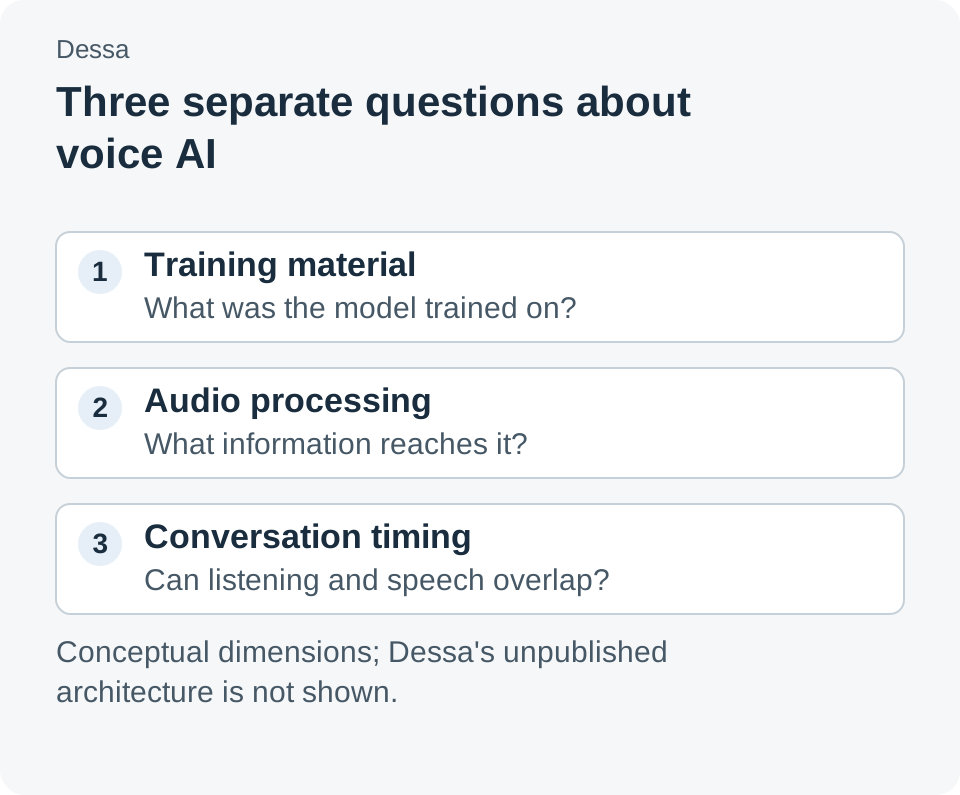
Original explanatory diagram. It separates three questions about voice systems and does not claim to reveal Dessa's unpublished architecture. Sources: Block's Dessa page and the 2024 Moshi paper.
A convincing voice and a correct answer need separate tests
An expressive response can be easy to follow. It can also make an unsupported answer sound more persuasive. If a listener feels that a system understands them, they may be less likely to stop and check a detail.
That is why perceived empathy, factual accuracy and task completion should have separate review criteria. A friendly acknowledgment may be appropriate even when the system lacks the information needed to answer. The better response in that situation is often a clear question, delivered at the right moment, rather than an emotionally polished guess.
Imagine an illustrative customer-support exchange about a delayed package. The caller sounds frustrated and interrupts to correct an order number. A useful system would allow the correction, preserve the right identifier and explain the next available action. Warm tone alone would not repair an incorrect lookup or an unauthorized promise.
The same principle applies when a speaker sounds uncertain. A pause can mean hesitation, a search for the right word, a distraction in the room or a turn that has ended. The audio provides evidence, but the meaning remains dependent on context. A sensible evaluation should reward clarification when the signal is ambiguous.
Block invites a limited group of safety researchers to examine Dessa's behavior. For readers, that is a meaningful description of the current stage. It does not establish that the system has already met the reliability requirements of customer support, education or another deployment setting.
The official demos are a listening exercise, not a scorecard
The public Dessa page offers selected recordings of conversations, including a release discussion and movie recollection. The company says the model chooses its responses and that subtitles were added afterward. These recordings let you inspect examples of behavior, but they do not tell you how frequently the same behavior appears across a broad test set.
Listen to the timing before reading the subtitles. When does the response begin? Does an acknowledgment support the human's turn or compete with it? Does the system give the speaker room to correct themselves?
Then examine the content. If the conversation contains a factual claim, assess that claim separately from the quality of the delivery. A response can have excellent pacing and still require correction. Keeping the two judgments separate prevents a pleasant demo from becoming a substitute for evidence about a task.
Finally, pay attention to recovery. A misunderstanding is especially informative when the speaker corrects it. Does the exchange settle the issue, or does the system continue with the original interpretation? A single recovery does not establish a rate, but it can help you design a later evaluation.
There is also a useful limit to this exercise. A selected recording does not give you control over the prompt, environment or repeated attempts. Treat it as a way to formulate questions for a trial, rather than a way to answer every deployment question in advance.
Three possible uses show why timing matters
The following scenarios are illustrative applications of conversational capability. They are not announced Dessa customer deployments or claims that the current preview supports their required integrations. Each scenario separates the behavior worth exploring from the work needed to make it dependable.
A language-practice partner could benefit from waiting through a learner's hesitation and acknowledging a successful correction. The evaluation should distinguish helpful encouragement from interruptions that prevent practice. A trial would also need explicit evidence for the target language, the quality of corrections and the handling of repeated mistakes; a natural-sounding English demo does not answer those questions.
A spoken rehearsal assistant could help someone practice a presentation or a difficult conversation. A useful interaction would let the speaker finish a thought, ask a follow-up and respond to a changed instruction. The team building the experience would need to decide whether the goal is rehearsal, feedback or factual coaching, because each requires a different review rubric.
A service-triage interface could listen to a caller's explanation, ask a clarifying question and preserve a correction without restarting the exchange. The difficult part is connecting that conversation to the right case and the right next action. Knowledge access, authentication, escalation and transaction permissions remain separate system responsibilities.
These examples share a pattern: smoother conversation can reduce friction in reaching the next decision. The value depends on whether the decision is useful and whether the user can correct it. That makes interruption handling and recovery practical product requirements, rather than details reserved for a voice demo.
Local execution is a hardware claim with an access condition
Block says Dessa runs locally on a MacBook Pro M4 Max or better and that its training used one NVIDIA GB200 NVL72. Both figures come from the official project page, accessed October 27, 2026. They are developer-reported details, not measurements from our own installation.
The distinction between training and inference matters here. A machine used to train a model and a machine able to run an existing model answer different questions. The reference to a training system should not be read as a consumer requirement, and the laptop statement should not be read as a published memory-and-latency matrix.
Access is a separate issue again. The public page still marks launch links as coming soon and describes early access for selected safety researchers. It does not provide general API pricing, downloadable model weights or a supported-language table on which to base a production rollout.
For a developer planning future work, this is enough to identify questions worth tracking. It is not enough to schedule a migration from an existing voice stack. A credible migration plan would need usable artifacts, integration details, measured behavior on the intended hardware and a clear support arrangement.
Build an evaluation that includes silence and correction
If a broader trial becomes available, start with tasks whose correct outcomes are easy to inspect. Use the same scenarios across systems and preserve the audio needed to understand disputed judgments, with the participants' agreement. The procedure below is a proposed evaluation design; it is not an experiment performed for this article.
- Define the desired outcome. For a scheduling exchange, write down the correct date and time. For rehearsal, define the requested feedback. Avoid an overall “sounds human” score as the only target.
- Write paired scenarios. Keep the core request similar while changing one conversational event: a pause, an acknowledgment, an interruption or an explicit correction. This makes the source of a failure easier to discuss.
- Include a recovery instruction. Ask the system to correct one earlier detail. Check whether the final answer reflects the correction and whether the conversation makes that change clear.
- Judge timing and content separately. Record whether the system interrupted inappropriately, missed a correction or answered with an unsupported fact. A single composite score can hide an important weakness.
- Test the intended environment. Once access permits it, repeat representative tasks on the actual device and audio setup. Treat results from a quiet microphone test as evidence for that setup, not every room or headset.
- Review disagreements with the audio. When reviewers differ, replay the relevant moment and refine the rubric. The disagreement may expose an unclear task definition rather than a simple model error.
An illustrative first set might contain 12 scenarios: four with pauses, four with corrections and four with brief acknowledgments. Those counts are a suggested starting design, not a scientific sufficiency claim or a published Dessa benchmark. The purpose is to expose different conversational demands before increasing the scale.
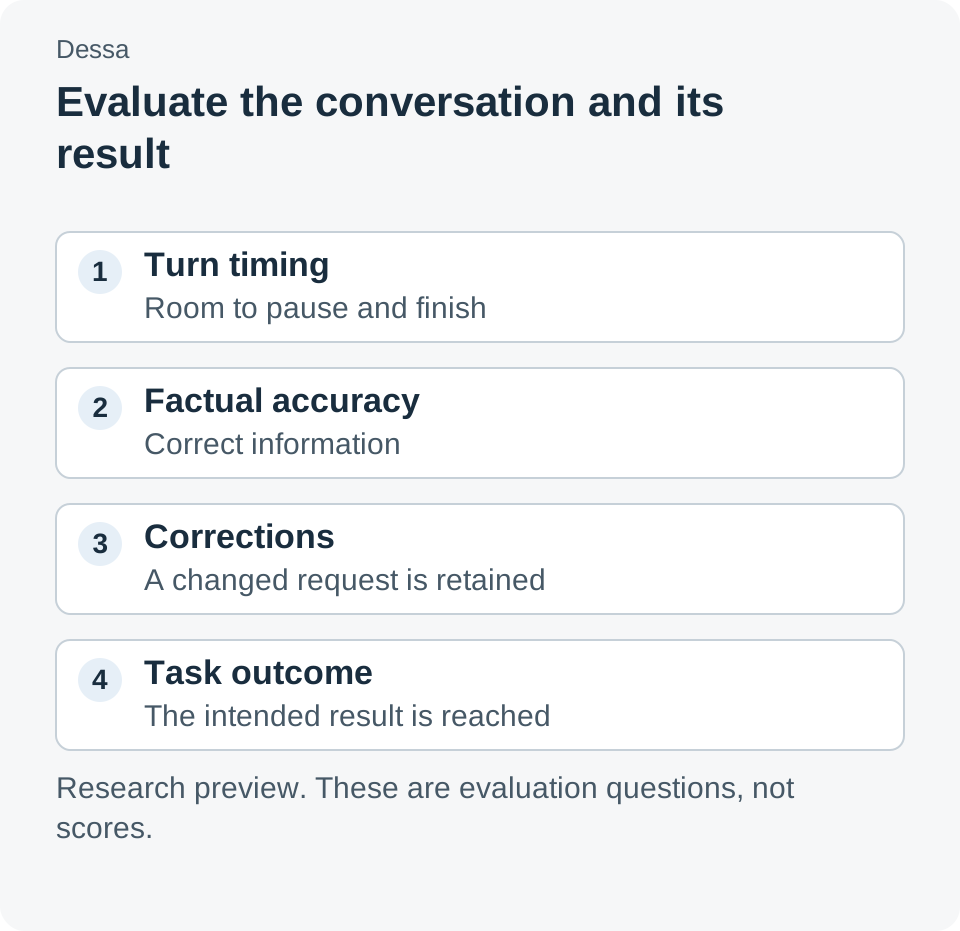
Original evaluation guide. No success rate, latency result or comparative model score is implied.
A voice interface should make correction feel ordinary
The most useful promise in this research direction is not that every assistant will become indistinguishable from a person. It is that a person may spend less effort adapting their speech to a rigid interface. Pauses, interruptions and unfinished thoughts are ordinary parts of talking.
Dessa gives that possibility a concrete research subject: a model its developers say learned through speech alone. The next question is whether the resulting behavior holds up across the situations users actually need. A good voice interface should make it easy to continue, clarify and correct while keeping the task itself understandable.
Sources
- Block: Dessa — official research description, demonstrations, hardware statements and access status; checked October 27, 2026.
- Block news — October 23, 2026 announcement listing.
- Défossez and colleagues: Moshi, a speech-text foundation model for real-time dialogue — 2024 primary research on full-duplex speech-text dialogue.
Source check: October 27, 2026. Product details are attributed to their publishers. Scenarios and evaluation steps are illustrative; we did not install Dessa or measure its performance. Listen to the official recordings at the linked project page.
A recommendation from Telli.sh
Want a searchable place for recordings, reference notes and the decisions that follow a conversation? Collect your reference material in Telli.sh and keep the handoff understandable.