Demandbase's AEO Agent follows the buyer into the AI answer
Demandbase has announced agents for answer-engine visibility, campaigns and audiences. The useful question is whether they help brands become more accurately understood, rather than merely more frequently mentioned.
Demandbase wordmark via Wikimedia Commons, classified there as PD-textlogo. Used for company identification; this is not a screenshot of AEO Agent or the new agents. Proportionally resized with neutral padding; no endorsement implied.

A potential customer asks an AI assistant which vendors can solve a particular problem. The answer may become the first shortlist the customer sees. For the companies being compared, the immediate question is no longer only where their website appears in search. It is what the assistant thinks they offer, which evidence it uses and whether it understands the requirements that matter to this buyer.
On October 20, Demandbase announced an AEO Agent, alongside Campaign and Audience Agents. AEO refers to answer-engine optimization: improving how a brand is discovered and represented in AI-generated answers. Demandbase says its new agent observes descriptions, recommendations and underlying sources, then helps teams identify content gaps. The release is a concrete commercial response to a new kind of product-discovery problem. Official announcement.
Our take: the most useful version of AEO would help a company become accurately understood when its product genuinely fits a need. Counting mentions is easier than proving that outcome. The opportunity is better product evidence; the risk is building another dashboard that rewards visibility even when the answer misleads the buyer.
Demandbase approaches AI discovery from account-based marketing
Demandbase supplies a B2B marketing and sales platform organized around accounts, buying groups and pipeline activity. In ordinary terms, it helps a company understand which organizations it wants to reach, which people participate in a purchase and how marketing and sales work connects. Its existing agent product direction coordinates specialized tasks around shared business information. Demandbase AI Agents overview.
That background distinguishes this announcement from a general chatbot-monitoring tool. A company selling complex software often addresses several people inside one account. A technical evaluator may care about integration and deployment. A procurement lead may ask about contract terms. A business owner may focus on the result the software should deliver. One broad question about the brand cannot represent all three perspectives.
The appeal of bringing AEO into this environment is a connection between what assistants say and the business questions the company already works on. A misleading answer about deployment options might matter to a technical evaluation. Missing information about a specific use case might matter earlier in discovery. A useful product would help the marketing team identify the relevant gap and involve the person who can correct it.
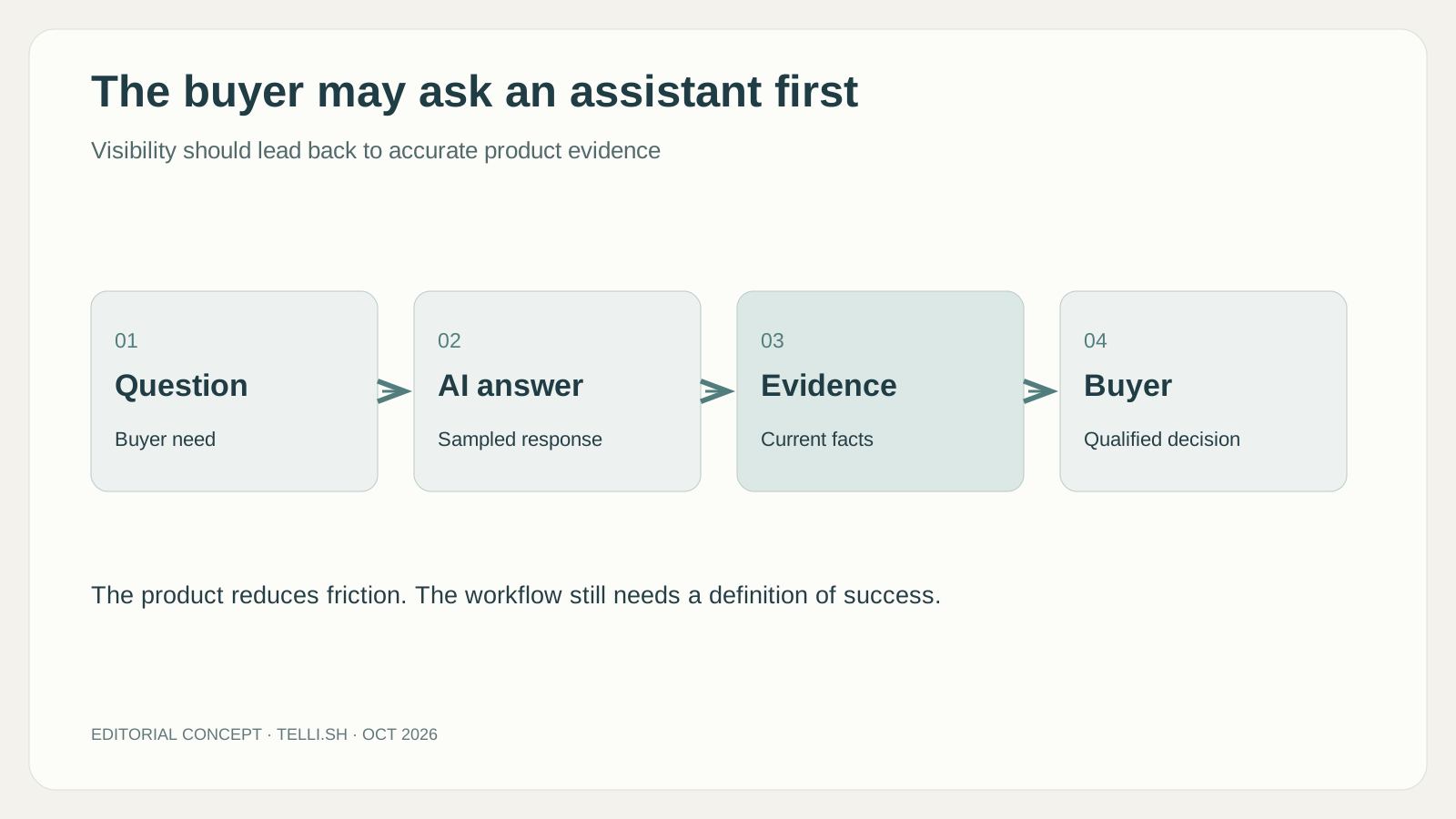
Original editorial infographic. This represents one possible discovery path, not a claim that all buyers now follow it.
Three agents connect observation to marketing work
The announcement assigns different jobs to the three agents. AEO examines AI descriptions and relevant sources. Campaign connects campaigns with revenue goals, finds performance gaps and recommends changes. Audience maintains groups based on customer profiles, buying groups and account activity. Demandbase also describes access through existing assistants and work tools using APIs and MCP, rather than requiring all work to stay in its own interface. Announced capabilities.
These jobs are related without being interchangeable. Discovering that an assistant misunderstands a product is an observation. Publishing a corrected explanation is an editorial action. Choosing which audience should receive it is a marketing decision. Measuring whether it helped a real buying process is another step. The product story becomes interesting where these steps connect, because a visibility report alone cannot make the content more useful.
The release does not provide a clear per-agent general-availability matrix or public pricing. Readers should treat the three named agents as announced capabilities and confirm access, included functions and contractual terms for their account. An announcement can identify a direction worth watching without establishing that every reader can immediately operate the full experience. That is particularly relevant when a demonstration combines several parts of an enterprise platform.
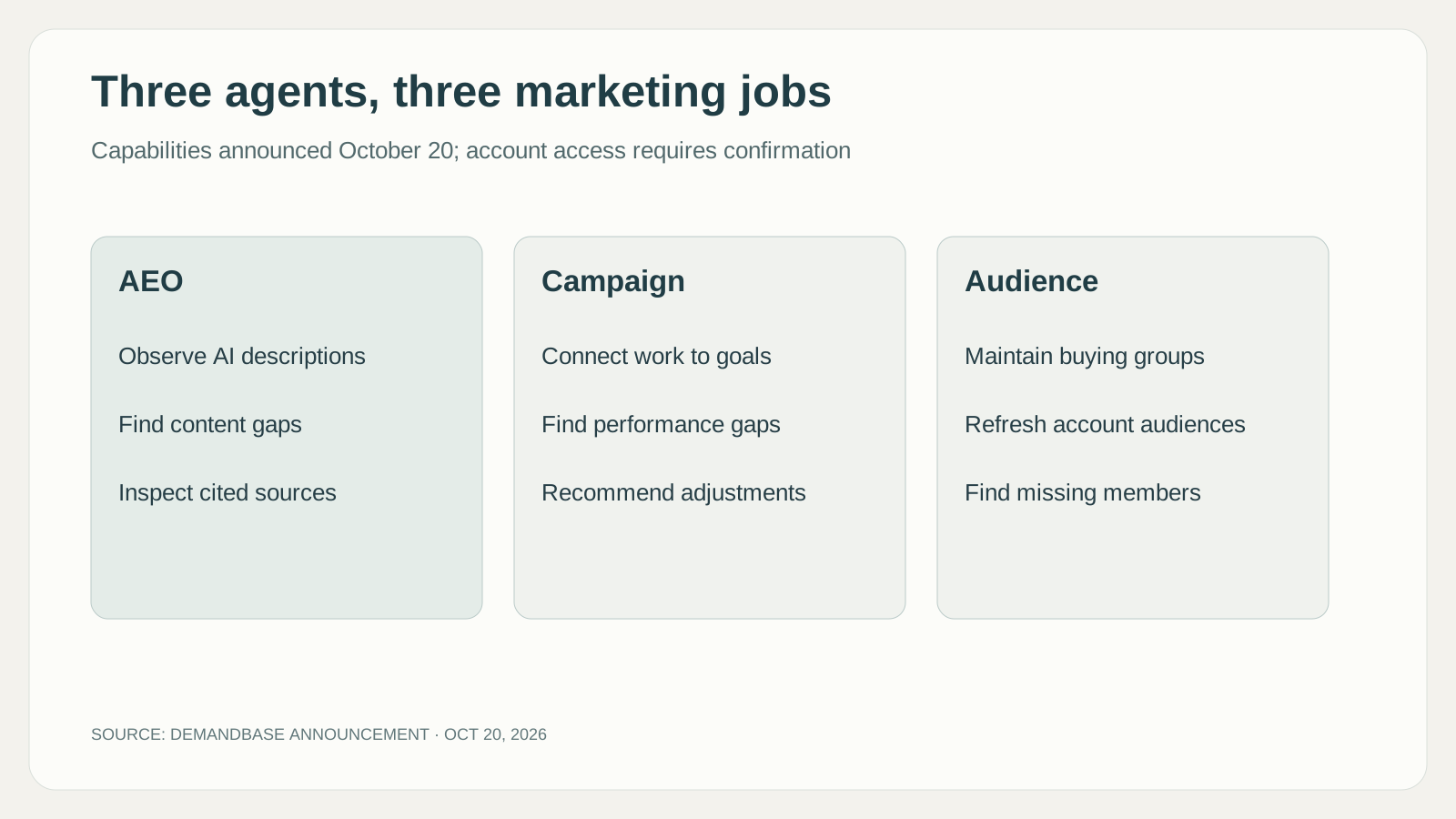
Original infographic based on the October 20 announcement. It summarizes intended jobs, not independently measured effectiveness or confirmed access for a particular account.
A wrong answer can reveal a useful content problem
Imagine a company offering both hosted and on-premises deployment. An assistant describes it as hosted only. The marketing team could treat this as a ranking problem, trying to increase mentions of the missing option. A more productive response begins by asking why the available evidence is unclear. Perhaps the relevant page is old, difficult to find or written in language that never directly answers the buyer's question.
Correcting that evidence can help people as well as assistants. A clear deployment page lets a technical evaluator answer a concrete question without booking a sales call. A dated comparison of supported options can reduce ambiguity when older third-party pages remain online. The important improvement is the public explanation itself; a change in sampled AI answers would be one sign to examine afterward.
A second illustrative case is a product associated with only its original use. The company has added a useful new capability, but the assistant still describes the older product. Before launching a campaign, the team needs to distinguish an evidence problem from a product-positioning problem. Is the new capability generally available? Does it work for the buyer's requirements? Is there a clear source explaining its limits? Better marketing cannot substitute for those answers.
A third case is a competitor comparison. An assistant may recommend several products while omitting the one that fits a particular constraint. The useful goal is not to force the brand into every answer. It is to make the relevant facts discoverable when the constraint genuinely differentiates it. A brand that appears in more unsuitable shortlists can create more work for sales while disappointing buyers sooner.
The buyer's question should shape the measurement
“Best software” is an easy prompt to monitor and a poor description of many real purchasing decisions. A small firm with limited support capacity asks a different question from a regulated enterprise with a dedicated operations team. A useful AEO evaluation needs a set of questions that reflects those differences, rather than a single phrase chosen because the brand performs well on it.
For a representative sample, record the question, language, assistant, date and whether live retrieval was involved. Keep the answer and cited sources so a later change can be interpreted. Repeating the observation matters because one response can vary without a meaningful change in market understanding. This is a proposed measurement method, not a description of every control included in Demandbase's product.
Evaluate accuracy as well as presence. Did the assistant describe the right deployment options? Did it distinguish a planned feature from a released one? Did it explain a limitation that would disqualify the product for this buyer? An answer that accurately excludes the brand can still be useful evidence. It can reveal a real product gap or prevent the team from celebrating a misleading recommendation.
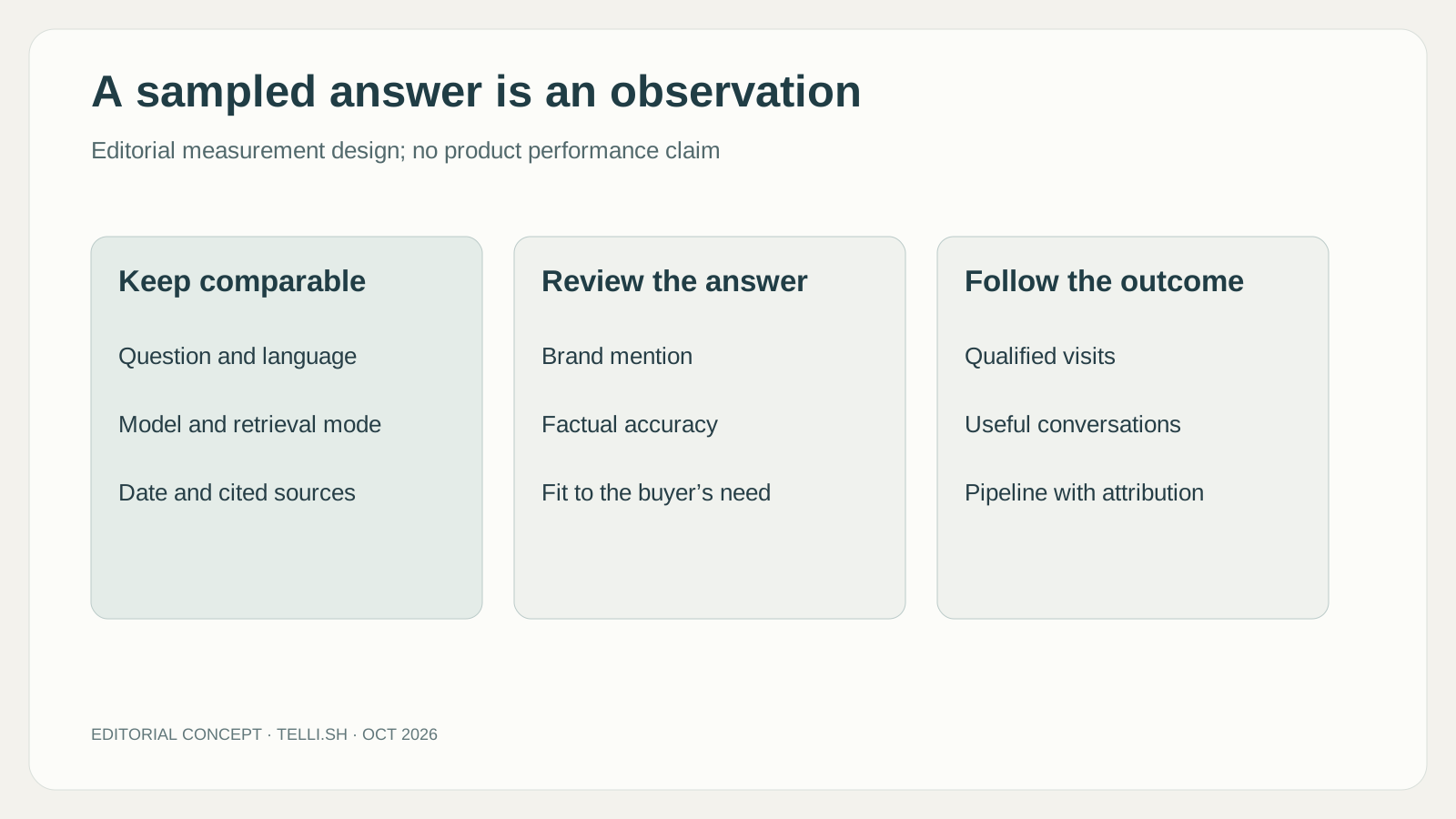
Original editorial measurement framework. No results or product capabilities are implied by this diagram.
Search platforms still set their own rules
A useful counterweight to AEO marketing comes from the search providers themselves. Google's AI features guidance says that existing SEO fundamentals remain relevant to AI Overviews and AI Mode; it specifies no special optimization or additional schema for appearing in those features. Eligibility still depends on ordinary search requirements, and inclusion is not guaranteed. That narrows the sensible promise of an optimization product: it can help find and prioritize information problems, rather than sell a secret format that obliges Google to recommend a brand.
OpenAI's crawler documentation separates another pair of decisions. OAI-SearchBot supports search discovery, while GPTBot concerns content that may be used for training; site owners can control them independently. A company can therefore consider search visibility and training preferences separately. This is a documented distinction for OpenAI's systems, not a universal rule for every assistant or a guarantee that allowing a crawler produces a particular answer.
Together, these references change the discussion with an AEO vendor. The question becomes which public evidence is missing, inaccessible or obsolete, and which supported system is being observed. A brand should be able to distinguish an access problem from an unclear explanation and from an assistant simply choosing another relevant source. Those situations call for different responses. Publishing more promotional pages cannot repair every one of them.
There is a useful opportunity for smaller brands here. Explaining a genuine deployment constraint, integration or supported workflow can help both a human evaluator and a retrieval system understand where the product fits. The durable asset is the explanation. Its usefulness should survive a change in a particular assistant's answer or a change in the monitoring vendor a company uses.
Similar visibility scores can describe different samples
The measurement market supplies a second perspective. Microsoft's Clarity Citations Dashboard documentation distinguishes page citations, share of authority and AI referral traffic. It also states an important detail: its daily share-of-authority calculation excludes query-days on which the domain was not cited, which can produce a higher value than broader calculations. This is a definition in Clarity's documentation, not a claim that Demandbase uses the same method. It demonstrates why the denominator belongs in any comparison of visibility scores.
Imagine two reports showing a strong share for the same brand. One may focus on days when the brand participated in the answer; another may include every scheduled observation, including days with no citation. Neither percentage is interpretable without that sampling rule. A headline improvement can reflect a changed question set or calculation rather than a stronger presence across the market. The useful commercial conversation asks for the definition before celebrating the change.
| Observation | What it can describe | What it cannot establish alone |
|---|---|---|
| Brand mention or page citation | Presence within the monitored answers | Whether an actual prospect saw or trusted the answer |
| AI-referred website session | A visit attributed to an assistant | Whether every assistant exposure led to a click |
| Qualified inquiry or opportunity | A later business event | That AEO alone caused the event |
Clarity's separation of citations and referrals is useful even without adopting its dashboard. An assistant can answer a question without sending a visit; a person who clicks may still be exploring rather than buying. Keeping those observations distinct prevents the website analytics from becoming an invented count of everyone who encountered the brand inside an AI product.
Demandbase's account-oriented position could add value by connecting a bounded visibility observation with a relevant buying process. The expectation should be a clearer explanation of that connection, including missing information and alternative causes. A good report would let a team see a content improvement, the answers sampled afterward and the business signals that followed. It would also remain useful when the evidence shows no measurable gain, because that result can stop a team spending another month optimizing the wrong question.
Visibility is an intermediate result
A brand mention can tell a team that the assistant included it in a particular answer. It does not establish that a buyer read the answer, visited the site or found the product useful. Even a referral can reflect curiosity rather than purchase intent. The closer a metric gets to an actual commercial outcome, the more context is needed to explain what changed.
This is where Demandbase's broader platform position could be useful. Connecting observations to campaigns and audiences could help teams investigate whether clearer product information reaches the right buying group. That is an interpretation of the product direction, not evidence that the newly announced agent increases pipeline. The company would need to demonstrate the connection through observable customer outcomes.
An illustrative pilot might focus on one product area with a known documentation gap. Record a stable question set, improve the source material and follow both answer accuracy and relevant visitor behavior. Keep other campaign changes visible. If the website, pricing and advertising all change at once, a rise in traffic cannot cleanly establish which change mattered. The point is to learn something that can guide the next editorial decision.
There is room for qualitative evidence too. Sales teams may hear fewer repeated questions about a newly clarified feature. Prospects may arrive with a more accurate understanding of who the product serves. Those signals are less tidy than a single score, but they can be more useful for deciding whether the information has improved. Measurement should serve that decision rather than become an end in itself.
Optimizing for answers can improve the web—or fill it with noise
The constructive path is straightforward to describe: publish current product facts, explain constraints clearly, date changes and support claims with inspectable evidence. A company that corrects an obsolete specification makes the information environment better for everyone. An assistant is one reader of that information; the eventual buyer is another.
The less attractive path is to manufacture repeated promotional claims because a dashboard appears to reward them. That can make an answer sound more certain without making it more accurate. It may also encourage teams to optimize for a narrow prompt sample while ignoring the questions buyers actually ask. A high score on a chosen set of answers is not a durable substitute for a clear product story.
The new agent category will therefore need editorial judgment. Marketing teams should be able to challenge a suggested content action: is it correcting a fact, answering a missing question or simply creating another place to repeat the brand name? The first two can build trust. The third may generate activity that looks like progress while adding little for the customer.
There is a related boundary around outreach. Demandbase's release makes ambitious claims about understanding AI-driven traffic and buying-group members. Such vendor claims do not establish that every individual behind an AI-assisted visit can be identified correctly. Teams should examine the actual signal, its confidence and permitted use before turning an inferred interest into personal outreach. A hypothesis about a buyer should remain a hypothesis until stronger evidence supports it.
A commercial product makes the next questions more concrete
For a smaller brand, accurate discovery could be especially valuable when the product serves a narrow need that broad category pages overlook. A clearly documented integration, supported language or deployment constraint can give an assistant a concrete reason to include the product in a relevant comparison. That is a more defensible expectation than assuming a new optimization tool can overcome every advantage of an established competitor. The opportunity begins with a fact the company can demonstrate. If the fact is absent, uncertain or still planned, the responsible content action may be to clarify that limitation rather than campaign for more recommendations.
For a prospective customer, a meaningful demonstration would show an actual question, the observed answer, the supporting sources and the proposed correction. It should make clear which part is observation and which part is the agent's recommendation. If a Campaign or Audience Agent then acts on that recommendation, the team should see the intended audience and the approval boundary before the action changes a live program.
The commercial conversation should also cover update frequency, the assistants and languages represented, data access, exportability and what the account actually includes. These are ordinary product-evaluation questions, not reasons to dismiss the category. A tool can be valuable within a well-defined sample if the buyer understands the sample. The trouble starts when a bounded observation is presented as a complete view of what all AI systems think.
The expectation worth watching is a shorter path from discovering a misleading answer to publishing a useful correction. That is a practical job, with a result a customer can inspect. It could give marketing teams a new reason to work closely with product and documentation colleagues. The best content opportunity may be the unanswered question that somebody inside the company has been meaning to explain for years.
Demandbase's announcement recognizes that product discovery can happen inside an assistant before a company sees the prospective buyer. Its strongest possible contribution is to make that discovery more accurate and more relevant. The lasting advantage will belong to brands that can show why their product fits the task—and to tools that make that evidence easier to find without confusing attention with trust.
Sources
-
AEO, Campaign and Audience Agent announcement, October 20, 2026.
-
Demandbase AI Agents platform background and product image, checked October 21, 2026.
-
Google Search guidance for AI features, checked October 21, 2026.
-
OpenAI search and training crawler controls, checked October 21, 2026.
-
Microsoft Clarity citation and referral metric definitions, checked October 21, 2026.
Keep the answer and the evidence together
For readers who want a separate workspace for source links and their own reviewed research, Telli.sh is one option. Open your notes workspace.