Which active customer did the AI count? Databricks puts definitions to work
Genie Ontology brings business definitions to Databricks agents. See how to test metric meaning, source authority and user access before trusting a report.
Ask two colleagues how many active customers you had last month. Sales may count accounts with a current paid contract. The product team may count accounts that used an important feature in the last 30 days. Both numbers can be correct. Now ask an AI for one answer and watch a question about business meaning turn into a number that looks more decisive than it is.
On November 11, 2026, Databricks announced general availability of Genie Ontology. The data and AI platform uses this layer to supply agents with reusable business context. Snippets can come from Databricks dashboards, SQL queries and notebooks. The separate external BI feature was in beta at launch, with Power BI supported. People can also define authoritative metrics and concepts in Unity Catalog. The accompanying visual Ontology Manager was described as a forthcoming beta in the same announcement.
The release asks a good question: if several agents are going to help run a business, why should each one reconstruct what the business means by “customer”? The payoff comes when you can trace a correct answer to an approved definition. The downside of sharing context is that a bad definition can travel farther. Here is how to tell the difference before the monthly report goes out.
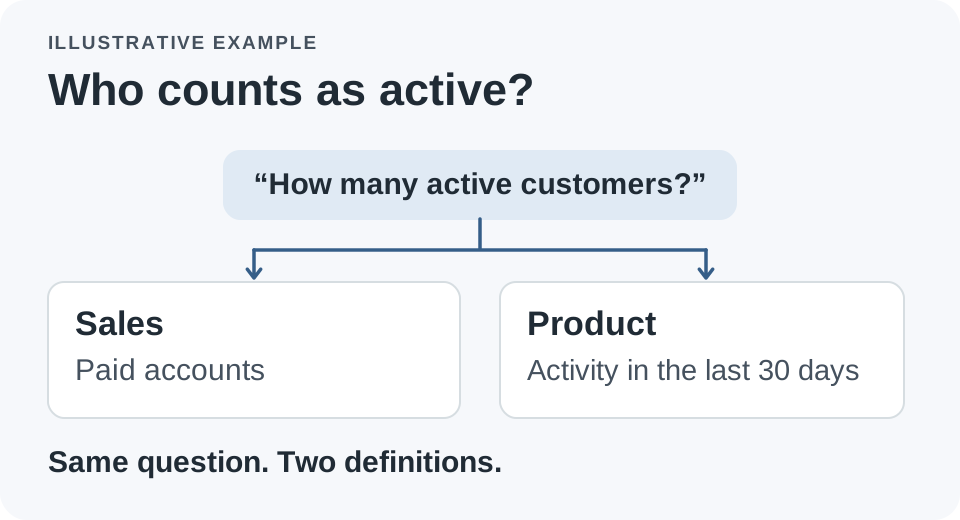
The same phrase can produce two legitimate numbers. Show the definition before you compare the result.
The chart knows how the metric was calculated
A dashboard usually contains more business knowledge than the bar chart you see. Someone had to decide which date to use, which records to exclude, what a paid account is and how to treat a merger. Those decisions can live in SQL, saved filters, a notebook or an unwritten understanding among the people who own the report. An agent may have permission to see the source table and still lack the rule that makes its answer useful.
The launch announcement describes two kinds of context. A learned snippet can express something an agent identifies in day-to-day artifacts such as an existing query. Modeled knowledge is something people explicitly define and govern, including certified KPIs in metric views. The article also describes OntoRank as the mechanism for ranking candidate context by authority and relevance. Those are Databricks' descriptions of its design. They do not guarantee every ambiguous question will be resolved the way your team would resolve it.
| Example question | Context to check | Who should settle the definition |
|---|---|---|
| How many active customers renewed? | Account key, renewal dates and contract status | Revenue operations |
| How many accounts actively used the product? | Activity events, time window and account mapping | Product analytics |
| How many customers were active at quarter end? | Reporting definition, timezone and period close | Reporting owner |
These teams are examples. A useful answer offers the definition it actually used, the reporting window, its effective date, and a source that the reader can reach. If the wording of the question is ambiguous, asking about contracts versus product usage is often the best first step. An ontology can help retrieve both relevant meanings, but the report still needs to communicate which one it used.
Use a number to make the difference obvious. Suppose the billing query yields 420 current accounts and the activity query yields 310 accounts with a qualifying event. Those are invented figures for this exercise. Saying “active customers: 420” is incomplete even if the math is right. Saying “420 billed accounts as of month end, excluding trials” gives the next reader a definition to check. If you combine the columns to answer how many billed accounts were also active users, the correct query requires a join and the two denominators need to stay distinct.
Shared context changes the cost of an error
A well-supported definition saves people from writing the same long prompt for every tool. One reporting team might maintain a certified revenue metric while different agents help answer finance, operations and management questions. Databricks says Genie MCP can expose context to agents outside Databricks. You should check the official Genie One documentation and the configuration of your own workspace before assuming a particular tool, data source, or action is enabled there.
The harder case is when two sources disagree. Imagine a marketing dashboard that still labels trial accounts as customers. A trusted finance report excludes them. An old notebook uses the finance name but last year's logic. If snippets are reused without visible provenance, the automation could keep a stale rule alive long after the people who remember the change have left.
Start by deciding which statements are allowed to be authoritative. A certified measure should have an owner and an approved reporting scope. A notebook can be valuable evidence of how a team works, but it is not automatically the policy. Where two legitimate rules coexist, give them different names or add the domain and period. A cross-company rollout succeeds when it preserves necessary differences between definitions, rather than forcing every team to answer every question identically.
A permission test belongs in the same exercise. Ask the identical question as an analyst who is allowed to see detailed data and a colleague who has access only to totals. Record the context and citations returned to both, including errors and empty results. Databricks describes the product as honoring existing permissions, but a rollout team still needs to confirm the behavior at the boundary it will deploy. A metric explanation that includes an inaccessible link is a usability problem. An answer that exposes restricted details is a much more serious failure. Test those outcomes separately.
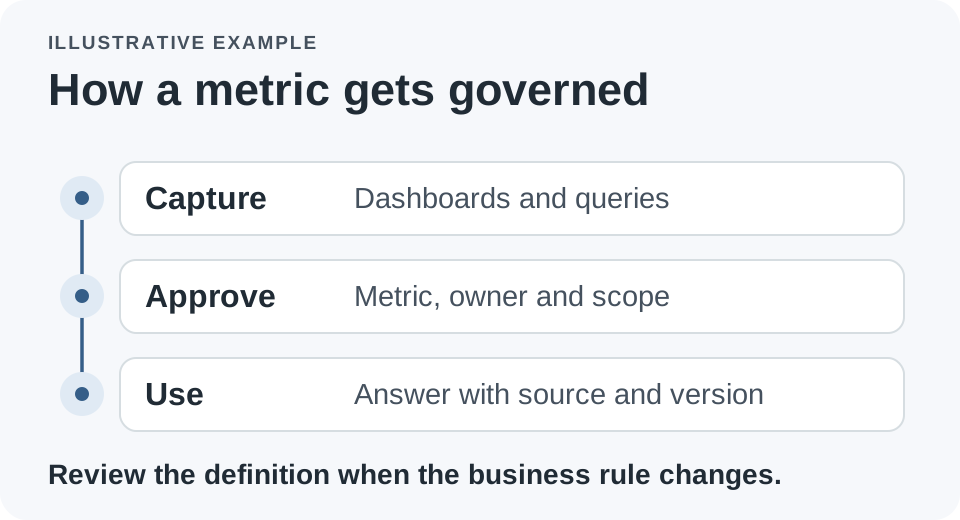
Assign ownership and an effective date, then test what happens when the definition changes.
The 91 percent figure has an important denominator
Databricks and Turing built an evaluation in a simulated workspace for a fictional UK energy supplier. The November 11 announcement reports a 91% pass rate for Genie with Ontology and 58% for the stronger of two anonymized comparison agents. It says each agent answered the same questions five times per task and results used a pre-defined rubric. This is a joint vendor evaluation in a particular setup, not independent evidence that every Databricks customer should expect those results.
The comparison captures a real business problem. If one agent already has the definitions it needs, it can spend less time looking through workbooks, source tables and notes. The announcement describes the Genie configuration as representing an established deployment with accumulated context. That's different from a freshly connected workspace. The test compares whole systems with different access to that prepared context; it does not tell you how much each feature alone accounts for the difference.
A team can build its own small evaluation without copying the vendor's task mix. Choose questions that look easy but have failed in practice: a monthly active account report, a region's renewal deadline, an exception to revenue recognition or the effective dates for a classification. Pull a snapshot of authoritative answers from owners. Write down which sources and date windows count as correct. Include questions the agent should decline or clarify because they have no single sanctioned answer.
Score the replies on traceability and access as well as numeric correctness. A report that happens to match the right number using the wrong formula can break the following month. A very quick response that takes an analyst several minutes to verify may save little work. Keep a record of who could check the answer and which boundary cases triggered a clarification request. That makes comparisons between the baseline and the trial useful even when both use the same underlying model.
Try a definition change before you scale
A one-metric pilot is enough to see whether the system stays current. On the first run, ask for active paid accounts at a fixed point in time. Then simulate a business change: partner accounts become a separate reporting segment from an agreed date. Historical dashboards must preserve the old treatment for earlier periods. New reporting must use the approved definition. The difficult part is keeping answers correct both before and after the change without giving the agent a personal copy of the policy every time.
- Pick one metric with a data owner and two honestly different interpretations. Write an approved rule, an effective date, a known answer and a known ambiguity.
- Run the baseline and governed versions on the same questions using the same reporting snapshot. Record the answer, the cited definition and time spent verifying.
- Repeat under two permission profiles. Verify that the reader can open appropriate sources without learning restricted details.
- Simulate a policy revision and ask for reports before and after it. Check whether the response uses the correct definition for each period and names the change.
The November 11 announcement is a reasonable point to start evaluating Genie Ontology with the people who govern your Databricks workspace. Availability of the ontology is distinct from availability of the new visual manager described as a forthcoming beta. An organization doesn't need that visual tool to write down metric ownership, reconcile a definition, and prepare a reference question set. Those steps will still be useful if the implementation takes longer than planned.
Add one question that tests the difference between finding a definition and using it correctly. Two accounts can have the same customer name. Subscriptions can change state in the middle of the month. A transaction recorded just after midnight may belong to a different local reporting day from the one suggested by its UTC timestamp. Pick including or excluding just one of these cases. Give reviewers a reference query and ask them to read the agent's interpretation before seeing the expected number.
There is also a practical way to look for collisions as coverage grows. Maintain a short list of words that already mean different things to different teams: active, region, return, renewal. When a new domain joins the system, ask owners to pair up and exchange three normal questions. Note where the same word changes the population, time window or source table. A human can decide whether to split names or keep a shared concept with qualifiers. The review should be small enough to continue whenever an important new definition enters the catalog.
Try sending the completed answer to a colleague who wasn't part of the pilot. Can they tell which report it belongs in? Can they open its approved source and spot any difference from their own dashboard? If a metric needs a walkthrough every time it moves to another team, a better answer may be a clearer name and a saved definition rather than more model context.
A number is only as reusable as its definition
The most valuable outcome is hearing two agents give the same answer for the same reason, then seeing them ask a follow-up when the question changes. That takes a definition the business can find, verify and revise. A shared context layer is a way to carry that work into more reports. It makes the work of naming and governing a metric more valuable, rather than making it disappear.
Sources
- Databricks general-availability announcement, November 11, 2026
- Databricks Genie One documentation
- Official Genie Ontology demo
Keep metric definitions, meeting decisions and follow-up questions in one searchable place. Start your first note with Telli.sh.