Composio Instant makes a tool call a spending decision
Agents can use paid tools through Composio's provider accounts. That removes setup friction, while making approval, budgeting and receipts part of the product experience.
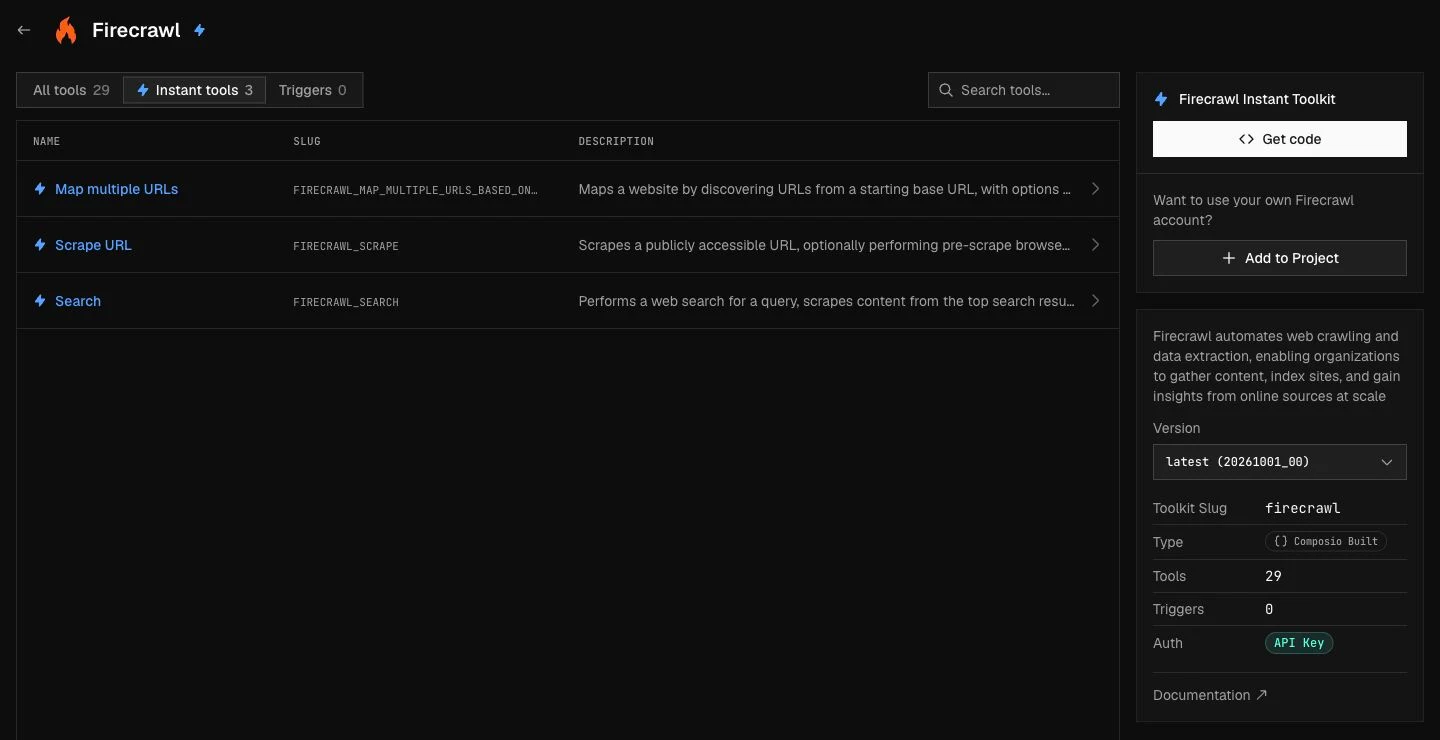
Official Composio documentation screenshot showing Firecrawl's Instant-eligible tools. Source: ComposioHQ/composio; copyright 2025 Sampark Inc., MIT License. This is a documentation example, not our account or a live catalog count.

An agent can plan a useful research job and still stop at a very ordinary obstacle: the next tool needs an account. The user has to sign up, find an API key, add credit and return to the original task. For a service they might use once, that setup can cost more attention than the result is worth. The agent's apparent autonomy ends at the checkout.
Composio introduced Instant on October 8, offering supported paid tools through its own provider accounts and charging the organization's Composio balance. The launch describes more than 100 paid tools, distinct from its much larger general app catalog. The product is interesting because it removes a purchasing interruption from the middle of an agent task. The same change also turns tool selection into a decision about somebody's money. Launch announcement.
Our take: this could make occasional, useful capabilities much easier to reach. Its value will depend on whether the convenience is paired with understandable spending authority. “The agent can use a tool” and “the agent may buy this result at this cost” are different promises, even when one button makes them look identical.
Composio works at the connection between an agent and other services
Composio supplies tool and authentication infrastructure for agents connecting to external applications. That position matters. A model may understand a request, but a useful application also needs a way to find the appropriate action, obtain access and execute it. Composio's existing integration business addresses those joins; Instant extends the connection to supported paid actions without requiring a separate provider account from the user. Product overview.
The old interruption is easy to recognize. A person asks for a short brief and an audio version to hear on a commute. Research, extraction and speech generation might involve several services. Each separate account creates another setup decision, billing relationship and credential to maintain. For frequent use, that may be a worthwhile investment. For an experiment, it can discourage the task entirely.
An intermediary can reduce that overhead by making a capability available at the point it is needed. The person can evaluate the output before deciding whether the underlying provider deserves a direct relationship. That is a meaningful product idea, particularly for small teams that want to try a workflow before building a permanent stack around it.
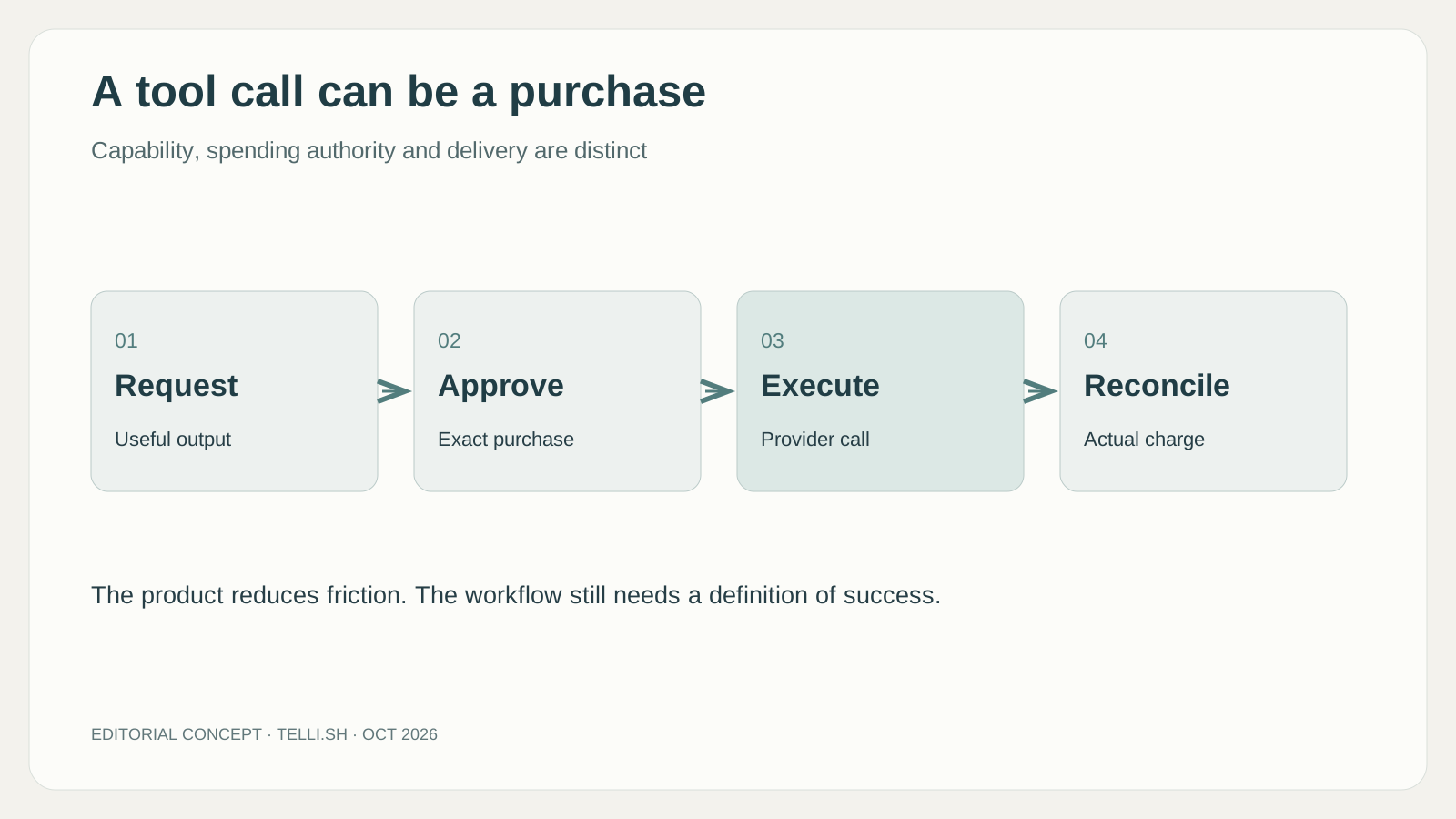
Original editorial infographic. This is a proposed spending workflow, not a guarantee that every Composio integration enforces it.
The wallet metaphor makes access clear and authority ambiguous
A wallet is a useful metaphor because it tells the reader that a capability costs money. It is less useful if it suggests a bounded physical purse that cannot spend more than it contains. The Instant Tools documentation explicitly says the prepaid balance is not a hard cap because checks are asynchronous. It also says the Session API has no built-in dollar cap. Those details substantially change how a strict budget should be designed. Instant Tools documentation.
This does not erase the convenience. It identifies where a product builder must make another choice. A personal experiment might tolerate a small amount of variable spending under a clear policy. A service operating on behalf of many customers may need a firm budget for each job, user or organization. Those are different requirements, and a visible balance does not by itself satisfy all of them.
The important distinction is timing. Access controls decide which tools are available. Authorization decides whether a particular purchase is permitted before it happens. Accounting reports what was charged after execution. A well-designed product makes those stages understandable. Combining them into a single “agent wallet” can conceal the difference between a helpful receipt and an enforceable limit.
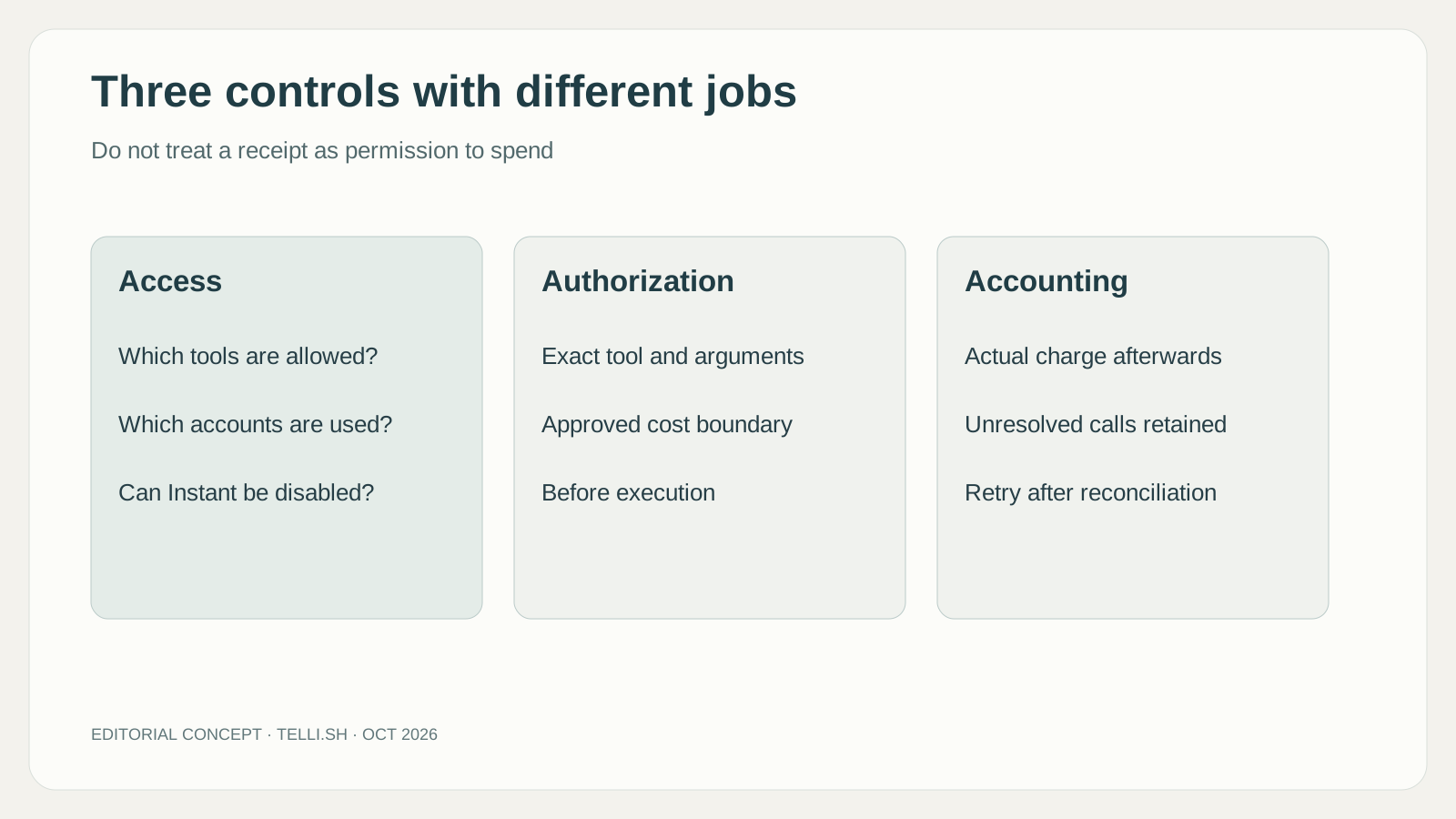
Original editorial model. These controls answer different questions and should not be treated as substitutes.
An experimental release is a useful place to test one narrow job
The current documentation labels Instant experimental, says it is off by default, and notes that access may need to be requested if the project setting is unavailable. It supports allowing or excluding toolkits and tools, as well as disabling Instant. Support is defined per action, so a supported toolkit does not imply that every feature of its underlying service is available through Instant. Availability and controls.
That suggests a bounded evaluation. Choose one useful job where a paid capability is genuinely missing. A research assistant might need a specific search action. A media workflow might need a short transcription or voice output. Establish what output would be sufficient, which data may be sent and who can authorize the purchase. The point is to test whether removing account setup improves the finished task, rather than to connect every available tool at once.
It is also worth asking whether the paid capability is needed at all. An agent may discover a sophisticated service when a simpler local operation would suffice. Easy access can encourage useful experimentation, but it can also make unnecessary purchasing feel like ordinary computation. A product that shows the proposed capability and its purpose gives the user a better chance to distinguish the two.
The attraction of Instant is clearest at the workflow level: a person can try a result without first assembling multiple commercial relationships. A useful pilot follows the task through to its deliverable, including the time spent approving and checking the purchase. Whether that trade is worthwhile depends on the quality of the result, total cost and the work saved in this particular situation.
The best approval explains the purchase in the user's language
Suppose someone asks an agent for a cited brief about a potential supplier, followed by a two-minute audio summary. A useful approval request might explain that the agent intends to purchase a research action and then generate audio from the reviewed brief. It should identify the data sent to each service and the cost boundary the application can actually enforce. The user should not need to understand an SDK method name to know what they are approving.
Another illustrative task is a small creative experiment: transcribe an authorized recording, extract a short passage and generate a draft voiceover. The output might be valuable even if the person never uses those services again. The purchasing interface should distinguish generating a private draft from distributing it. Paying for a capability is not permission to publish the result, contact another person or reuse source material without the relevant rights.
A third case involves an internal agent serving several employees. One team's useful experiment should not silently consume the budget another team expects to use. Here the product needs a meaningful spending owner, not just a shared balance on a dashboard. The task's budget, the person approving it and the eventual receipt should remain connected so an unexpected charge can be understood later.
The common thread is reviewability. A small, specific purchase can be easier to approve than a broad instruction to “use whatever you need.” That does not require interrupting every harmless calculation. It requires the application to recognize when a tool call crosses into a commercial commitment and present that commitment clearly.
A prompt is not the place to enforce a strict budget
Telling an agent “do not spend more than five dollars” expresses a preference. It does not create a spending boundary if the tool path can execute purchases without checking that instruction. The Instant documentation recommends keeping approval in the application's execution path; handing a spending-enabled tool surface directly to an agent can bypass such an application gate. A reported charge arrives too late to authorize the action that produced it. Execution and approval guidance.
For a strict cap, the application needs to know the maximum amount a proposed call can consume and reserve that amount before execution. Simultaneous calls must not both assume they own the same remaining budget. When a call times out, the application must avoid assuming that nothing happened and purchasing the same work again without checking. These are ordinary accounting problems made more visible by autonomous tool use.
The difficult case is an action whose maximum cost cannot be established. A natural-language price description may be informative without being a guaranteed upper bound. If the product promises an absolute ceiling, uncertainty about the maximum is a reason to reject or defer that purchase. If the promise is only “no paid call without approval,” that is a different and simpler policy. The interface should state the promise it actually keeps.
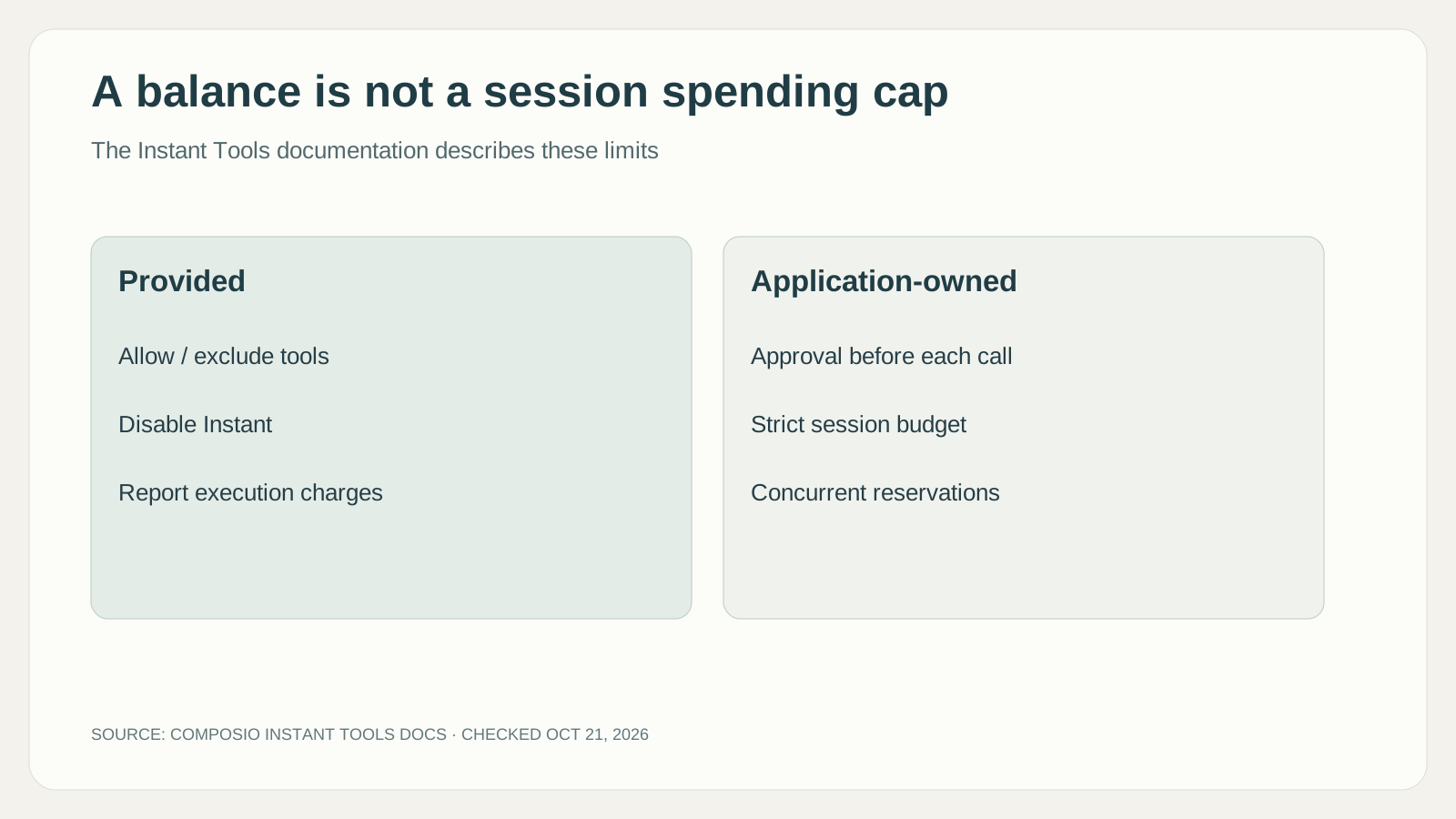
Original infographic based on the current Instant Tools documentation. A prepaid organization balance should not be presented as a guaranteed per-session cap.
Receipts are useful when they explain both the charge and the result
Removing a provider account does not remove the provider from the data path. A buyer evaluating this arrangement should understand which service receives the input and what operating terms apply to the result. A public research question and a confidential customer recording create different requirements even if both can be processed by a paid tool. The convenience of one billing relationship is valuable, but the application still needs to explain the relevant external processing in ordinary language. That explanation can be brief and task-specific; it should arrive before the data is sent, rather than being discoverable only in the eventual receipt.
A receipt can do more than list money spent. For an agent task, it can connect the user's request, the external action, the returned result and the final deliverable. If the research brief is poor, that record helps distinguish whether the problem was the search, the interpretation or the task itself. Otherwise, the user sees one disappointing answer and a collection of unfamiliar charges.
This connection also helps with retries. A tool can produce a result even if the agent loses the connection before reading it. Automatically repeating the request may purchase the same work twice. A visible unresolved state is preferable to silently treating a timeout as a free failure. The right recovery depends on what the provider executed and what the billing record confirms.
For recurring work, aggregate receipts could reveal whether a supposed convenience is economical. Perhaps the agent spends heavily on research but the user mostly values the final audio summary. Perhaps a direct provider subscription becomes worthwhile after repeated use. Those are useful outcomes of an intermediary too: it can lower the cost of learning which capabilities deserve a more permanent place in the workflow.
The receipt should remain intelligible to the person paying. “Tool call 38” is accurate but unhelpful. A description such as “extract the approved document's tables for this comparison” explains the purchase. Better accounting can therefore improve the agent experience itself, rather than existing solely as an administrative report after the interesting work is done.
Agent payments are becoming a separate product discipline
Composio's release sits beside a broader effort to describe what it means for software to buy something on a person's behalf. The Agent Payments Protocol implementation considerations discuss intent, checkout and payment mandates, including a trusted interface for reviewing and signing delegated authority. These are protocol design concepts, not evidence that Composio Instant implements AP2. Their relevance is the distinction between a tool being technically callable and a purchase being within the authority a person actually granted.
That distinction becomes clearer when a request evolves. “Find a useful source for this report” might justify searching a catalog. It does not automatically settle whether the agent may buy a dataset, which license is acceptable or whether a recurring subscription is permitted. A structured purchase instruction can preserve those boundaries as the agent chooses among providers. The commercial value is not only preventing an unwanted charge; it is allowing an appropriate purchase to proceed without repeatedly asking the user to restate the entire task.
Payment infrastructure offers another useful comparison. Stripe's Issuing spending-control documentation describes controls on card authorizations, including merchant categories and spending intervals. Those checks operate at a different layer from an instruction in a conversation. They illustrate why purchase enforcement belongs in systems that can allow or decline execution. They are not a documented Composio integration, a substitute for its tool-accounting logic or a promise that card controls eliminate every financial edge case.
| Layer | Useful responsibility | Example of evidence to inspect |
|---|---|---|
| Task intent | Describe the outcome the user wants | A bounded research or creation request |
| Purchase authority | Define the permitted purchase before execution | Approved tool, quantity, terms and amount |
| Payment and accounting | Apply the relevant controls and record the charge | Authorization result and itemized receipt |
An interface can present these layers in one simple interaction. Keeping their responsibilities distinct is what makes that simplicity believable. Otherwise, a reassuring “approved” label can refer only to a task plan while the actual paid call follows a different path.
The economics differ for occasional and repeated work
The business appeal also depends on how often the capability is used. For an occasional project, creating several provider accounts can be more work than the task itself. Instant's shared access and consolidated charges could let a small team try a specialist capability without committing to a separate procurement process for every experiment. The relevant saving is the combined effort of setup, administration and delivery, rather than the price of one isolated call.
Repeated production use changes that calculation. A team may then care more about the provider's contractual terms, predictable volume pricing, output portability and what happens if the intermediary stops offering a tool. A direct account could become attractive for some workloads while shared access remains convenient for infrequent ones. That is an economic comparison to investigate, not a measured claim that either route is always cheaper. The announcement does not establish the best purchase arrangement for every organization.
There is a provider perspective too. Easier discovery could bring a specialist service work from users who would never complete its normal onboarding. But the provider still needs its terms and limitations to reach the eventual user. A tool returning a technically successful result does not settle whether the result's license or permitted use fits the project. The approval screen and receipt should make commercially relevant terms findable, particularly when the requested output will be redistributed.
This is the expectation worth carrying into a pilot: a smaller administrative burden without losing the information needed to make a buying decision. Watch one task from request to useful deliverable, then ask whether a colleague could understand the choice and repeat it. A system that makes the first experiment effortless but the second impossible to reconstruct has solved only part of the purchasing problem.
The opportunity is purchasing useful outcomes with less setup
The most attractive future for a product like Instant is a wider range of small tasks becoming worth doing. A person who would never subscribe to several specialist tools might still pay for one useful, well-bounded result. An agent can help discover the capability at the moment it becomes relevant. That could make software feel more like an accessible collection of services and less like a series of setup projects.
The concern is that the same ease can make spending hard to see. A task that retries, expands its scope or asks several agents for help can become a chain of purchases. Keeping the user informed only after completion may be acceptable for a clearly authorized budget, but it is a poor substitute for establishing that budget in the first place.
Composio Instant brings this trade-off into a concrete product. It removes a familiar account-and-key interruption, while exposing the next design problem: who can buy which capability, for what purpose and within what limit? The strongest agent experience will make those choices understandable without making every useful task feel like procurement. Convenience starts the job. Clear authority and a useful result make it worth repeating.
Sources
-
Composio Instant launch, October 8, 2026.
-
Instant product overview, checked October 21, 2026.
-
Instant Tools access, approval and spending documentation, checked October 21, 2026.
-
AP2 implementation and delegated purchase authority, checked October 21, 2026.
-
Stripe Issuing spending controls, checked October 21, 2026.
Keep the result and your assessment together
For readers who want a separate place to retain source links and reviewed research notes, Telli.sh is one option. Open your notes workspace.