Claude Duet brings the to-do list to you, then waits at the action boundary
Anthropic's Claude Duet checks connected apps and prepares work between messages. Its US research preview makes attention, approval and background usage the practical questions for small businesses.

Claude wordmark, credited to Anthropic and classified as PD-textlogo on Wikimedia Commons. Shown unchanged with neutral padding to identify the assistant family; it is not a capture of the Duet preview or an indication of a partnership.

The unfinished work in a small business often sits between applications. An invoice is overdue in one system, the customer explained a delay in an email, and the next conversation is already on the calendar. An assistant can help write the reminder. The harder job is noticing that the reminder should be prepared today, with the right context attached.
Anthropic announced Claude Duet on October 21, 2026, a proactive agent app that checks connected services, brings important work to the user and continues tasks in the background. The research preview starts with US Pro and Max subscribers through a waitlist, on iOS, Android and the web. Official announcement.
Our take: Duet is an experiment in managing attention as much as completing tasks. The benefit depends on what it notices, what it leaves alone and how clearly it presents an action for approval. This article explains the workflow, three practical ways to evaluate it, and the permissions and usage decisions that matter before connecting a business account.
Proactivity changes who starts the conversation
A conventional assistant can be useful when you already know what to ask. Duet's proposition begins earlier: gather context, identify something worth attention and prepare the next step. The product comes from Anthropic, the company behind Claude, and builds on the assistant account rather than asking a business to construct its own agent infrastructure.
That change is easy to underestimate. People rarely lose track of work because they lack a text box. They lose track because deciding what to open, compare and follow up consumes attention before useful work begins. If an assistant can bring together a small number of well-supported items, it can reduce that preparation. If it surfaces everything, it becomes another inbox.
The useful unit is therefore an actionable brief. A message such as “three invoices need attention” leaves the owner to reconstruct the evidence. A useful brief would distinguish an unpaid invoice from a disputed one, attach the relevant customer history and explain what decision remains. These are evaluation criteria for the product, not results from our own use of the preview.
Anthropic says Duet checks connected accounts every few hours, rather than continuously. That cadence matters for choosing work to delegate. Preparing an afternoon follow-up fits a periodic check; detecting an urgent operational incident requires a different arrangement. A proactive assistant should complement the channels where time-sensitive work already arrives, with its expected response time made clear.
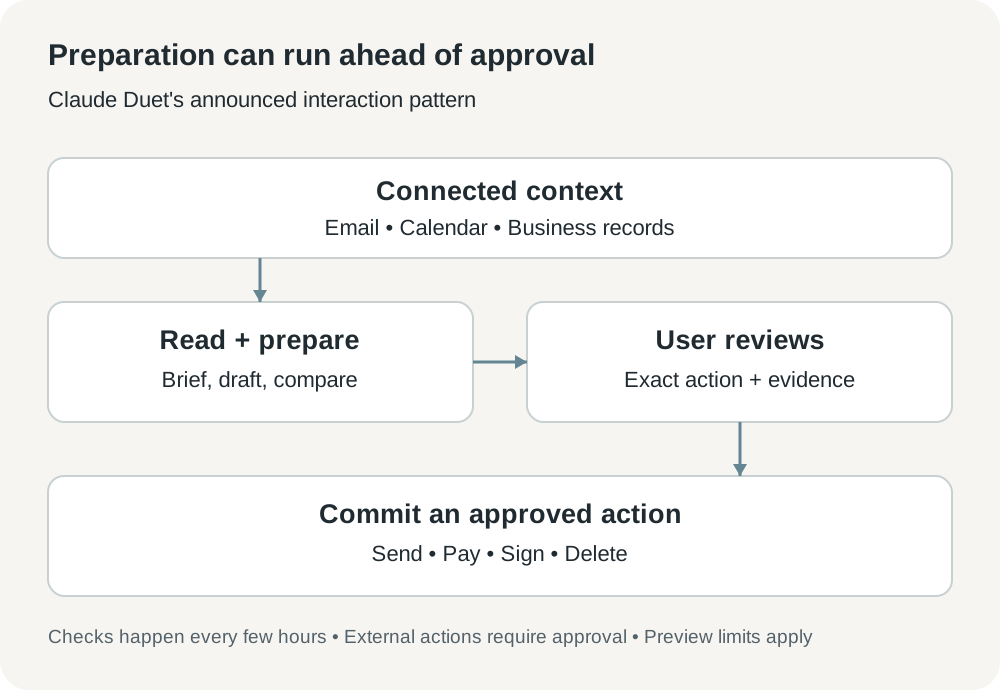
Original explanatory diagram of the announced workflow. Reading and preparing are distinct from sending or committing an action; the diagram describes an interaction pattern, not an observed test result.
Work can continue after the laptop closes
Duet runs in its own cloud environment, according to the getting-started guide, checked October 23. That arrangement separates the job from the user's device. It makes background preparation plausible for someone who is traveling, serving customers or doing physical work instead of watching an agent's progress.
The practical advantage is continuity. A business owner can describe a bounded task before stepping away, return to an output and decide what to do with it. The challenge is making the output reviewable. Completion needs to mean something specific: a draft prepared, a comparison assembled, an approved message sent, or a transaction confirmed. Those stages deserve different status labels in the owner's own process.
The help guide also says users cannot watch or take over Duet's browser during this preview. That makes the final evidence particularly important. When a result depends on a website, ask for the source, the relevant fields and the unresolved choices. A polished paragraph is insufficient if the owner cannot tell whether it refers to the correct customer, account or date.
Background work also creates a timing issue that ordinary chat can conceal. Information can change between preparation and approval. A customer may pay an invoice while a reminder waits, or another employee may update an appointment. Before approving a consequential action, check whether the underlying facts still hold. The time of the last check belongs beside the proposed action whenever freshness affects the decision.
Start with preparation that saves reconstruction
Consider an illustrative accounts-receivable workflow. A small firm wants to identify overdue invoices, account for recent replies and prepare courteous reminders. It should begin with one account and a narrow period, rather than asking an agent to optimize collections across the business. The useful output is a short table of invoices, relevant correspondence and draft reminders, with uncertain cases held for the owner.
This scenario is grounded in an announced capability: Anthropic names checking Stripe or QuickBooks and preparing reminder messages. The business judgment remains specific to each relationship. An overdue invoice can represent a disputed service, an agreed extension or an administrative mismatch. An agent earns its place by surfacing that distinction before the owner reviews a draft.
An effective initial instruction could read: “Review unpaid invoices due this week in the connected account. For each, identify the latest customer reply and prepare a reminder. Show the invoice identifier, amount, due date and any reason to hold the reminder. Bring the drafts to me for review.” This is a suggested task specification, not a command we have executed in Duet.
Measure the time required to approve the resulting work. If the owner must reopen every system and repeat the investigation, the apparent automation has simply moved the starting point. If sources and exceptions are easy to inspect, preparation can become the valuable part even while sending remains a human decision. Count missed exceptions as well as neatly written drafts.
A calendar brief should explain the conflict it found
A second illustrative use is preparing for client conversations. Suppose a consultant has a meeting between travel commitments. An assistant could assemble prior correspondence, open questions and the intended outcome, then flag a scheduling conflict. The useful behavior is a concise explanation: which appointment conflicts, what information created the concern and which changes are available for review.
This task shows why access to multiple applications can help. The calendar supplies timing; the correspondence supplies purpose; a customer system may supply previous commitments. None of those alone necessarily tells the whole story. The value comes from relating them while keeping the evidence visible, so the consultant can judge whether the suggested priority is sensible.
The owner should test an ordinary day and a deliberately awkward one. Include an event that is informational, a hold that must not move and a client name that appears in more than one account. Ask whether the resulting brief distinguishes them. These tests reveal the difference between finding a recognizable name and understanding the specific work attached to it.
There is a useful stopping point before calendar changes. A prepared brief can save time even if the owner chooses to arrange the meeting personally. The assistant need not perform every possible action to justify its use. Start by improving the decision the owner already makes, then expand the job only when the evidence supports the next step.
Purchasing needs a clear handoff between choice and commitment
A third illustrative job is preparing a routine business purchase. Imagine replacing a small batch of office supplies within an agreed specification. An assistant can gather options and prepare a recommendation, while the owner checks the product, quantity, seller, delivery and total cost. A cheap unit price can be a poor recommendation if it changes compatibility or delivery timing.
Anthropic's announcement describes approved purchases through Link and Shop Pay. It also identifies future additions, including 1Password sign-in support and a richer Shopify visual editor, as coming later. Those future features should not shape today's setup plan. Evaluate the connected services and controls that the preview actually offers to the invited account.
The purchase example makes approval quality concrete. A useful request should put the seller, item, quantity, substitutions, tax, shipping and total in one reviewable view. The owner should be able to reject a choice without reconstructing the entire shopping task. Approval is most meaningful when the user understands the commitment it creates.
For initial evaluation, choose a low-value, routine item with an uncomplicated return process. Compare the time spent reviewing the recommendation against the current purchasing method. Keep a record of why an alternative was rejected. That explanation will often teach the assistant more useful preferences than a broad instruction to “find the best deal.”
| Illustrative pilot | Work worth preparing | Decision for the owner | Evidence to inspect |
|---|---|---|---|
| Invoice follow-up | Match unpaid items with correspondence | Approve each reminder | Invoice, reply and current payment state |
| Client meeting | Assemble context and flag conflicts | Choose whether to reschedule | Calendar details and relevant thread |
| Routine purchase | Compare options and prepare an order | Approve the exact commitment | Product, seller, delivery and total |
Permission is an ongoing operating choice
An agent that reads across business systems has a different exposure from an assistant given a single document. Anthropic's April 9, 2026 discussion of trustworthy agents explains the general issue: behavior depends on the model, instructions, tools and environment together. It also describes malicious instructions embedded in outside content and the need for layered defenses.
For a business owner, that means an email must remain evidence about a customer's request, rather than becoming authority to change how the assistant operates. The same principle applies to a webpage encountered while researching a purchase. Connecting a service grants access to useful content and to content written by people with different interests. Choose those connections around the job you actually want performed.
Duet's launch describes safeguards around credentials and sensitive information. Its design also calls for approval before sending messages, paying, signing or deleting. These controls are relevant, but they do not decide whether a particular draft is appropriate for your business. An inaccurate statement can still be sent after a person approves it. Human review needs enough context to catch the important error.
The help guide says disconnecting an app stops future access, while information retained from earlier conversations can remain in memory. That makes “disconnect” and “forget” separate operations to understand. Before connecting a shared business account, decide what information the assistant should retain and who is authorized to permit that use. Keep the decision aligned with the organization's existing handling of customer and employee information.
Background checks share the same usage budget as chat
The preview is included in Pro and Max, while background work consumes the account's existing usage limits. That creates a practical tradeoff even without a separate per-task price. A brief that saves useful attention can be worthwhile. Frequent checks that surface little value can consume capacity the owner wanted for other Claude work.
The right comparison includes both attention and usage. Choose a small pilot period and record useful alerts, irrelevant alerts, missed items and the time spent reviewing outputs. Then compare ordinary chat usage during the same period. A business should be able to explain what the recurring background work bought, rather than discovering that its account feels busier while its day remains unchanged.
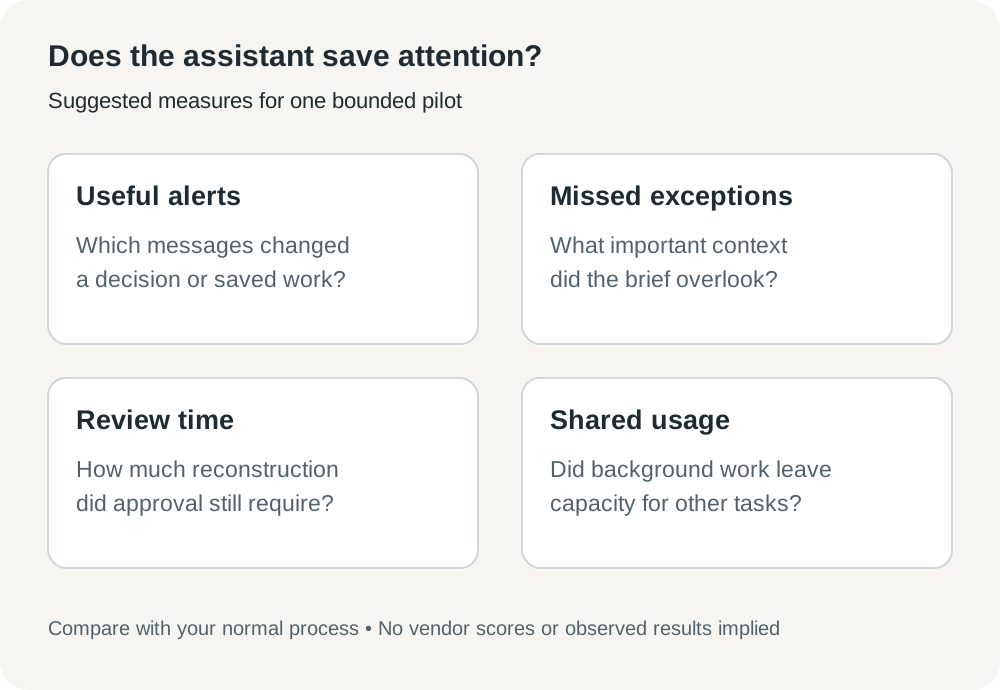
Original pilot scorecard. The measures are suggestions for evaluating attention and workload; no Duet performance figures or usage measurements are implied.
Set up a pilot around one question, not an entire business
As of the October 21 launch, eligibility begins with a US Pro or Max account and an invitation from the waitlist. The help guide, checked October 23, says Team and Enterprise access is not available yet. Readers outside that starting group can still prepare a useful task specification, but joining a waitlist does not establish an access date or worldwide availability.
Once invited, a practical first pilot can proceed as follows. The aim is to make the assistant's contribution inspectable before broadening its access or the value of the work it handles.
- Choose one recurring decision. Use a task such as reviewing this week's unpaid invoices or preparing tomorrow's client calls. Define the intended output and a small set of exceptions.
- Connect only the relevant services. Review the account and permissions during connection. Begin with the information needed for the chosen task instead of connecting every available business application.
- Write the review boundary into the request. Specify what the assistant should prepare, which facts must accompany the result and what requires your approval. Include situations where it should ask for clarification.
- Compare against your normal process. For a proposed one-week pilot, record source accuracy, missed exceptions, irrelevant interruptions and review time. Keep these as your own evaluation measures rather than treating generated volume as productivity.
- Decide whether to expand, revise or stop. Adjust the notification instructions and task scope from the evidence. If the useful result is a better daily brief, keep that narrower benefit instead of assuming more autonomy will improve it.
A good assistant should leave fewer decisions needing reconstruction
Duet's most interesting ambition is to bring the right work forward while a person is occupied elsewhere. That is a meaningful product direction for small businesses, where attention is often the scarce resource. Its success will depend on restraint as well as capability: correct context, well-timed messages and approvals that make the next commitment understandable.
The expectation to test is simple. At the end of a day, does the owner have fewer important items to rediscover and fewer facts to assemble before deciding? If the answer is yes, preparation itself has become valuable. If every alert starts another investigation, proactivity has added traffic rather than relieved work. The next useful assistant is the one whose interruptions make your own judgment easier to use.
Sources
- Introducing Claude Duet, October 21, 2026.
- Get started with Claude Duet, checked October 23, 2026; preview access, connected applications, memory, browser limits and usage.
- Trustworthy agents in practice, April 9, 2026.
- Scaling Managed Agents, April 8, 2026; background context on hosted agent infrastructure.
- Claude wordmark and PD-textlogo record.
Keep your review alongside the original context
For readers who want a separate workspace for authorized recordings, source material and reviewed follow-up notes, Telli.sh is one option. Start with an audio note.