ChatGPT can now read audio files. A useful summary still needs evidence.
Audio uploads bring recordings into a conversational workflow. Here is how to turn that convenience into reviewable transcripts, decisions and follow-ups without confusing a fluent answer with a faithful record.
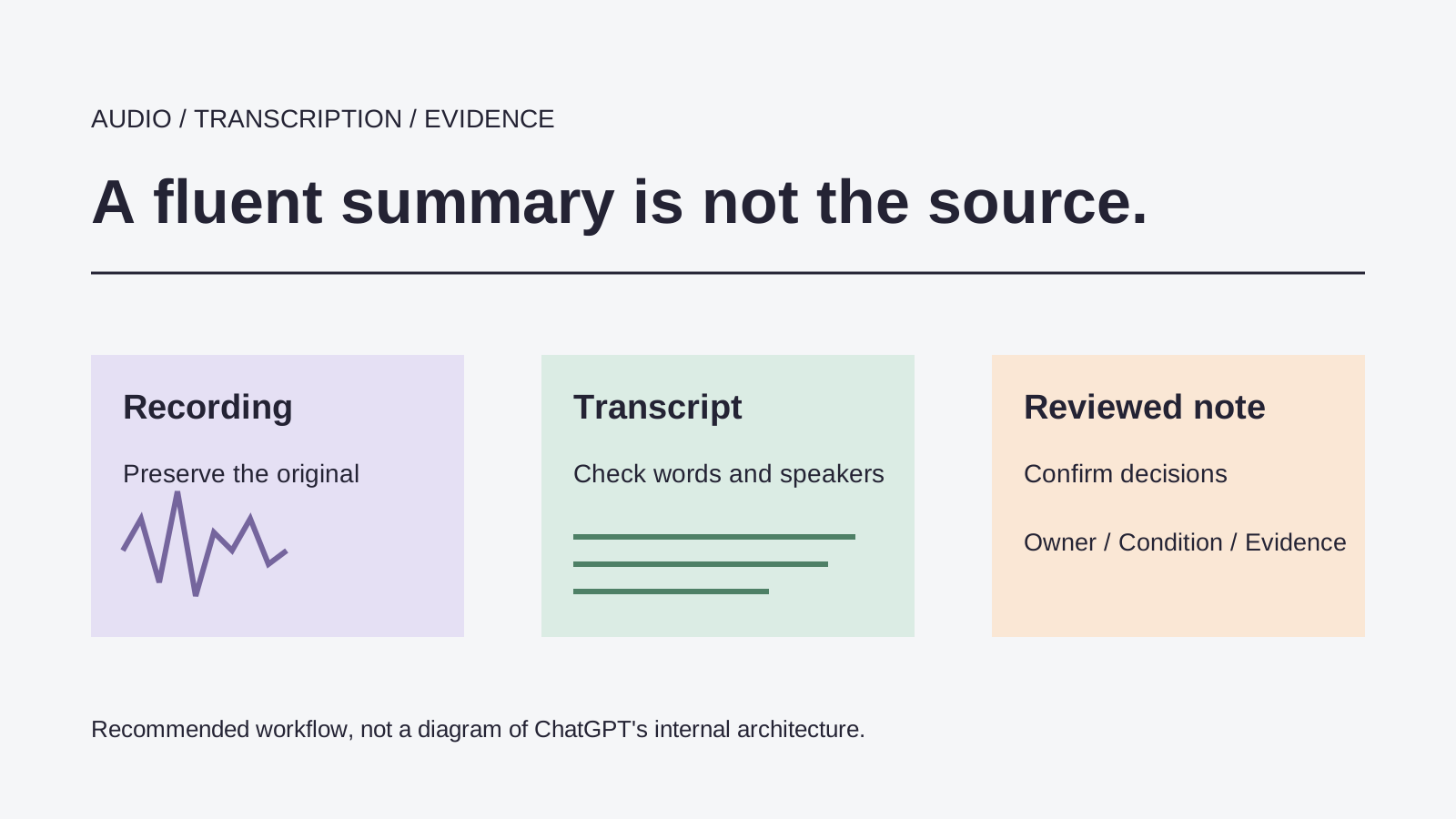
Original editorial illustration. The stages describe a recommended review process, not ChatGPT's internal processing architecture.
A recording is often easy to make and difficult to use. The important detail may sit somewhere inside forty minutes of discussion, surrounded by digressions, interruptions and tentative ideas. Conversational access to that recording changes the experience: instead of searching manually, a person can ask what was decided, which question remains open or what somebody said about a deadline. The appeal is immediate, particularly for people who accumulate more audio than they can realistically revisit.
On October 6, 2026, OpenAI announced audio uploads in ChatGPT for transcription, summaries and questions about a recording. It creates a quick path from an existing file to questions and draft notes, while the audio remains the source to check. Availability depends on the account, workspace and supported client. ChatGPT release notes
The recording is the source; the answer is a derivative
The most useful mental model is to keep three things separate. The original audio records what was captured. A transcript attempts to render that sound as words. A summary selects, compresses and organizes those words for a purpose. Each step can introduce a different kind of error, and improving one does not automatically fix the others.
A transcript can mishear a number while otherwise sounding convincing. A summary can accurately describe the discussion but promote an unaccepted suggestion into a decision. A follow-up email can correctly identify a task while assigning it to the wrong person. Treating all these outputs as one undifferentiated "AI note" makes it harder to locate a mistake and easier to spread it into the next workflow.
Consider a hypothetical team discussing a release. One person proposes Friday; another says Friday is possible only if a security review finishes; nobody explicitly agrees. A polished summary that says "Launch scheduled for Friday" loses the condition and invents finality. The problem is not just speech recognition. It is the transformation from a conversation full of uncertainty into prose that appears settled.
A better record preserves the distinctions: Friday was proposed, a review is a prerequisite, and final approval was not captured. This may look less tidy, but it is more useful. Good summarization does not eliminate uncertainty merely because uncertainty is inconvenient to display. It helps a reader see which parts of a conversation are ready for action and which still require confirmation.
Check availability and the file before debugging the model
OpenAI's upload guide lists common audio formats, a 512 MB limit and the need for a valid decodable audio stream; a video-classified MP4 or WebM is not equivalent to an audio-only file. Audio uploads are available with paid subscriptions and workspaces, subject to workspace settings, region, client version and model. OpenAI warns that transcripts and speaker identification can be unreliable, so the file limit does not guarantee that every long recording will be handled successfully. Uploading files and audio to ChatGPT, checked October 12, 2026
If an upload fails, first check account availability, the selected model, file type and whether the audio plays through to the end locally. These checks separate a format or access issue from a problem with the service or recording.
Do not interpret a successful attachment as proof that the entire recording was analyzed. Ask a question about the beginning and another about the ending. If the recording has known sections, compare coverage across them. An answer that understands the opening topic but ignores the closing discussion should be investigated before anyone relies on a comprehensive summary.
For a critical recording, keep an independent original copy. That way, the source remains reviewable if a chat is deleted, an account changes or processing fails; a derived answer is no substitute for the recording.
Start with a small, deliberately chosen task
It is tempting to ask for a transcript, a summary, action items, sentiment analysis and a follow-up email in one request. A smaller first task makes errors easier to spot. Ask for the principal topics and areas the system could not understand, then inspect whether the overview matches the recording. Only after that should you ask it to turn the material into a more consequential output.
Start with a bounded request such as: "Describe the main topics in this recording. Keep proposals separate from agreed decisions, and explicitly mark anything you cannot determine from the audio." This is a prompt example, not a guarantee of model behavior.
Next, ask a targeted question you can check quickly, such as the conditions attached to a proposed deadline rather than the deadline alone. A spot check tells you about that passage; it is not an accuracy score for the whole recording.
The sequence matters because later outputs tend to inherit earlier errors. If the model mistakes a suggestion for a decision, a subsequent email can turn that mistake into an authoritative announcement. Correct the record before generating the message, and review the message again before sending it. Transformation increases convenience, but it can also increase the distance from the source.
Action items need an owner, an obligation and a boundary
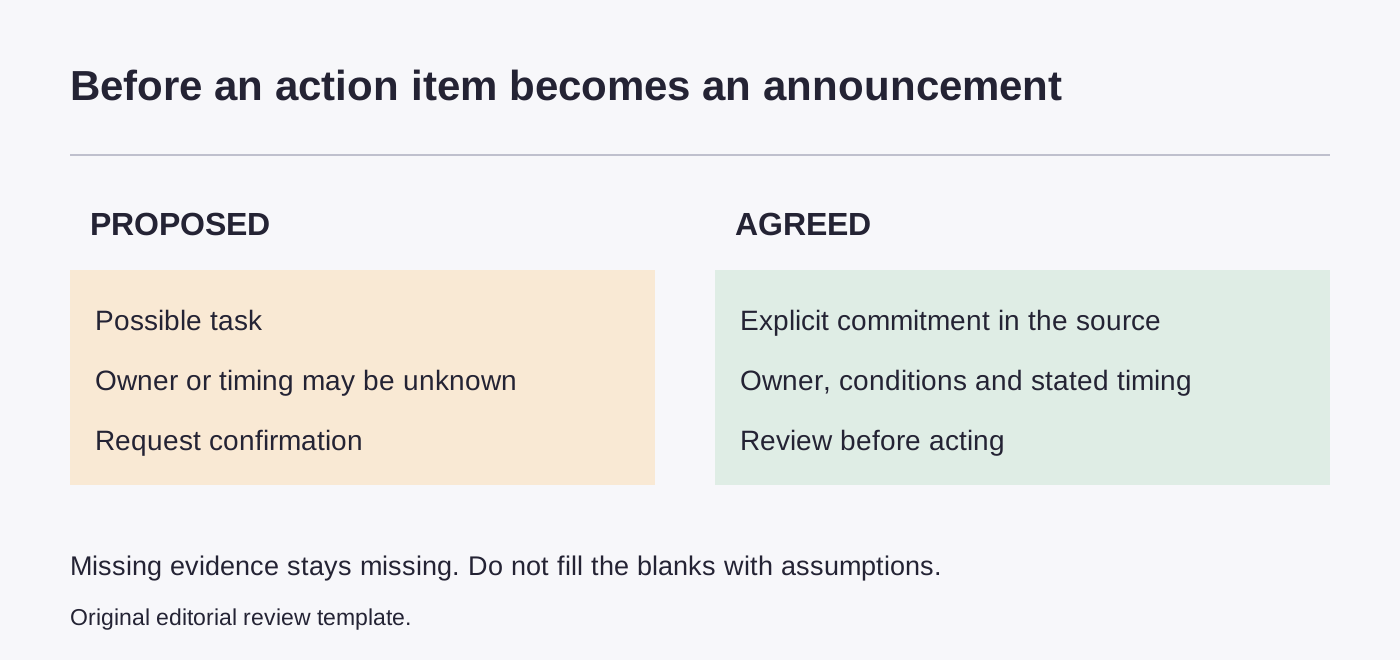
Original review template. Empty fields are a reason to ask for confirmation, not an invitation for the model to invent missing information.
An action item is more than a verb extracted from a conversation. "Look into pricing" could be a suggestion, a request or a commitment. A practical list should identify what is to be done, who agreed to do it and what timing or conditions were stated. If one of those elements is absent, the record should say so.
That standard prevents a subtle form of overconfidence. A model may infer an owner from whoever spoke most often about a topic. It may infer a deadline from a nearby date. The resulting list can look impressively complete while being wrong in ways that matter to the people named. An incomplete but honest list is often a better starting point for follow-up.
Use labels such as "agreed," "proposed" and "needs confirmation" as review categories. They are not a replacement for listening, and they should not be treated as a model's authoritative judgment. They simply give the reviewer a place to preserve differences the conversation already contains. The goal is not to make every row actionable; it is to avoid confusing possible work with assigned work.
A follow-up message can then ask people to confirm the uncertain items. That is a different communication from announcing them as settled. In a hypothetical project team, "I heard a proposal to move the release to Friday; please confirm whether the review condition is satisfied" is safer than "We agreed to release Friday" when agreement was never recorded.
Multilingual audio needs a source-language check
Mixed-language recordings deserve special care because several tasks can get blended together. Recognizing speech, translating it and summarizing it are not the same operation. A reader may ask for a Korean summary of a Russian interview, but that does not make a Korean rendering suitable evidence for an exact quotation in Russian. Specify which output should remain in the source language and which may be translated.
Keep names, technical terms, product identifiers and numbers visible during review. These details can be rare in the training data and difficult to distinguish from similar sounds. Give the system a short glossary if appropriate, while making clear that a glossary is context rather than proof that a particular term was spoken. Otherwise, an expected word can quietly replace an unexpected but correct one.
When an exact quotation matters, return to the original audio. A translation can clarify meaning while changing phrasing, and a summary compresses it further. Neither should be placed in quotation marks as though it were a verified verbatim statement. If the passage is unclear, preserve that uncertainty and seek human confirmation rather than asking the model to make the wording more confident.
The upload guide notes that performance can vary across languages. For recurring work, check a few representative recordings in the languages you use and verify names, numbers and key passages against the audio rather than assuming uniform accuracy.
Privacy depends on the feature and the workspace
An uploaded audio file, a live voice conversation and a recording feature can have different data-handling rules. OpenAI's Record documentation, for example, describes audio being used for transcription and deleted afterward. That is a statement about Record, not permission to assume the same retention behavior for every file attached to ChatGPT. ChatGPT Record documentation
For files saved in ChatGPT Library, removing a conversation leaves the saved copy in place. To remove it, open Library and delete the file there as well. Check where your actual file is stored and which workspace retention policy applies; deleting a file and deleting the conversation are separate actions. OpenAI's file-management guidance
OpenAI's privacy guidance distinguishes eligible personal-account controls from managed-workspace policies, and says business workspace content is not used for training by default. An administrator may control retention and available privacy settings. Check the policy for the actual account and workflow you plan to use; do not derive it from a different feature's marketing description. Privacy Center in ChatGPT
Before attaching a recording, ask a separate question: are you authorized to send this material to this service? A helpful summary is not a reason to ignore participant consent, an organization's policy or confidential content. The practical first step may be removing an unrelated private section or choosing an approved workspace. This is general workflow guidance, not legal advice about recording consent in any specific location.
Minimization also improves the review process. If the task concerns one interview answer, an authorized excerpt can be easier to check than an entire day of audio. Preserve enough surrounding context to avoid changing meaning, and clearly label the excerpt's boundaries. Less data is not always better, but unnecessary data increases both handling burden and the number of details that can be misinterpreted.
Evaluate saved time after review, not before it
The meaningful productivity question is not how quickly a summary appears. It is how long it takes to produce a record you can trust for its intended purpose. A fast answer that requires extensive correction may save less time than a slower process with better coverage and traceability. Conversely, even an imperfect overview can be useful when the task is simply deciding which part of a recording to replay.
Different tasks warrant different standards. A personal reminder may tolerate approximate wording. A publication quote, a consequential decision or a disputed commitment requires closer checking. There is no reason to apply the same review cost to everything, but there is also no reason to treat one convenient output as adequate for every use.
To judge whether the workflow saves time, compare representative authorized recordings: include quiet and noisy material, multiple speakers and the languages you encounter. Track missed sections, incorrect names, mistaken decisions and time spent correcting them; measure the reviewed record, not just how quickly a summary appears.
Retain the distinction between system failures and content errors. A failed upload, an incomplete analysis and an inaccurate summary need different remedies. Keeping those categories separate helps you decide whether to change the file, adjust the task, improve capture quality or abandon the result. Without that separation, every disappointment becomes the vague conclusion that "AI did not work."
The opportunity is conversational access, not automatic truth
Audio uploads make recordings easier to approach. They allow a person to ask a second question without first producing an elaborate document or searching through every minute manually. That can reduce the friction that makes useful recordings disappear into an archive. It is an important change even without assuming that every answer is correct.
The most durable workflow combines that convenience with an ordinary discipline: preserve the source, distinguish transcription from interpretation, inspect consequential details and keep unresolved questions unresolved until someone answers them. AI can help organize a conversation. It should not silently decide what the participants agreed to, and a readable summary should not become more authoritative than the audio from which it was derived.
Keep source material and your own notes together
For readers who want a separate workspace for recordings and reviewed notes, Telli.sh is one option. Start with an audio note.