Who owns an AI agent after its creator leaves? BetterCloud turns that into a workflow
BetterCloud's October release connects AI agent ownership, access and spending. A practical guide to offboarding agents, evaluating connector coverage and planning a controlled rollout.
An employee's departure has a familiar checklist: disable accounts, revoke sessions, transfer documents and recover equipment. An AI agent adds a less familiar question. If that person created an automated researcher or connected a model to business tools, what keeps running after their own login stops working?
BetterCloud's October 29, 2026 release connects AI agent lifecycle management with AI spend tracking. BetterCloud is an enterprise SaaS governance platform whose existing work includes employee access and offboarding automation. The new release applies that operational approach to agents and their related resources. The company's release announcement describes controls for creating, updating and retiring agents, managing tool authorization, and connecting ownership with consumption.
The useful development is a bridge between identity administration and ongoing machine activity. This guide explains what that bridge needs to accomplish, where cost visibility helps, and how an IT team can evaluate the release without confusing a central inventory with complete control of every AI system.
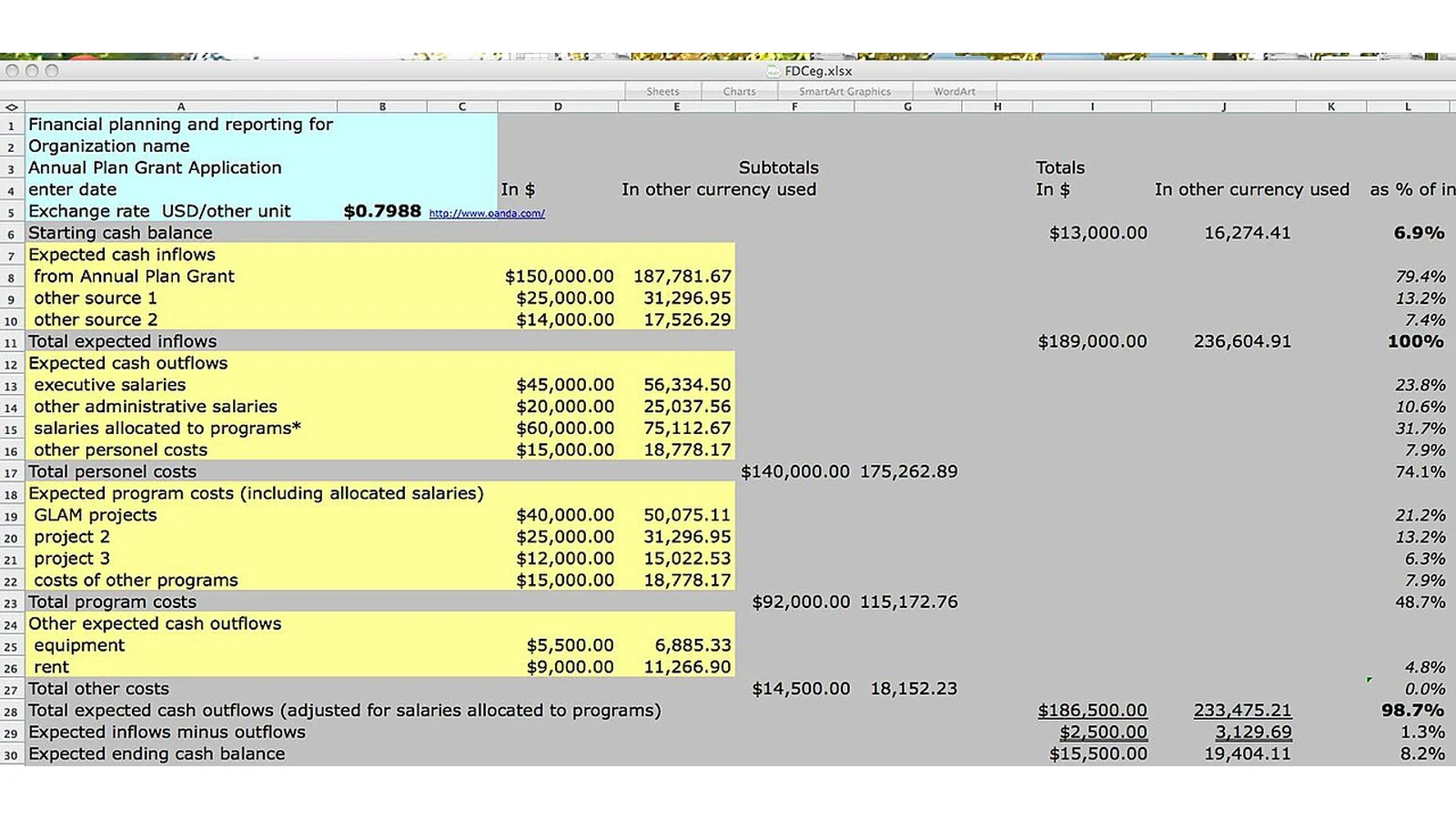 A budgeting spreadsheet example from 2014; illustrative spend-review context, not BetterCloud UI or actual AI usage data. Image: Smallbones, CC0; resized with margins. Image source · License and image notes. Official product reference.

An agent needs an owner who outlasts one account
Consider an illustrative sales-operations assistant. One employee connects it to a customer database, schedules a daily report and shares the results with a team. It becomes useful enough that colleagues rely on it, but nobody revisits who owns its credentials, operating budget or correction process. A departure turns those small omissions into one urgent handoff.
Disabling the person's account answers only part of the problem. The business must decide whether the assistant should continue, who should receive its results and which connections remain legitimate. An agent can be valuable while its original permissions are no longer appropriate. Ownership transfer and access removal should therefore be separate decisions in the offboarding design.
Our take is that an agent belongs in the same operational conversation as a service account, a scheduled integration and a recurring vendor bill. It needs a named business purpose, a responsible owner and a retirement path. The metaphor is simple: an organization chart now has a night shift. Work continues outside a person's session, so responsibility must continue too.
That does not mean every automated task deserves a long approval meeting. A low-impact internal summary and a system allowed to change customer records should have different controls. What they share is a basic record of purpose, access, ownership and expected behavior. Without that record, “keep it running” becomes a decision made through guesswork.
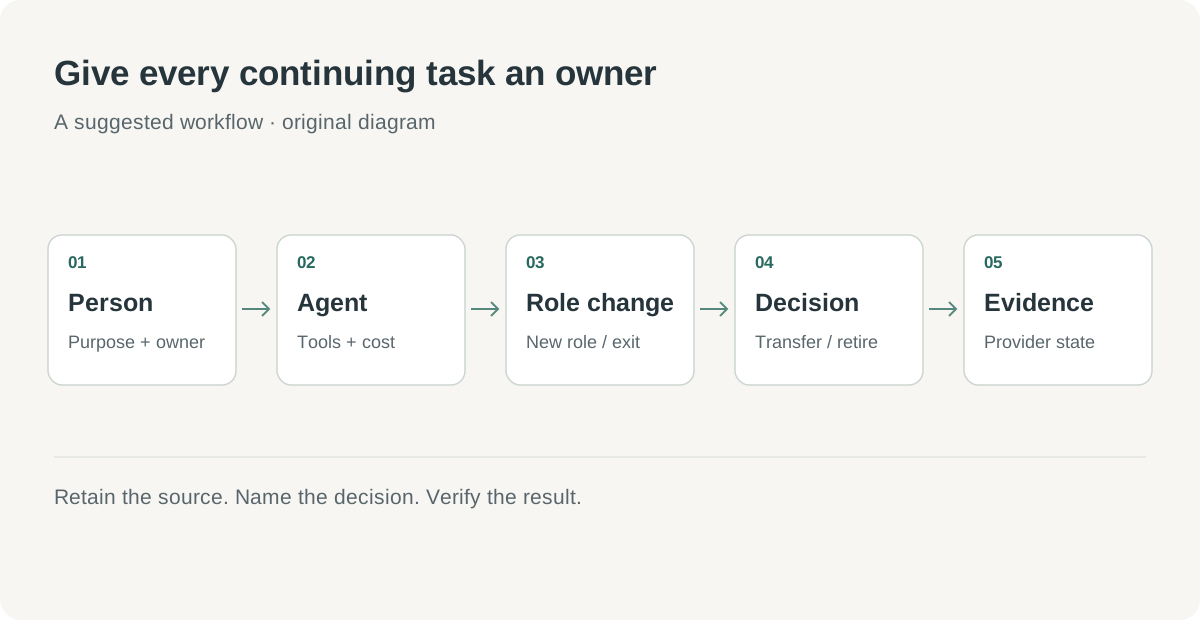 Original lifecycle diagram: a role change should trigger explicit decisions about ownership, permissions and ongoing cost. The diagram is an evaluation framework, not a screenshot of BetterCloud.
October extends an inventory that already existed
BetterCloud introduced its AI Governance discovery surface in an August 28, 2026 update. That earlier description includes an inventory of AI entities with provider and owner information. The October announcement adds lifecycle and consumption capabilities around that context. An image from the August update should therefore be read as an earlier inventory view, rather than evidence of an October action screen. BetterCloud's August update.
The distinction matters for evaluation. Discovery answers what the system can see. Lifecycle management answers which supported changes the system can perform. Audit history answers what actually happened. A team should verify each separately because a connector may be good at listing a resource without supporting every desired action on it.
Start with a specific resource rather than an abstract promise of AI governance. Can the platform identify a particular assistant, name its owner, show the relevant access and retire it through an approved workflow? Can an administrator see a failed step and understand which part still needs attention? Those questions expose useful differences between a polished inventory and an operational control.
Connector coverage also changes the meaning of “central.” A central view of connected providers is valuable, but it does not automatically reveal a personal account, an unconnected tenant or every agent embedded inside a SaaS application. The October release itself describes further expansion of discovery as a plan. Keep a documented gap list alongside the connected inventory so teams know which systems still require another process.
Offboarding should preserve useful work while removing inappropriate access
BetterCloud's October announcement gives an example in which a workflow reassigns an employee's agents to a manager while suspending a Google Workspace account, revoking Microsoft Entra ID sessions and removing AI-tool access. It says executions are logged. These are vendor-described capabilities for covered integrations, and the relevant permissions and tenant configuration remain part of deployment. BetterCloud, October 29.
For the sales-operations scenario, a useful handoff begins before departure day. The future owner should be able to explain the report's audience, data sources and expected schedule. If nobody can explain them, the team has a retirement candidate or an investigation task. Automatically assigning a new name does not itself create operational knowledge.
The workflow should also distinguish access needed by the agent from access formerly held by the employee. Transferring responsibility does not justify copying the person's full role to a new service identity. Review the minimum tools and data necessary for the continuing task, then verify that the results still reach an authorized recipient.
An illustrative finance assistant presents a different case. If it was created for a temporary reconciliation project, retirement may be the appropriate outcome. Preserve the approved records and execution evidence required by the business, stop new activity, and verify that the connections are no longer usable. A completed project should not retain a perpetual budget simply because the automation still works.
| Situation | Ownership question | Access question | Completion evidence |
|---|---|---|---|
| Employee departure | Who is accountable for the continuing task? | Which human and agent permissions must change? | Transfer or retirement recorded, with unresolved steps visible |
| Internal role change | Does the original team still need the agent? | Does the new role create an inappropriate combination of access? | New owner accepts the purpose and reviewed permissions |
| Temporary project ends | Is there any continuing business purpose? | Can credentials and connections be removed? | Activity stops and retained records have an owner |
| Provider replacement | Who owns migration and shutdown? | Which old connections remain active? | New workflow verified and the old route retired |
These are suggested control questions, not a claim that every row is an automatic BetterCloud template. A team can use the table to test its own workflow and to identify where a human decision must precede an automated step.
Spending is more informative when it has a responsible owner
The October release describes a view of AI consumption that distinguishes the billed vendor from the model provider, and associates tools with monthly cost and ownership. It also describes employee-level AI spending across tools. BetterCloud's announcement, dated October 29, is the source of those product claims.
That distinction is useful when a company buys access through an intermediary. Procurement needs to know who receives the payment; technical teams need to know which model or service is actually used. Keeping both fields avoids a misleading comparison in which two routes to the same model appear to be entirely unrelated technology choices.
For an illustrative customer-support operation, attach a spending question to a business question. How much does the daily categorization task cost, who owns it, and is its output still reviewed or consumed? A rising bill may reflect higher legitimate usage, an unnecessary repeated job, or a configuration change. The cost number becomes actionable when someone can connect it to the intended work.
Do not measure success only by reducing the bill. A cheaper configuration can produce more rework, slower service or a queue that nobody trusts. A pilot should compare cost with a defined operational outcome, such as reports delivered to the right audience or requests correctly reaching the intended review queue. Savings are a result to establish, rather than an assumption to import from a dashboard.
Approved workflows give the AI a bounded place to act
BetterCloud describes IT agents that interpret requests and hand execution to workflows an IT team has built and approved. That is an important architectural distinction: interpretation helps select the work, while the approved procedure defines the allowed steps. The release also describes role-based access for administrators and agents. October 29 release.
A natural-language request can still be ambiguous. “Remove Alex's access” might refer to one project, one tool or an entire employee departure. A well-designed service should resolve that ambiguity before taking a consequential action. The right product interaction can be a preview of the selected workflow, affected person and scope, with the appropriate approval rules applied.
Deterministic execution also needs failure design. If a provider rejects one operation, the overall workflow should reveal the partial result. A revoked session, transferred agent and failed license removal are three different facts. Combining them into a green “done” state would make the automation less useful precisely when an administrator most needs its audit trail.
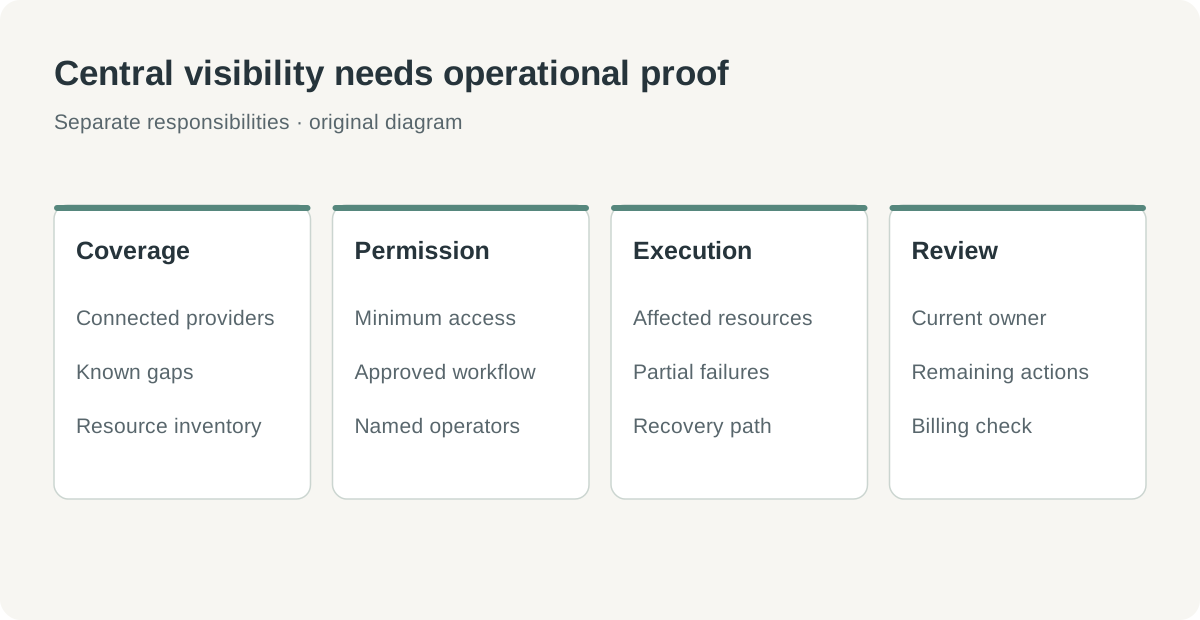 Original evaluation diagram: central visibility becomes operational control only when supported permissions, verified execution and remaining gaps are clear.
Rollback needs equal care. Restoring a workflow definition is different from reversing a completed provider action. Some changes require a compensating action, a new authorization or manual recovery. Ask the vendor to demonstrate the relevant failure and recovery cases using the exact integrations that matter to the organization.
The audit trail should answer a colleague's next question
An execution record is useful when another administrator can connect it to a business event. The record should make the initiating request, affected identity, selected workflow and resulting provider changes understandable together. A list of successful API calls leaves too much interpretation to the person investigating a complaint the next day.
For the departing employee scenario, imagine the manager reporting that a daily summary stopped arriving. The administrator should be able to determine whether the agent was intentionally retired, transferred but paused, or left partially configured after an error. Each explanation leads to a different repair. Good evidence shortens that diagnosis and reduces the temptation to restore broad access just to make the symptom disappear.
Include this investigation in the pilot. Give a colleague the execution record without narrating the run, and ask them to identify the current owner and the remaining action. If they cannot, improve the workflow's naming, documentation or reporting before increasing its scope. Administrative automation succeeds when it is understandable during an interruption as well as during a clean demonstration.
Begin with one provider and one departure scenario
The announcement says the October capabilities were available to BetterCloud customers that day. Existing customers can therefore begin with a scoped account discussion and a covered integration, while prospective buyers should request a demonstration against their own requirements. Availability of the platform does not establish that a particular tenant has all the desired permissions configured. BetterCloud, October 29, 2026.
- Inventory one team's known agents, owners, purposes and connected tools. Include a small set of resources whose correct state can be independently checked.
- Confirm which provider objects and lifecycle actions the current connector supports. Record the resources that remain outside its coverage.
- Choose a test identity and low-impact agent in an appropriate test environment. Define the desired transfer or retirement outcome before building the workflow.
- Review the connector's administrative permissions and separate routine operators from people allowed to change the workflow itself.
- Run the agreed scenario, then inspect both execution history and the provider's resulting state. Check that access removal and ownership changes actually took effect.
- Introduce a controlled failure, such as an unavailable test resource, and verify how partial completion is reported and recovered.
- Compare connected spending with the organization's billing records over a defined period. Reconcile ownership gaps before expanding automatic actions.
Keep the first success criterion narrow. “The test departure transferred this agent, removed these permissions and exposed this failed step” is concrete. “We now govern AI” is too broad to establish what the team can rely on tomorrow morning.
The next responsibility is the agent's entire lifetime
The release's practical ambition is to make an agent governable beyond the moment it is created. An organization needs to know why it exists, what it can reach, who pays for it and what happens when its purpose or owner changes. That is ordinary operational work, even when the system performing the task is new.
Our expectation is that teams will get the most value by treating ownership and cost as part of one continuing record. A spike in spending can lead to a purpose review; a role change can lead to a permissions review; a retired project can lead to a verified shutdown. The record becomes more useful each time it explains a real decision.
The question after an employee leaves should have an answer before the next automated job runs. A useful agent lifecycle is the ability to keep the intended work and retire the unintended access.
Sources
- BetterCloud: AI spend tracking and agent lifecycle management release, October 29, 2026; checked November 2, 2026.
- BetterCloud: AI Governance arrives, August 28, 2026; checked November 2, 2026. This is the earlier discovery/interface context.
Keep a governance decision connected to its source
Telli.sh is one option for retaining authorized source material and the notes behind a governance decision. Create a note workspace.