AWS can give your agent a cited answer in one call. Does the link back it up?
Amazon Bedrock AgentCore Web Answer combines search, retrieval, and synthesis. A support workflow shows how to check the evidence without rebuilding the search stack.
A customer asks whether a software version still receives security updates. A support agent produces a confident answer and links to the vendor's documentation. The link opens. It even belongs to the right domain. The catch is that the page describes the newest version, while the customer is running the previous one.
AWS made Web Answer generally available on Amazon Bedrock AgentCore on November 5, 2026. Bedrock AgentCore is AWS's infrastructure for running and connecting AI agents. Its new managed connector can search the public web, read pages, and produce a synthesized answer with citations from one tool call. AWS lists the connector in US East (N. Virginia), or us-east-1. The result can save work for teams that used to build these steps separately. It also gives them a concrete object to review before sending an answer to a customer. AWS launch and walkthrough · AWS connector documentation
Version support, release dates, and revised instructions are good tests for this kind of tool. Each question has a useful answer when the right source exists. Each also gives a search system plenty of opportunities to return a relevant page that supports a different claim. Here's how to make the connection between the answer and its evidence visible.
AWS data-center buildings in Ashburn, Virginia, photographed in 2020. Regional context photo by Vahurzpu, cropped and resized, CC BY-SA 4.0. Image source · License.

One tool call does several jobs
AWS offers two related connectors. Its Web Search Tool returns ranked results with details such as titles, links, snippets, and publication dates. The caller decides which results to examine and how to turn them into an answer. Web Answer takes a natural-language question, plans its own searches, reads relevant pages, and returns text and citations. The difference matters when deciding which stage your team wants to own. AWS Web Answer and Web Search comparison
When a support assistant needs to answer one factual sub-question inside a larger workflow, the synthesis can remove a round of orchestration. Instead of feeding a model twenty snippets and asking it to pick the useful ones, the application can ask for a cited statement about a single version or policy. When a reviewer needs to compare competing articles, inspect the spread of results, or explain why one source outranks another, the raw search route leaves more decisions visible. Teams can use both paths for different questions in the same application.
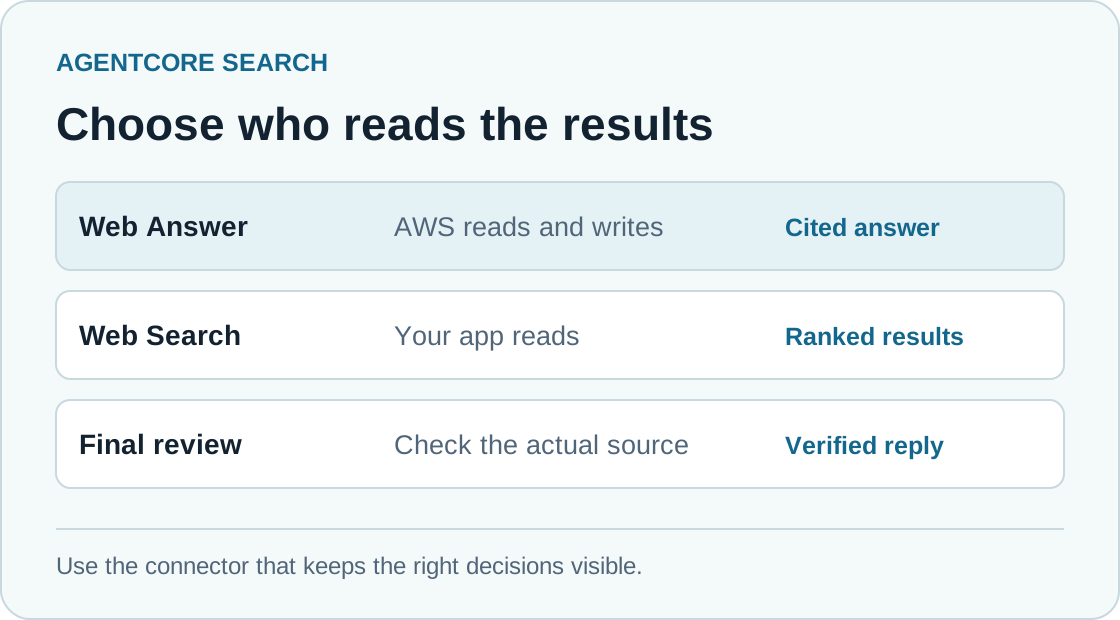
Two ways to use search in the same support workflow. The Web Search route leaves reading and synthesis with the caller. Original illustration by Telli.sh.
The connector is exposed through AgentCore Gateway as a Model Context Protocol tool. AWS documents a result with text and a structured answer list. Each answer block can include its own citations, with a URL and a domain when available. When the tool returns an error, the response marks isError. AWS requires applications using Web Answer results in end-user outputs to retain and display the source citations and links. Keep the block-to-citation association as the answer moves through the interface. Joining all citations into an undifferentiated footer makes review harder even if the text still looks sourced. AWS response format and acceptable use
| Question | Web Answer is useful when | Ranked search is useful when |
|---|---|---|
| Is a product version supported? | One public status and its evidence are needed in a support reply | Several editions or contradictory lifecycle pages must be compared |
| Which releases mention an issue? | The agent needs a concise result for a named release | The reviewer needs to see all candidate release notes and decide which matter |
| Has a policy changed? | The assistant can ask about a defined date or region and present the supporting passage | An analyst needs to trace policy versions and independently assemble the timeline |
Give the tool a question with boundaries
Consider a fictional vendor called ExampleSync. The customer says they have ExampleSync Server 4.2 running under the standard support plan in Germany. A useful question asks whether security updates for that version and plan are still available on the date of the inquiry. It asks for the governing lifecycle statement, a source URL, the effective date, and an explicit indication if the cited pages apply to a different product or edition. It does not need the customer's name, account number, license key, or private correspondence.
This framing separates the support decision from the evidence request. A question such as “Can I tell this customer they are supported?” can invite the system to reason about the whole relationship. A question about the published lifecycle for a named release gives a reviewer something specific to check. If the public schedule is silent about a private maintenance contract, the answer can point the support worker to the contract channel for the remaining decision.
The current connector documentation describes domain controls, published-date filters, and a country hint for version 1.1.0 and later. An agent can include domains such as the vendor's documentation and support sites. AWS also documents target-level domain controls, which let the gateway apply boundaries without leaving all domain decisions to a user-supplied prompt. The country setting refines search results. A result still needs to identify the right locale or contract if geography determines the outcome. AWS filtering configuration and input schema
A narrow domain policy helps avoid reposts, but it can make a result incomplete when the vendor spreads its material across multiple sites. A narrow published-date filter can miss a lifecycle document from two years ago that is still authoritative. Conversely, an up-to-date page can describe a date that has yet to take effect. Treat the page's publication date, any stated effective date, and the date you checked it as different values. If the results contradict one another, retain the conflicting sources and give a person a way to decide which governs.
Follow the citation all the way to the sentence
For a support workflow, a citation is a pointer to evidence. Start by opening the page cited for the decisive claim. Verify that its title and language are appropriate, then locate the passage. Match the product name, version, edition, and region. If the answer contains a date, read the line or table that states it. A general explanation of an end-of-support policy may be correct while doing nothing to establish an individual version's date.
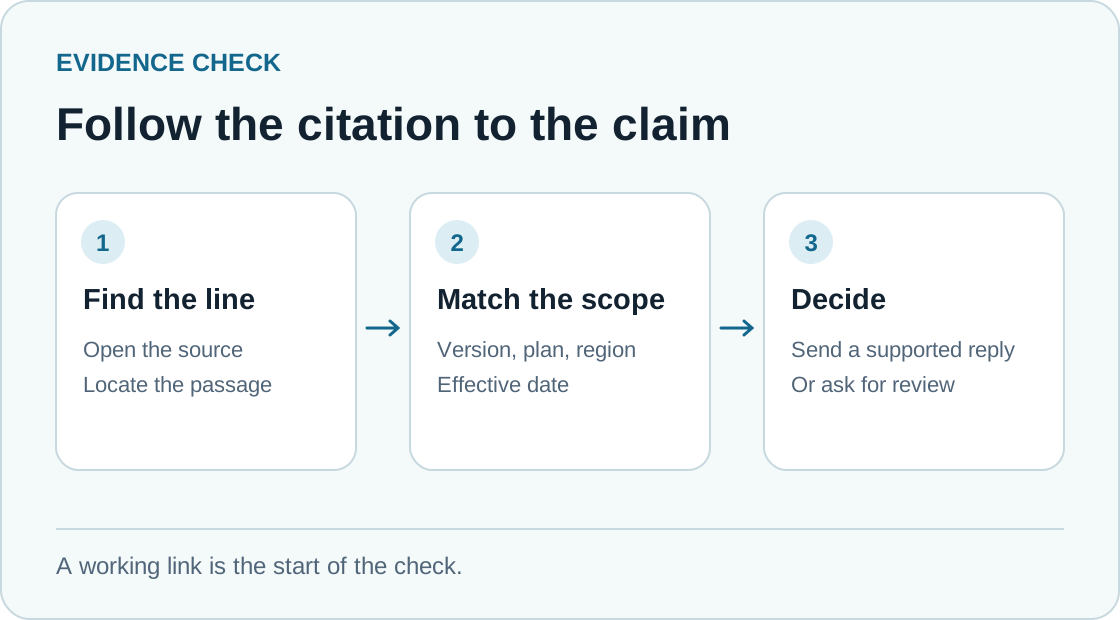
A reviewer checks the actual passage and its scope before deciding how to use an answer. Original illustration by Telli.sh.
Suppose the result says that version 4.2 receives security updates through December. Its source is a vendor lifecycle page, but the source table has separate rows for Standard and Extended Support. Standard ends in September and Extended ends in December. A reviewer should catch the discrepancy even if the link loads and the cited date appears on the page. A robust interface leaves the citation attached to the disputed claim and makes it easy to flag the plan mismatch.
Sometimes the problem is a missing distinction in the question. If the user has not supplied the edition, the safest next step can be a follow-up question. Sometimes the evidence is incomplete. A general product overview might fail to say which version a feature applies to, or a release note might refer to a staging rollout without indicating general availability. A useful interface can say what was found and what remains open without asking the user to interpret a row of unexplained links.
| Check | Ask the reviewer to identify | What to do on failure |
|---|---|---|
| Source authority | The organization or team responsible for the claim | Look for the publisher's own lifecycle or release record |
| Evidence match | The exact sentence or table cell that supports the answer | Narrow the claim or send it for review |
| Scope | The matching product version, plan, and applicable region | Ask the user for the missing qualifier |
| Timing | The effective date and any superseding notice | Show both sources or route to the responsible team |
Do the same exercise for a question where the right result is uncertainty. For example, ask about a version that does not appear in the lifecycle schedule. The expected outcome is a clear explanation that the public documentation does not establish a status, plus a useful next step. That test helps a team see whether it is measuring the ability to answer and the ability to recognize when it should hold an answer back.
Make the first integration easy to measure
- Use a test gateway in the documented region. Follow the AWS guide to attach Web Answer and grant the gateway service role the documented permission to invoke the connector. Grant the caller the separate gateway invocation permission appropriate to the test. Use a test account or an isolated environment already approved for billable requests. AWS setup walkthrough
- Build a small question set before tuning prompts. Include a current answer, an outdated but relevant document, a plan-specific answer, a question with competing sources, and a question with insufficient public evidence. Write down what a good answer should do in each case.
- Start with test questions and published documentation. Pass the domain and date constraints only where they have a clear purpose. Inspect the structured answer blocks, retain their source links in the display, and give reviewers a way to compare the text to the original page.
- Compare with the current manual workflow or the ranked-result connector. Record the number of supported claims, answers withheld for good reason, and questions reviewers had to reopen. If possible, time from question submission through final approval so the comparison includes human review.
- Set a fallback for tool errors, missing sources, and timeout conditions. Let the support worker open the official documentation or send the case to a teammate. Record a narrow reason code for diagnosis and follow the organization's retention and access rules for the original ticket.
AWS's November 5 walkthrough lists Web Answer at $10 per 1,000 tool calls. Under that example price, 100 calls have a $1 Web Answer line item and 250 have a $2.50 line item. Gateway usage, the calling agent's model, and any repeated calls are separate considerations. The distinction is useful because the unit to compare in support is a usable, verified response. A short answer that takes three revisions and several minutes of manual source checking can cost more to operate than a slower answer accepted on the first review. AWS walkthrough pricing
Track that time and the most common failure reason before expanding coverage. If most failures come from edition mismatches, add an explicit edition field to the question form. If stale pages are the main issue, identify the vendor's canonical policy and learn how updates are published. If useful sources are frequently outside the include list, revise the gateway's policy with the support owner. Each change addresses a different cause.
Compare those results separately for straightforward and contested questions. If nineteen routine questions are accepted immediately but the twentieth combines two conflicting regional policies, a single average will hide where a reviewer still needs time. Record the reason each case went to review and the time spent there. Use the same cases after a change to the connector settings. The point is to see whether the revised policy makes more answers usable while still sending uncertain cases to the right person.
The practical gain is the time between a well-formed question and an evidence packet a reviewer can act on. AWS supplies the search and synthesis in one request. A support team gets value from specifying which evidence counts and giving its staff the path to open it.
Sources
- AWS general availability announcement, November 5, 2026
- AWS Web Answer walkthrough and public demo, November 5, 2026
- AWS Web Answer connector, filtering, response schema, and acceptable use
- AWS Web Search Tool connector
- Context photograph by Vahurzpu, CC BY-SA 4.0
For a searchable record of the questions, source checks, and decisions that come up in support reviews, Create a Telli.sh account.