Baseten joey-1 asks whether every AI decision needs a large model
A 2B decision model, a $0.01-per-million-input-token API, and a practical way to route uncertain work to larger models or people.
“Which team should handle this ticket?” rarely needs a five-paragraph answer. It needs one of a few valid destinations, enough confidence to choose responsibly, and a way to ask for help when the request does not fit.
Baseten introduced joey-1 on October 29, 2026 for that kind of work. Built by its Base Labs research group, the model sits at the small end of a decision-model family alongside elephant-1 and mammoth-1. Its appeal is a narrower output contract: decisions and probabilities rather than a generated explanation that an application must interpret. Baseten's announcement presents the launch.
The practical opportunity is a different division of labor. Let a small model handle well-defined, repeated decisions; spend more on the uncertain remainder. This guide explains the price arithmetic, three illustrative applications, and the checks that make such a routing strategy useful.
 Baseten’s official joey-1 model-card banner. Image: Base Labs / Baseten, from its MIT-declared model repository; resized with margins. Image source · License and image notes.
A decision model starts with the choices your application can accept
A general language model can classify a request by writing “billing,” returning JSON, or explaining why a customer deserves a refund. Each interface has its place. A dedicated decision model focuses on choosing among supplied answers and reporting probabilities in structured form.
That changes the work you do before inference. You need a precise question and options that describe meaningful actions. “What should we do?” is a weak contract. “Which of billing, technical support, or fraud should receive this case?” is narrower, although it still needs a policy for requests that match several teams or none.
Baseten's joey-1 model library page, checked November 2, documents text and image inputs, choice questions, yes/no decisions, and ordered scoring through /v1/systemone. The result is intended for programmatic use. It is not a substitute for a separate explanation or response generator when the user needs one.
Think of the small model as a sorting desk. Its value comes from moving ordinary work to the right place while sending unusual cases to someone with more authority or context. A desk that confidently misroutes difficult cases creates hidden work downstream, even when each inference is cheap.
This is why the application should preserve uncertainty. A routing system can record a tentative label, ask a clarifying question, or hand the item to a person. It does not have to turn every probability distribution into an immediate business action.
One cent buys input tokens, not a fixed number of decisions
As checked November 2, 2026, the official pricing entry lists $0.01 per 1 million input tokens, with cache input and output listed at $0.00. “A penny” refers to that token unit. A request containing a long history costs more input processing than a short, carefully scoped request.
Here is illustrative arithmetic at that published input rate, before taxes, other services, or commercial terms. It assumes uncached input and a stable price; it is a planning example rather than an invoice estimate.
| Illustrative workload | Total input tokens | Input charge at $0.01 per million |
|---|---|---|
| 100,000 requests × 500 tokens | 50 million | $0.50 |
| 1 million requests × 500 tokens | 500 million | $5.00 |
| 10 million requests × 500 tokens | 5 billion | $50.00 |
| 1 million requests × 2,000 tokens | 2 billion | $20.00 |
The formula is simple: total input tokens divided by 1 million, multiplied by $0.01. The operational calculation is larger. Include the cost of any escalations, data preparation, retries, monitoring, and manual correction.
Suppose two routing configurations differ by a few dollars in model usage. One sends fewer cases to review but occasionally directs urgent requests to a slow queue. The second escalates more requests and avoids that error. The right choice depends on the cost of the mistakes and the available reviewer capacity, not merely the cheapest token bill.
That argument becomes stronger as inference gets cheaper. Once model usage is a small part of the workflow's total cost, a modest improvement in calibration or label design can matter more than another reduction in token price. Cheap inference expands the range of viable automation; it does not remove the need to value outcomes.
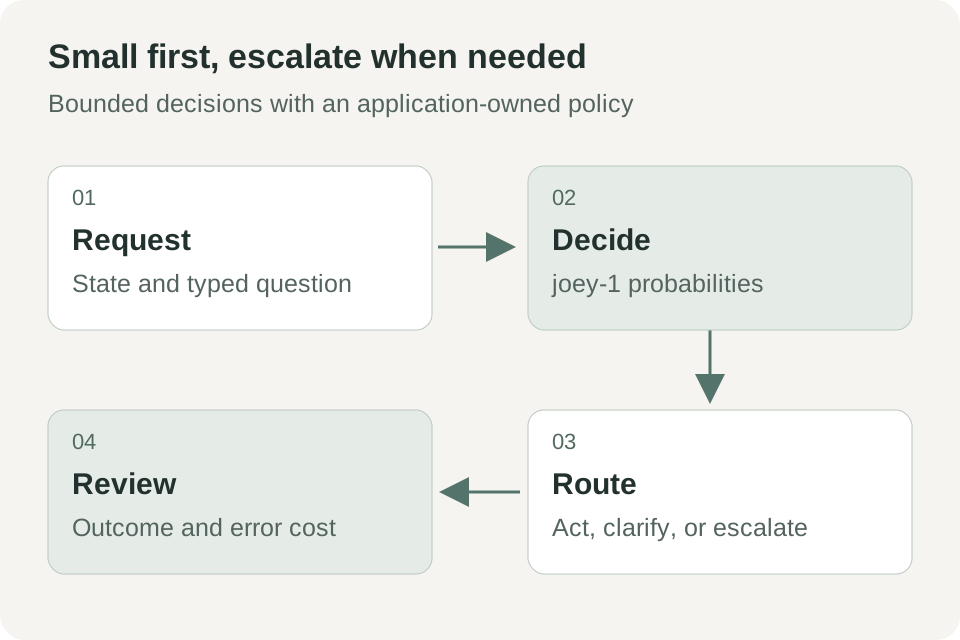 Original routing diagram, inspired by the escalation approach in Baseten's October 29 announcement. Thresholds belong to the deploying application.
Ticket routing is a good first task when labels have owners
In an illustrative support workflow, joey-1 assigns incoming messages to billing, technical support, or account security. A separate yes/no question checks whether the customer is requesting a refund. An ordered score identifies how urgently the case needs attention.
These are related questions, but they should not be collapsed into one label. A billing request can also be urgent. An account-security request can contain a refund demand. Keeping the decisions separate makes it easier to define what each team receives and which combinations require special handling.
Begin by writing the labels with the people who own the queues. Include examples of cases that caused disagreement in the past. Decide how to handle a message that mentions a payment failure caused by a software bug. The model cannot resolve an organizational ambiguity that the organization has left undefined.
For rollout, compare recommendations with existing decisions before moving work automatically. Review disagreements by category: ambiguous policy, missing context, clear model error, or an incorrect historical label. A single aggregate accuracy percentage hides these different problems.
Baseten's October 29 announcement positions joey-1 as a first-line model with larger siblings available for uncertainty. It reports a 20-millisecond P50 end-to-end latency for an average 2,000-token request under its production serving conditions. This is a vendor measurement of a particular service workload, rather than a latency guarantee for your application or hardware. Source: Baseten.
A document router should recognize when the destination is missing
A second illustrative use case is document intake. An application receives a file and needs to decide whether it belongs in an invoice workflow, an expense review, or a general records queue. Text and optional image input can make the model relevant to mixed document material, provided the submitted representation contains the information the task needs.
Define the actual decision narrowly. Checking whether a page appears to be an invoice is different from verifying that the invoice is authentic, legally sufficient, or payable. A classifier can help choose a workflow without receiving permission to approve a payment.
The most valuable test cases may be the ones outside the taxonomy: a receipt attached to a contract, an image too blurred to read, or an unsupported language. If the application only offers three valid destinations, it needs another mechanism for incomplete evidence and unfamiliar content. An explicit review path is easier to operate than a forced guess.
Also track changes in the input population. A model that sees mostly short domestic invoices during evaluation may later encounter multipage statements and scanned correspondence. Monitoring only the final selected label can miss the shift. Record request length, input type, uncertainty, and review outcomes at an appropriate level of privacy.
The published model card, checked November 2, describes joey-1 as a 2B-parameter model post-trained from Qwen3.5-2B and lists an MIT license. Those facts support an open-weight deployment option. They do not establish a universal memory requirement, CPU performance, or permission to reuse every illustration from the announcement.
Image checks become useful when the condition is observable
For a third scenario, imagine checking submitted product photographs before they enter a manual catalog review. Useful questions might ask whether a label is visible, whether the image contains the requested object, or whether the photograph is too obstructed to judge. Each question should name something that can be observed in the supplied image.
An unhelpful rubric mixes observation with hidden facts. “Is this a trustworthy seller?” cannot be answered from a product photograph alone. “Is the requested serial-number area visible?” is narrower and gives the next workflow a concrete reason to request another image.
Ordered scoring can be useful when reviewers already share a rubric, such as unusable, needs review, and usable. Write the criteria in terms a reviewer can apply consistently. If two adjacent levels are indistinguishable even to people, a probability distribution will not fix the taxonomy.
Use the model to prioritize review before allowing automatic rejection. Rejected submissions can affect customers directly, and the cost of a false rejection may exceed the savings from automation. A review stage also supplies examples for refining the rubric and checking whether performance differs across input conditions.
These are illustrative designs, not reported joey-1 deployments. Their common feature is a bounded question followed by a reversible next step. That is a sensible place to learn how the model behaves on your data.
Probabilities need a policy before they become actions
A confidence value is not a permission flag. If the application chooses to act above 0.90, that threshold is a design choice whose consequences need measurement. A high score can still be wrong, especially when the request differs from the data used to establish the threshold.
Different errors deserve different policies. Routing an ordinary question to the wrong support team is inconvenient. Treating an account-takeover report as routine can be much more costly. The same probability threshold should not automatically govern both tasks.
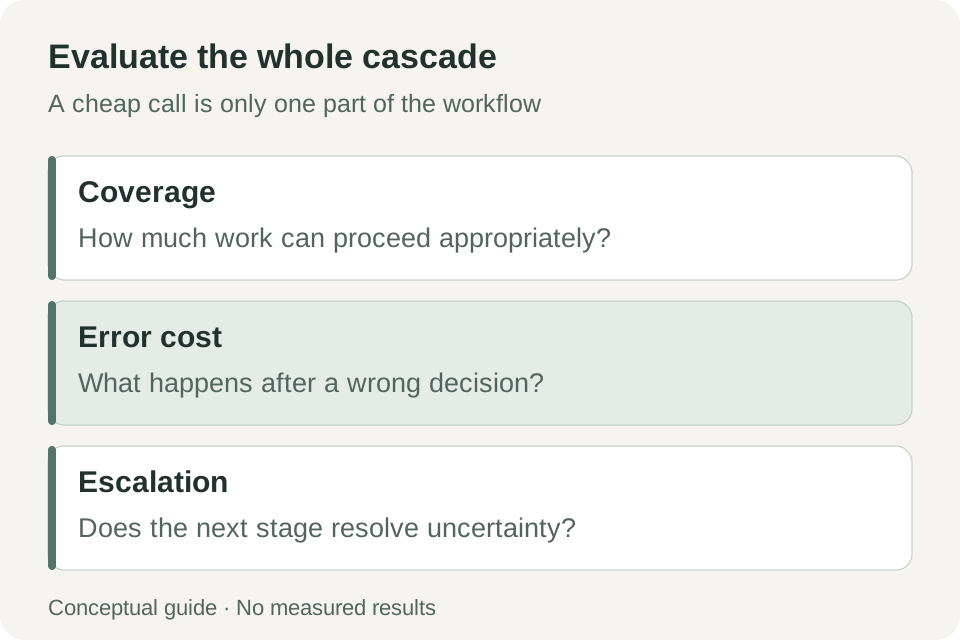 Original evaluation framework. Coverage, wrong-action cost, and escalation quality are application metrics; the diagram reports no measured joey-1 results.
Build a held-out set with representative ordinary cases, difficult cases, and out-of-scope inputs. For each proposed threshold, inspect the fraction handled automatically and the errors within that fraction. Then examine what happens to the rest: a model that avoids errors by escalating almost everything may leave the workflow unchanged.
Compare the whole cascade with a larger model used alone. The small-first design adds a routing stage, which has its own failure modes and latency. It wins when enough requests can be handled appropriately at the first stage and the escalation path improves the hard remainder.
Begin with the hosted API, or budget explicitly for self-hosting
Baseten offers hosted Model APIs, dedicated deployments, and downloadable weights. Their context and serving conditions should be checked separately. The launch post describes 16k context for Model APIs and a 262k dedicated-deployment option, while the model card specifies a 16,384-token trained sequence length and refuses requests beyond its trained limits. There is no single maximum that should be copied indiscriminately across paths. Launch post, model card.
- Pick one decision contract. Name the valid options, the meaning of each, and what the application does when evidence is insufficient.
- Choose a deployment path. For a hosted pilot, open the model's API entry and create credentials in the provider's account interface. For local serving, follow the model card's pinned runtime requirements.
- Send a minimal request. The official API example uses
https://inference.baseten.co/v1/systemonewith astate, typedquestions, and the model identifierdecision-models/baseten-joey-2b-latest. - Validate the structured response. Reject malformed or unavailable results, preserve the probabilities needed for evaluation, and keep routing policy in your application.
- Run a shadow evaluation. Compare recommendations with reviewed outcomes before enabling automatic actions.
- Add and measure escalation. Route uncertain or consequential cases to a larger model or a person, then inspect the outcome of the entire path.
The model card documents a self-hosted setup requiring a CUDA GPU and a pinned serving environment. “2B” describes the model scale; it is not a promise that any laptop has enough memory. Include runtime overhead, image processing, concurrency, and context length when sizing a deployment.
An API pilot can answer the product-fit question before you invest in that infrastructure. Self-hosting becomes a separate decision about control, utilization, operational effort, and total cost. Open weights make that choice available; they do not make it automatically economical.
A replay set protects the workflow when models or prompts change
Keep a versioned collection of reviewed requests once the first pilot works. Include ordinary cases, costly mistakes, and examples where the correct answer is to ask for help. Preserve the question wording and option descriptions beside the expected outcome, using data you are authorized to retain.
When you change a prompt, threshold, or serving configuration, replay that collection before expanding traffic. A gain in one category can hide a regression in another. For instance, more decisive routing may reduce review volume while increasing mistakes on short, ambiguous messages. The overall average alone cannot explain that tradeoff.
Record the actual model identifier and serving path used for each evaluation. If a deployment follows a moving latest identifier, establish how you will notice behavioral changes and revisit acceptance. A stable application schema does not guarantee identical decisions forever.
Also exercise service failure. A timeout, unavailable model, or invalid response should enter a defined recovery path rather than silently choosing a default team. The default is itself a business decision, and it may be inappropriate for sensitive requests. A reliable small-model system handles unavailable answers as deliberately as confident ones. That operating discipline matters even when the normal request costs a fraction of a cent.
Small models make the quality of the decision boundary more visible
Our take: joey-1 is most interesting where an application has already defined its choices clearly. Cheap, quick decisions can move a large volume of work, but a poor taxonomy simply moves mistakes faster.
The valuable question is how much work the system can handle correctly within a known scope, and how well it handles the rest. A small model earns its place when the escalation path is part of the product, rather than a footnote after the price.
Sources
- Baseten: Decisions for a penny, introducing joey-1, October 29, 2026.
- Baseten joey-1 model library and API example, checked November 2, 2026.
- Base Labs joey-1 model card, checked November 2, 2026. Benchmark entries are publisher-reported; its Artificial Analysis entry is identified as an internal replica.
Keep your review connected to its source
Telli.sh is one option for retaining authorized source material and the notes behind a technical decision. Create a note workspace.