A thousand security alerts, one reachable database: AWS Continuum changes the queue
AWS Continuum for code vulnerabilities is generally available. Its useful promise is evidence about exploitability and business impact before a team spends another day reviewing generated fixes.
A security dashboard shows hundreds of findings. One sits in a utility that never receives outside traffic. Another is a few steps from the system that holds customer payment data. A severity label alone does not tell a small engineering team which one to fix first.
On October 22, 2026, AWS announced the general availability of Continuum for code vulnerabilities. The service connects code analysis with environment context, evaluates exploitability and business impact, and proposes fixes for review. Its detailed launch article places a person before the final remediation decision. AWS launch announcement.
AWS is the cloud infrastructure provider behind services such as EC2 and S3. That background matters here because a code weakness becomes more or less urgent depending on the network, resources and data around it. Continuum's interesting claim is a better-informed repair queue, rather than simply another way to generate a patch.
 AWS data centers in Oregon, August 2023. Photo: Tedder / Wikimedia Commons, CC BY-SA 4.0. Resized and converted to WebP without cropping. This external background photograph does not show the Continuum interface; see the official product announcement and screens.

A vulnerability becomes an incident through a path
A scanner can identify a dangerous function or a dependency with a known weakness. Whether an attacker can use it depends on additional facts. Is the vulnerable code path actually used? Can an external request reach it? Which permissions and data become available if the request succeeds?
Those questions connect application security with the way the system is deployed. A development-only tool and an exposed service may share a vulnerable component while presenting very different risks. Conversely, an issue with a less alarming generic score may deserve immediate attention if it leads directly to an important system.
Continuum's launch describes a context graph built from code and, when configured, AWS environment information collected through an authorized collector. It uses that context to relate findings to resources and business-critical systems. Context and collector workflow; service overview.
Our take is that this makes prioritization the central product question. An AI-generated fix is useful only if the team understands the issue well enough to review the change and decide when it should ship. More automated output does not help if it expands an already unmanageable review queue.
The queue is like a waiting room. Sorting everyone by the loudness of the alarm is less useful than understanding which condition is urgent, what evidence supports that judgment and what treatment would change. A security service earns trust by making that reasoning inspectable.
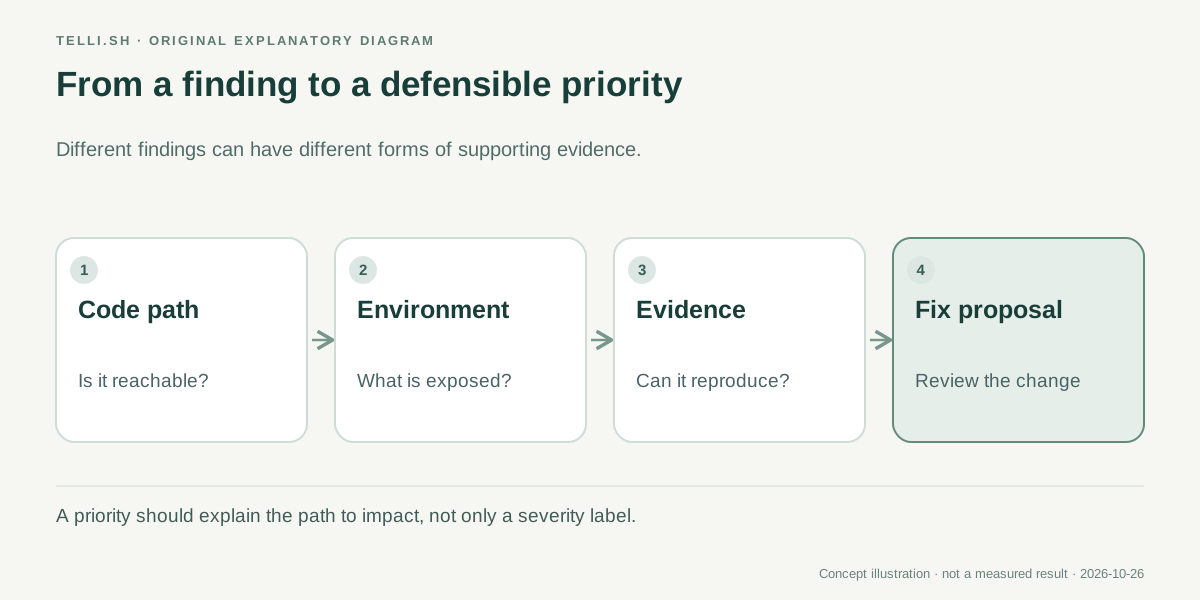 Original explanation of an evidence-led review path. Not every finding has the same kind of proof or can be reproduced in the same way.
Evidence levels matter more than a confident explanation
AWS describes several forms of supporting evidence. A finding may be established through static analysis of a code path. For issues the service can reproduce, it can use an isolated sandbox and attach proof-of-concept code and reproduction steps. The distinction matters: a plausible narrative about exploitation is not the same thing as a reproduced exploit.
The launch walkthrough also makes a useful distinction between producing a patch and resolving an issue. Continuum can open a pull request, but the team must review and merge it. The presence of a generated change does not itself mean the vulnerable service has been repaired in production. Launch walkthrough and review flow.
A reviewer should be able to answer several concrete questions from the evidence. Which input reaches the vulnerable operation? What assumptions does the proof make about authentication or permissions? Does the proposed change remove that path without breaking a legitimate use?
It is useful to keep those questions separate from the writing quality of the report. A clear explanation can help a team review faster, but clarity is not independent validation. The supporting code, configuration and reproduction conditions still carry the technical claim.
In a pilot, include examples where exploitation should fail. A service behind an effective control, an unused dependency path and an issue already mitigated by a configuration change can help reveal whether the tool understands context or simply repeats the original scanner's severity.
A payment service and a development tool need different decisions
Consider an illustrative application with a public checkout service and a private report generator used only during development. Both contain findings that look serious in isolation. The checkout service handles requests connected to customer transactions; the report generator has no intended production role.
An evidence-led review would first establish the actual deployment facts. It would check whether the supposedly private utility is reachable, whether the checkout issue crosses a real trust boundary and what data or operations become available through each path. The description in a team's architecture document should be tested against the deployed configuration.
If the checkout path is confirmed, the proposed fix still needs a bounded change. A patch that blocks a malicious request but also rejects valid orders has moved the problem rather than solved it. Regression checks should cover the legitimate behavior the team intends to preserve.
If the development tool is truly absent from the deployed application, the team may schedule its repair differently. That is not a reason to ignore the issue forever. It is a reason to distinguish immediate exposure from maintenance work and to retain the evidence that supports the distinction.
This example is a way to frame an evaluation, not a reported customer result. The important outcome is a repair order the team can defend with current information. A tool that agrees with every existing priority provides less insight than one that explains a surprising but verifiable difference.
The first rollout should inspect one application, not authorize every fix
Continuum's general-availability announcement identifies US East in Northern Virginia and US West in Oregon as its initial regions. It describes connecting a code source through GitHub or S3 and optionally adding AWS environment context with a collector. Account, region and access requirements remain part of the setup. Availability and source requirements.
For a team considering a trial, an appropriate starting point is an application whose architecture and important workflows are already understood. That makes it easier to notice both an unexpected finding and a missing assumption. It also gives the people reviewing the result a baseline for what the service should consider critical.
- Select the repository or supported source and identify the application environment it actually represents.
- Read the current service requirements, choose a supported region and review the access needed for the code connection.
- Decide whether to add an authorized AWS collector and which environment context it should supply.
- Compare the first findings with known issues, known mitigations and deliberately selected difficult cases.
- Inspect the evidence behind one proposed repair, including assumptions and the likely effect on legitimate users.
- Review the pull request, run the relevant checks and verify the deployed outcome through the team's normal release process.
This is a proposed evaluation sequence. It does not replace the product's current setup guide or the organization's deployment rules. The useful habit is to keep source access, evidence review and release approval as distinguishable decisions.
The cost calculation should follow the same logic. A team needs to understand the current pricing and the amount of work it plans to scan. It should also count the reviewer time spent accepting, rejecting or correcting a proposal. A generated patch that saves coding effort can still create review effort elsewhere.
A repair proposal and an autonomous repair are different milestones
The detailed launch article says remediation starts with a proposed fix that a person approves. It describes wider autonomous application of selected fixes as a future capability. Other AWS product wording discusses progressive enforcement more broadly. For a team making a deployment decision, the conservative and actionable starting point is the documented human-reviewed path. Detailed launch description; What's New announcement.
That distinction is not a minor wording issue. Automatically preparing a patch, automatically opening a pull request and automatically changing a running system have different consequences. A product demonstration of one stage should not be treated as evidence that every later stage is enabled or appropriate.
| Stage | What the team can learn | What remains to establish |
|---|---|---|
| Finding | There is a suspected weakness | Whether the relevant code and configuration are actually used |
| Evidence and context | Why a path may be exploitable and important | Whether the assumptions match the current environment |
| Proposed patch or PR | A concrete change is available to review | Whether it fixes the issue and preserves intended behavior |
| Merged and deployed change | The running system has received an approved change | Whether the vulnerable path is closed without a new regression |
This separation helps teams use automation incrementally. A service may be valuable as a source of evidence before the team is ready to accept its patches routinely. It may produce useful patches before the organization wants any form of automatic release.
The next evidence worth watching is how the service handles repeated operations in real environments. Does a previously accepted class of repair remain safe after the application changes? Can a reviewer see why an apparently similar finding receives a different priority? Can the system detect when the context it relies on is incomplete?
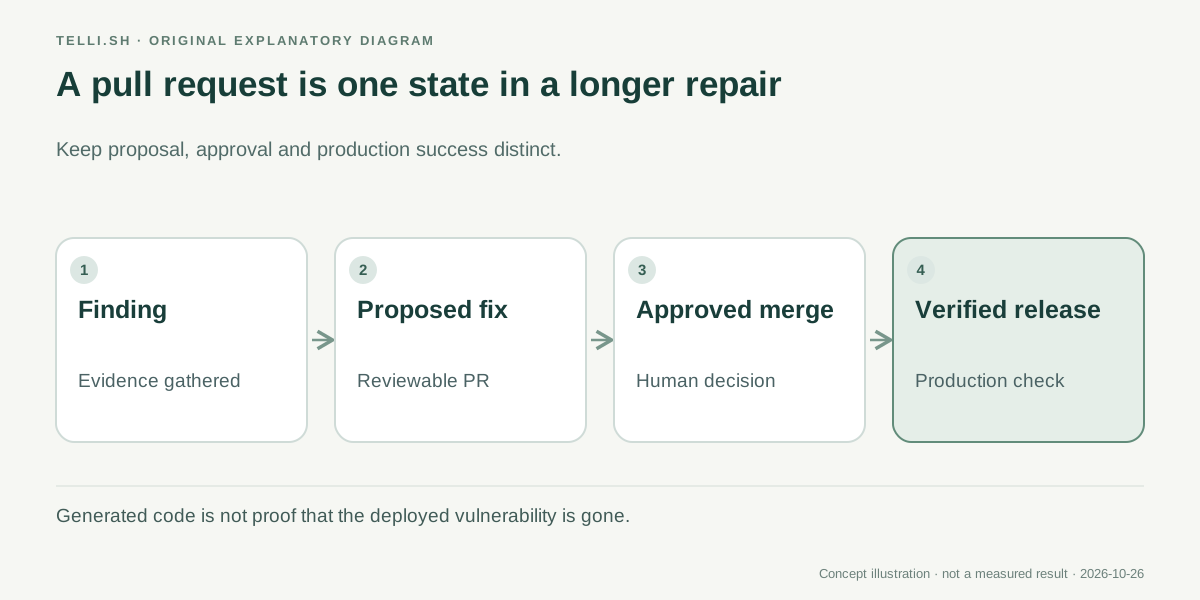 A generated PR is a reviewable artifact. Successful production remediation is a later state with its own evidence.
The context collector deserves the same scrutiny as the model
Better context can make a security judgment more useful, but the connection that supplies it becomes part of the system's operating assumptions. If the collector sees only some resources, the report may describe only part of the attack path. If the environment has changed, an earlier judgment may need to be revisited.
That is why a pilot should record which sources were connected and when they were current. A report should be interpreted in relation to that scope. It should not become a universal statement that an application is secure simply because one set of findings was reviewed.
The same principle applies to business impact. A database can be technically reachable while containing low-value test material, or appear peripheral while supporting a critical workflow. The business owner and the engineering team need a shared understanding of what the resource means.
There is a promising division of work here. Software can help connect large amounts of technical evidence and produce a concrete proposal. People can decide which system matters, whether the assumptions are right and what release risk the business is prepared to take.
An effective evaluation should measure both false alarms and missed priorities. Fewer alerts can look impressive even when important issues disappear from view. The goal is a queue that preserves the right work and gives reviewers a better reason to act on it.
The useful AI security tool makes the next decision easier to justify
Continuum's release is interesting because it connects AI-assisted repair with the context that tells a team whether the repair deserves attention. That is a more useful ambition than producing another pile of plausible code changes.
Before accepting a proposed fix, ask what changed in your understanding of the risk. If the answer includes a reachable path, inspectable evidence and a bounded repair, the tool has helped with the hard part. If it only supplies a confident paragraph and a new PR, the queue still belongs to you.
Sources
- AWS: Continuum for code vulnerabilities is generally available, October 22, 2026.
- AWS What's New: Continuum GA, October 22, 2026.
- AWS Continuum user guide, checked October 26, 2026.
Keep your review connected to its source
Telli.sh is one option for retaining authorized source material and the notes behind a technical decision. Create a note workspace.