Eight hours apart, one decision: the 10-minute async handoff
A practical handoff system for teams that end one workday as another begins. Learn the six fields an incoming teammate needs, why acknowledgement matters, how to write unambiguous deadlines across time zones, and how to test whether work can resume in ten minutes without a recovery meeting.
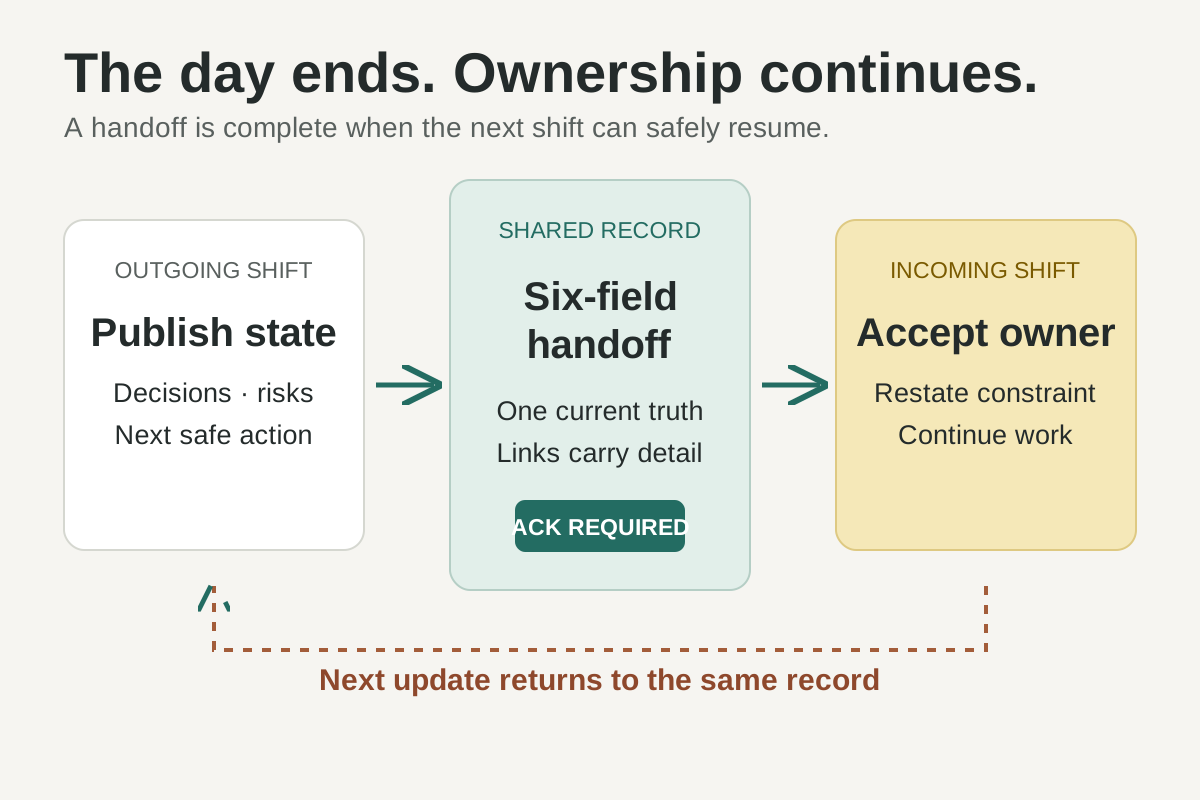
An original workflow diagram. A handoff is complete only when the next person can identify the state, the next move, and their ownership without replaying the previous shift.
Seoul finishes at 18:00. London still has most of its day. San Francisco has not started breakfast.
This arrangement is often sold as a 24-hour advantage: work can keep moving while each person sleeps. In practice, many distributed teams get a slower system. London spends its first hour reconstructing what Seoul changed, San Francisco asks for a clarification after Seoul has gone offline, and the next shared meeting repeats a decision that was already made once.
The time zones are not the failure. The handoff is. This guide defines a compact handoff that an incoming teammate should be able to understand and accept in 10 minutes: current state, decisions, evidence, next action, risks, and ownership. Ten minutes is a diagnostic target proposed for this guide, not a published industry benchmark. The guide also explains when text is insufficient and a short overlap call is the safer choice.
TL;DR:
- A status update describes activity. A handoff transfers responsibility. The second requires a named receiver and explicit acknowledgement.
- Write six fields in a fixed order: state, changes, decisions, next action, risks, and owner/time. Put the newest operational truth at the top.
- Never write “tomorrow,” “Friday EOD,” or a bare
09:00across time zones. For future local events, include the date, local time, and IANA zone such as2026-10-02 09:00 Europe/London.
Follow-the-sun fails at the seam, not the sun
Researchers gave the model a precise name before remote work became an ordinary job condition. In 2009, Erran Carmel, Yael Dubinsky, and J. Alberto Espinosa described follow-the-sun development as work handed from one site to another many time zones away, every day, with the intended benefit of reducing project duration. Their exploratory study also observed that the practice was rare and often misunderstood. IBM Research's publication record.
Their 2010 Journal of Management Information Systems paper frames the attraction clearly: work can continue around the clock. It also identifies the conditions that decide whether the model helps—calendar efficiency, handoff efficiency, and coordination within and between sites. The journal abstract lists 12 research propositions rather than promising a universal speedup.
That caveat matters. Three eight-hour workdays do not automatically become one uninterrupted 24-hour day. Every transfer introduces what we will call the restart toll: the time and error created when the incoming person must infer state, rediscover rationale, and locate the next safe action.
If the restart toll is 45 minutes at two daily boundaries, the nominal 24-hour pipeline loses 90 minutes before any new work begins. More importantly, the missing context can send the next shift in the wrong direction. A fast handoff into the wrong task is not continuity.
The objective is therefore not “more async.” It is resumability: can a qualified teammate continue the work without waiting for the previous shift and without making a hidden assumption?
A status update is not a transfer of responsibility
Many handoff failures begin with a message that looks perfectly reasonable:
Made good progress on checkout. API is mostly done.
There is a strange retry issue. Will look again tomorrow.
It reports activity, but the incoming shift cannot act from it. Which branch or environment changed? What remains incomplete? Is the retry issue reproduced or suspected? Should the incoming engineer investigate it, avoid the area, or continue a different task? Who owns the problem while the author sleeps?
A handoff has a different grammatical job. It transfers a live state and names the person or role responsible for the next interval.
Google's published SRE incident-management guidance makes the ownership transition explicit. It recommends a live incident document with the most important information at the top and says an outgoing incident commander should state the handoff clearly and remain until the incoming commander acknowledges it. Google SRE, “Managing Incidents”. An ordinary project is not a production incident, but the underlying rule travels well: responsibility is not transferred merely because information was sent.
This distinction also appears in a very different high-stakes setting. A prospective intervention study published in the New England Journal of Medicine on November 6, 2014 evaluated a standardized handoff bundle across nine academic hospitals and 10,740 patient admissions. Medical errors fell from 24.5 to 18.8 per 100 admissions, a 23% relative reduction, while preventable adverse events fell from 4.7 to 3.3 per 100 admissions, a 30% relative reduction. Oral handoff time did not change significantly: 2.4 versus 2.5 minutes per patient. The I-PASS study.
Do not import those percentages into software, design, or marketing work. The study concerned pediatric resident handoffs and a bundle that included training, observation, and sustainability work—not merely a template. The transferable lesson is narrower and still valuable: standardized written and oral elements, combined with training and acknowledgement, can improve handoff quality without necessarily making each handoff longer.
Six fields make work resumable
Use the same six fields in the same order for every operational handoff. Fixed order matters because the incoming reader should not spend the first five minutes learning how today's author organized the message.
- State now: the smallest accurate description of what is true at handoff time.
- Changed this shift: completed work, with links to the artifact or revision.
- Decisions made: settled choices and their rationale; link to the decision record.
- Next safe action: one concrete move the incoming person can begin.
- Risks and unknowns: failures, assumptions, blocked paths, and what must not be changed casually.
- Owner and time: who owns the next interval, when acknowledgement is due, and when the next checkpoint occurs.
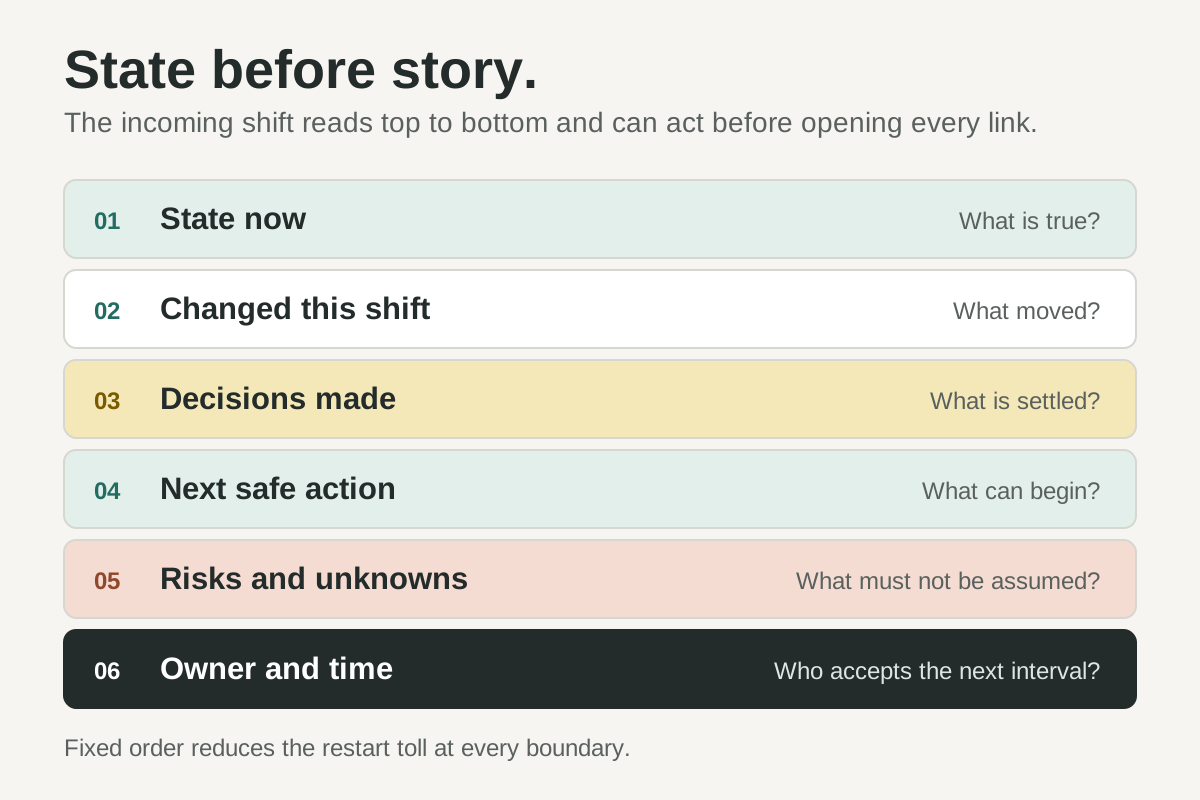
Figure 1: The incoming reader should find operational truth before narrative. Links carry the detail; the packet carries the state.
Here is the earlier message rewritten:
CHECKOUT HANDOFF · 2026-09-24T18:00+09:00 [Asia/Seoul]

STATE NOW
Retry endpoint is deployed to staging behind flag `checkout_retry_v2`.
It is off for all test accounts. Main checkout remains unchanged.

CHANGED THIS SHIFT
- Added idempotency key storage: PR #1842, commit 7ac2e91.
- Added 12 tests; 11 pass. The failing case is linked below.

DECISIONS MADE
- Keep retries server-side; do not add a client retry loop.
- Reason: duplicate-charge risk. Decision D-77.

NEXT SAFE ACTION
Reproduce test `retry_after_timeout` against staging with request ID logging.
Do not enable the flag.

RISKS / UNKNOWNS
- Unknown whether the gateway reuses the same request ID after a 30 s timeout.
- Test customer `acct_retry_04` may contain stale attempts.

OWNER / TIME
London on-call owns investigation after acknowledgement.
Please acknowledge by 2026-09-24 10:00 Europe/London.
Next checkpoint: 2026-09-24T14:00Z in issue #912.
The rewritten handoff is longer by roughly 100 words and shorter by an hour of archaeology. The incoming person knows what not to do, which test to run, where the code changed, why the architecture was chosen, and when ownership begins.
The next-safe-action field is the hinge. A broad instruction such as “continue investigating” leaves prioritization to someone who has the least context. A safe action should be reversible or clearly bounded, and it should produce new evidence even if it does not solve the problem.
Separate settled decisions from open questions
Time-zone teams often re-decide work because their handoffs mix three states: accepted decisions, proposals awaiting review, and unresolved questions. The morning reader sees a polished paragraph and assumes closure. The evening author wakes to find that a suggestion became implementation.
Use explicit state words. The four labels below are a suggested local vocabulary, not an external standard:
| Label | Meaning | What the incoming shift may do |
|---|---|---|
DECIDED | The authorized person or group selected an option | Execute within the recorded constraints |
PROPOSED | A recommendation is ready for review | Test assumptions; do not present it as policy |
OPEN | Evidence or authority is still missing | Gather evidence or escalate the named question |
SUPERSEDED | A later record replaced this choice | Follow the linked replacement |
This is stricter than ordinary prose because the cost of ambiguity rises with response time. A colleague in the same room can ask, “Did we actually decide that?” A colleague eight hours away may wait a full workday for the answer or proceed without it.
Every DECIDED line should carry three links or fields: who had authority, the short rationale, and the durable decision record. Every OPEN line should name the missing input and the person who can close it. “Pricing unresolved” is not enough. “OPEN: annual discount; Mina supplies churn-by-term data by October 2” is resumable.
GitLab's live communication handbook offers a public example of this documentation bias. As retrieved on September 24, 2026, it describes asynchronous communication as a starting point, asks teams to write down conclusions from offline conversations, favors public issues and merge requests over private messages, and directs decisions and discussions toward a single source of truth. GitLab Communication. This is one company's operating model, not controlled evidence that every company should copy its tools. The useful principle is that a conversation may happen anywhere, but its conclusion needs a durable home.
“Friday EOD” is not a time
Distributed work turns casual time language into defects. “Tomorrow morning” depends on who reads it. “Friday EOD” can describe a window more than 24 hours wide across Auckland, Seoul, London, and San Francisco. Even 09:00 PST is fragile: people use abbreviations inconsistently, and seasonal clock changes alter some regions while others remain fixed.
For a completed event, write an unambiguous timestamp with its UTC offset:
2026-09-24T18:00:00+09:00
RFC 3339, published in July 2002, defines an Internet date-time format that includes a numeric offset and gives examples such as 1996-12-19T16:39:57-08:00, which represents the same instant as 1996-12-20T00:39:57Z. RFC 3339.
For a future event tied to local civil time, include the date, local time, and IANA time-zone name:
2026-10-02 09:00 Europe/London
Why include the name? A numeric offset identifies one instant, but future local schedules depend on time-zone rules that governments can change. The IANA Time Zone Database records location-based rule sets; America/Denver and America/Phoenix, for example, can share a conventional mountain-time description while applying different daylight-saving behavior. IANA's time-zone theory. RFC 9557, published in April 2024, extends Internet timestamps with additional information including IANA time-zone names. RFC 9557.
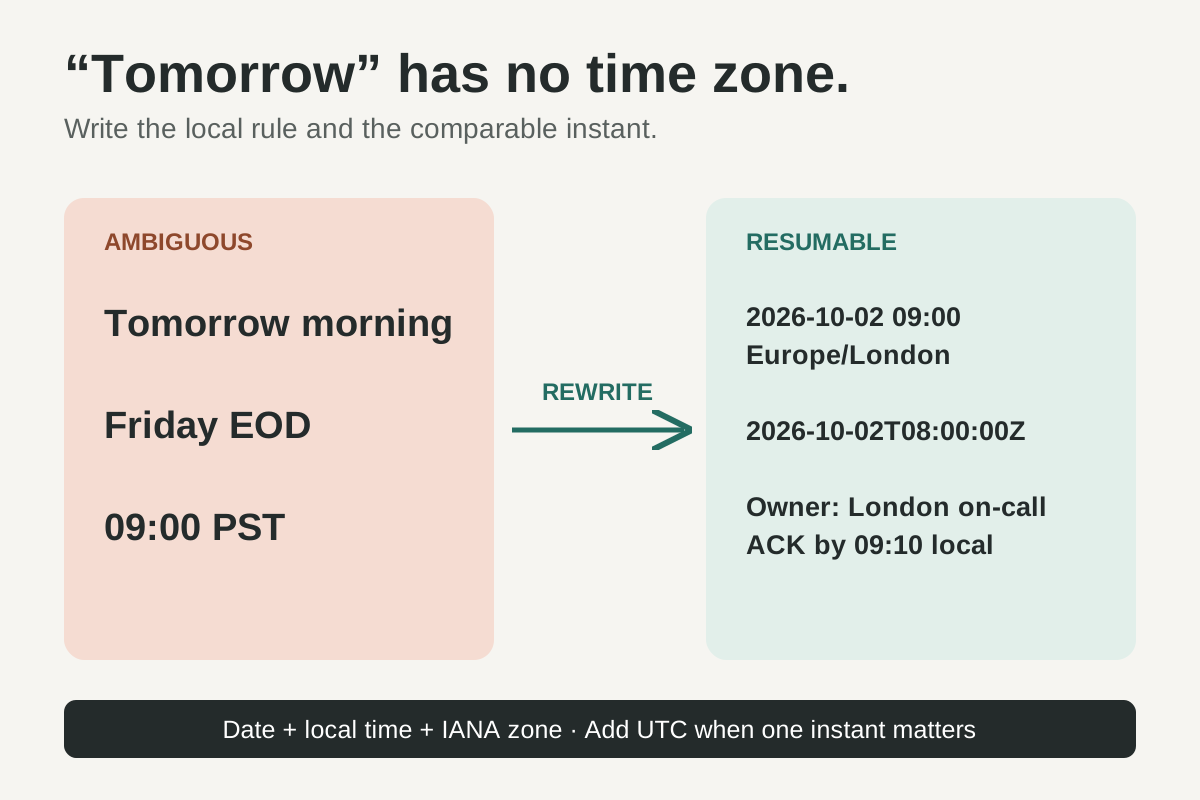
Figure 2: The receiver should not have to infer whose tomorrow, which Friday, or whether an abbreviation observes daylight saving time.
For human-facing notes, show both the receiver's local time and UTC when coordination is sensitive. The UTC value makes the instant comparable. The named zone preserves the intended local rule for calendar scheduling. Software should calculate one from the other; people should not do offset arithmetic in their heads.
Acknowledgement closes the ownership loop
Sending is observable. Understanding is not.
The incoming person should acknowledge the handoff with a short restatement, not a reaction emoji:
ACK 2026-09-24 09:08 Europe/London
I own checkout retry investigation until the 14:00Z checkpoint.
I will reproduce `retry_after_timeout`; the feature flag stays off.
First update goes to issue #912.
This takes less than a minute and tests four things at once: the receiver saw the message, understood the next action, accepted ownership, and knows where to publish the next state. A misunderstanding becomes visible while the outgoing shift may still be reachable.
Set an acknowledgement deadline. If no acknowledgement arrives, ownership has not moved. The outgoing person should use the predefined escalation path rather than assuming silence means consent. For routine work, that may be a team channel mention. For an incident, regulated process, or customer deadline, it may require a live call.
The acknowledgement should not repeat the whole packet. Its purpose is a checksum, not a second handoff. Restate the owner, the immediate action, the critical constraint, and the next update location.
Use a short overlap call when text cannot carry the risk
Asynchronous work is not a moral preference. Some states are too unstable or consequential for a document-only transfer.
Use a live handoff when at least one of these is true:
- Active customer or safety impact is changing faster than the document can be updated.
- The next action is irreversible, destructive, or legally consequential.
- Ownership is disputed or the incoming person cannot confidently restate the plan.
- The record contains contradictory evidence that the outgoing person has not resolved.
- Access, credentials, or environment state cannot be verified from the shared record.
Keep the call narrow. Open the same handoff packet, walk from state to risk, ask the incoming owner to restate the next action, and record the acknowledgement in the document. The call supplements the record; it does not replace it.
Google's incident guidance follows that shape: shared state document, explicit spoken transfer, firm acknowledgement, and communication to the wider group about who now leads. The durable artifact lets everyone else orient without joining the handoff call.
Test whether work resumes in 10 minutes
The quality metric is not the number of updates posted or meetings avoided. It is time to safe resumption.
Once a week for four weeks, choose one real handoff and ask the incoming person to start a 10-minute timer before opening it. The weekly cadence and four-week window are starting heuristics; change them for your team's volume and risk. At the end, the reader should answer six questions without contacting the author:
- What is true now?
- What changed during the last shift?
- Which decisions are settled, and why?
- What is my next safe action?
- What must I avoid or escalate?
- Where and when do I publish the next state?
Score each answer clear, found after searching, or missing. Do not average the result into one satisfaction number; repair the recurring field. If risk is repeatedly missing, move it higher. If decision rationale requires transcript search, link the relevant section directly. If acknowledgement regularly arrives late, the designated receiving role or deadline is wrong.
Also track recovery meetings. A recovery meeting is a call scheduled mainly to reconstruct state or rationale that should have crossed the boundary in the handoff. Label it when it happens. The count will not prove causality, but each instance gives you a concrete failed transfer to inspect.
Run one absence test after the fourth week: let the usual author be unavailable for a shift. A resilient handoff system should degrade gracefully when the person with the most context takes a day off. If the work stops, the workflow still depends on memory, whatever the documents say.
The bottom line: asynchronous work is a chain of accepted ownership
Time zones do not create continuity. They create the opportunity for continuity.
The actual chain is human and explicit: one person publishes current state, another restates the next move, ownership changes hands, and the shared record receives the next update. Remove any link and the team gets a delayed chat thread, not a 24-hour workflow.
Design the handoff for the colleague waking up eight hours later. Give them the state before the story, a decision before a discussion summary, an exact time instead of “tomorrow,” and one safe action they can begin. Then ask for acknowledgement. Ten disciplined minutes at the boundary are cheaper than a second meeting spent recovering yesterday.
A practical place to leave the shared record: Telli.sh records meetings, preserves the transcript, and keeps the summary and action items in the same workspace. Use one durable note as the handoff point so the incoming shift can inspect what was said without waiting for the previous shift to wake up.
Create a Telli.sh workspace and record the next handoff
Sources
- Carmel, Dubinsky, and Espinosa, “Follow the sun software development: New perspectives, conceptual foundation, and exploratory field study,” IBM Research / HICSS — April 3, 2009; definition, intended duration benefit, and exploratory study context.
- Carmel, Espinosa, and Dubinsky, “Follow the Sun Workflow in Global Software Development,” Journal of Management Information Systems — volume 27, issue 1, 2010, pp. 17–37; 12 propositions concerning calendar efficiency, handoff efficiency, and coordination.
- Starmer et al., “Changes in Medical Errors after Implementation of a Handoff Program,” New England Journal of Medicine — November 6, 2014; nine hospitals, 10,740 admissions, and the reported error, adverse-event, and handoff-duration results. The article above does not generalize the medical effect sizes to ordinary knowledge work.
- Google, Site Reliability Engineering: Managing Incidents — retrieved September 24, 2026; live incident document, explicit command handoff, and acknowledgement.
- GitLab Communication Handbook — retrieved September 24, 2026; asynchronous-first communication, documenting offline conclusions, public work channels, and a single source of truth. This is a company practice, not a controlled study.
- IETF RFC 3339, Date and Time on the Internet: Timestamps — July 2002; unambiguous Internet date-time syntax and numeric offsets.
- IANA, Theory and pragmatics of the tz code and data — retrieved September 24, 2026; location-based time-zone rules and examples of regions with different civil-time behavior.
- IETF RFC 9557, Date and Time on the Internet: Timestamps with Additional Information — April 2024; additional timestamp information including IANA time-zone names.