ANYmal X reaches customer sites: the useful robot is the inspection record it brings back
ANYbotics has begun shipping its hazardous-area inspection robot. Understand the sensing workflow, ATEX scope, pending IECEx certification and how to evaluate a first industrial route.
A pump can look ordinary while its temperature changes. A valve can remain in the same place while a leak begins. The value of a routine inspection is often the small difference from yesterday, attached to the correct asset and delivered to someone who can act on it.
On October 27, 2026, industrial robotics company ANYbotics announced customer deliveries of ANYmal X, its legged inspection robot for explosive atmospheres. The company named Equinor and DSM-Firmenich among the recipients and described earlier field testing beginning in 2023. The event is a move into customer deliveries, distinct from the earlier trials. ANYbotics' launch announcement is the source for that milestone.
The important product question reaches beyond whether a robot can walk through a plant. Can it collect useful observations repeatedly, keep them connected to equipment history and support a maintenance decision? This guide follows that path and explains the certification and deployment boundaries a site needs to understand before planning a first route.
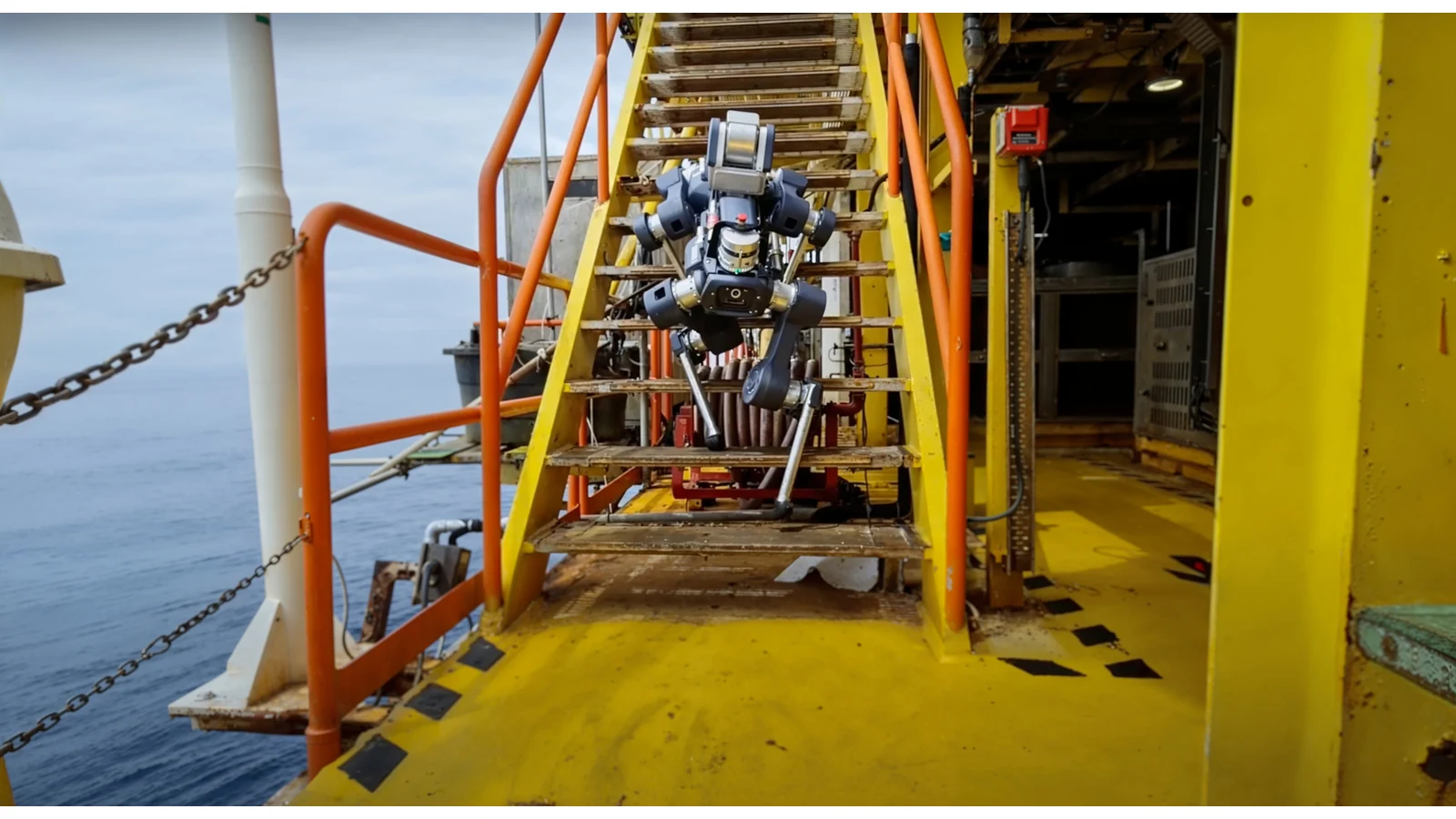 ANYmal X on offshore inspection stairs in 2022. Photo: Cvoellmy, CC BY-SA 4.0; resized with margins. Image source · License and image notes.

A mobile inspection route fills a different role from a fixed sensor
A fixed instrument and a mobile robot answer related questions in different ways. A fixed sensor is positioned for its assigned measurement and can provide a continuing stream. A mobile system visits multiple locations and gathers observations during a route. A plant's reliability strategy can need both, because coverage, timing and the kind of measurement all matter.
Our take is that the robot should be evaluated as a moving inspection record. Mobility earns its place when it brings repeatable observations from assets that the team needs to understand. A successful walk is a prerequisite, while useful evidence is the operational outcome. This changes the pilot from a demonstration of movement into a test of the complete inspection process.
For an illustrative pump route, define the assets, observation positions and expected measurements before judging the mission. A thermal image without a stable view or clear equipment identity is difficult to compare. A timestamped reading attached to the right pump can become part of a trend, even when the individual observation appears unremarkable.
The same principle applies to exceptions. A route should reveal which assets were observed and which were missed. A closed passage, obstruction or unusable view is valuable operational information when it is visible. Treating an incomplete route as a complete inspection would erase the very coverage gap the deployment was meant to address.
Sensors need asset context before they become maintenance evidence
ANYmal X's product page, checked November 2, lists visual, thermal and acoustic inspection capabilities, including 640 × 512 radiometric thermal imaging. It describes gas sensing as an optional module. A buyer should therefore specify the required payload and configuration rather than assume every advertised sensing category is included in every robot.
Consider three illustrative uses. A rotating-equipment route could collect comparable thermal and acoustic observations around pumps or compressors. A visual route could check gauge readings and equipment states. A leak-inspection route could focus on the relevant acoustic observations and, where configured and approved, gas measurements. Each has different acceptance criteria and should be designed with the site's specialists.
For the rotating-equipment case, ask how a change in operating load is recorded. A higher temperature under a different load may call for a different interpretation from the same increase under similar conditions. The robot's observation should be connected to plant context so the reliability team can assess the finding instead of reacting to an isolated number.
For a gauge-reading route, include a range of actual viewing conditions in the pilot. Reflections, partial obstruction and the position of a needle can matter more than a clean marketing image suggests. The useful output includes the underlying observation and a way to review uncertain results, rather than only a transcribed value that hides the source.
For an acoustic route, agree on what triggers further investigation. An anomaly notification should point a specialist to the asset and supporting material. It should not be treated as an automatic diagnosis of every mechanical or process condition. A good deployment turns an unexpected reading into a clear next step with an accountable owner.
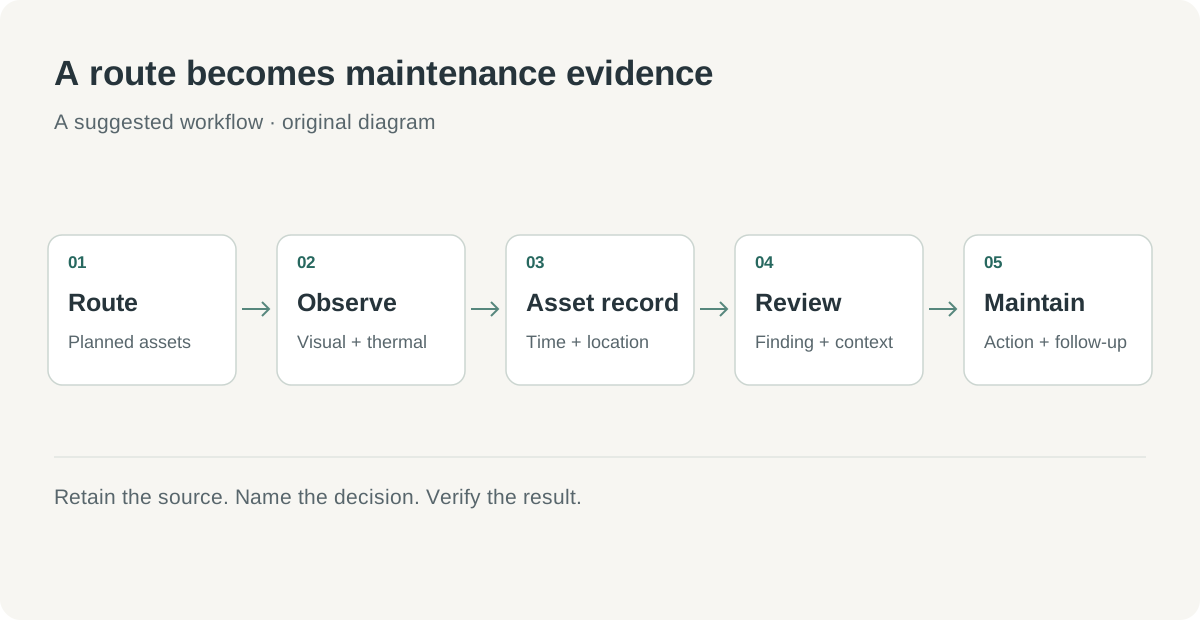 Original inspection diagram: the chain ends with a maintenance decision, not with the robot completing its walk. The examples are illustrative deployment patterns.
Hazardous-area suitability has a precise scope
ANYbotics' current FAQ specifies ATEX Zones 1 and 2, Gas Group IIB, temperature class T4, Category 2G, and states that ANYmal X is not intended for Zone 0, explosive dust atmospheres or IIC gases. The same FAQ says IECEx certification is pending the production-line audit, with availability planned with first production. Charging and nitrogen refilling belong outside the hazardous area. ANYmal X FAQ, checked November 2, 2026.
Those details should be part of site qualification before a route is proposed. A broad phrase such as “explosion protected” does not replace matching the equipment's approved scope to the site's classification and operating procedures. The certificate, user manual and the site's responsible safety personnel determine what is acceptable for the intended deployment.
The charging location is also a route-design input. The team needs an approved place for the robot to return, a way to manage required servicing and a practical route between that location and the inspection area. This is a system deployment involving infrastructure and procedures, even if the robot does not require the plant to rebuild each inspection position.
Avoid turning a general product claim into a site-specific safety conclusion. One facility's approved deployment does not establish that another atmosphere, route or operating condition is suitable. Procurement should obtain the current documentation for the exact delivered configuration and reconcile it with the site's requirements before acceptance.
The platform matters when an observation must become a work order
The October 27 announcement describes ANYbotics Shift as the operational layer for missions, fleet status, findings and integration with maintenance systems. It says the Shift API can exchange mission triggers, inspection results and alerts with customer systems. ANYbotics' announcement therefore presents the robot as part of an inspection workflow, rather than a standalone device.
That integration should be tested around an actual decision. If an observation exceeds a site-defined threshold, who sees it and what information accompanies it? Does the maintenance system receive the correct asset identifier? Can a reliability engineer review the original observation before assigning work? These are more consequential questions than whether an API request returns successfully.
An illustrative thermal finding might lead first to a review task rather than directly to a repair order. The reviewer can compare earlier observations, check operating conditions and decide whether another measurement is needed. The robot helps increase the availability of evidence, while the maintenance process determines the response.
The loop should also close after action. If a technician inspects or repairs the asset, the next route should help establish what changed. Keeping the finding, work decision and later observation connected makes the record useful for future reliability work. Without that connection, automation can generate a larger collection of images without improving the team's understanding.
| Inspection approach | Useful role | What a pilot should establish | Responsibility that remains |
|---|---|---|---|
| Fixed instrumentation | Continuing measurement at a defined point | Correct placement, signal quality and alert handling | Sensor maintenance and interpretation |
| Human inspection round | Flexible observation and contextual judgment | Consistent records and clear follow-up | Site procedures and specialist decisions |
| Mobile robotic round | Repeatable observations across a planned route | Coverage, usable data and recovery from missed points | Route ownership and response to findings |
| Specialist investigation | Deeper diagnosis of a suspected issue | Adequate evidence for the specific question | Qualified assessment and maintenance authorization |
This is a comparison of roles within a maintenance program. It does not establish a universal replacement order. The right combination depends on what must be measured, how often, and how quickly a person needs to respond to a change.
Customer deliveries and customer outcomes answer different questions
The launch announcement establishes that shipments have begun and names customer organizations. It does not, by itself, provide a universal payback period or the percentage of human inspection work that every site can remove. Those outcomes depend on routes, labor arrangements, maintenance processes and the cost of missed or unusable observations.
ANYbotics also cites more than 120,000 inspections analyzed per month across its integrated solution. That is a broader vendor-reported operating figure, not an accumulated result attributable only to the newly shipped X units. October 27 launch announcement. Keeping the scope clear makes the number useful context without turning it into a new-product performance result.
For a site pilot, choose a baseline that can be measured locally. Record how the selected route is performed today, what observations are retained and how findings reach maintenance. Then compare the robotic process against the same operational questions. The aim is to identify where coverage, consistency or routine exposure improves and where new support work appears.
Include the effort required to maintain the deployment. Route changes, blocked access, sensor cleaning, servicing and data review all belong in the evaluation. A robot's productive mission time matters, but so does the time people spend making that mission dependable. A useful business case accounts for the system people will actually operate.
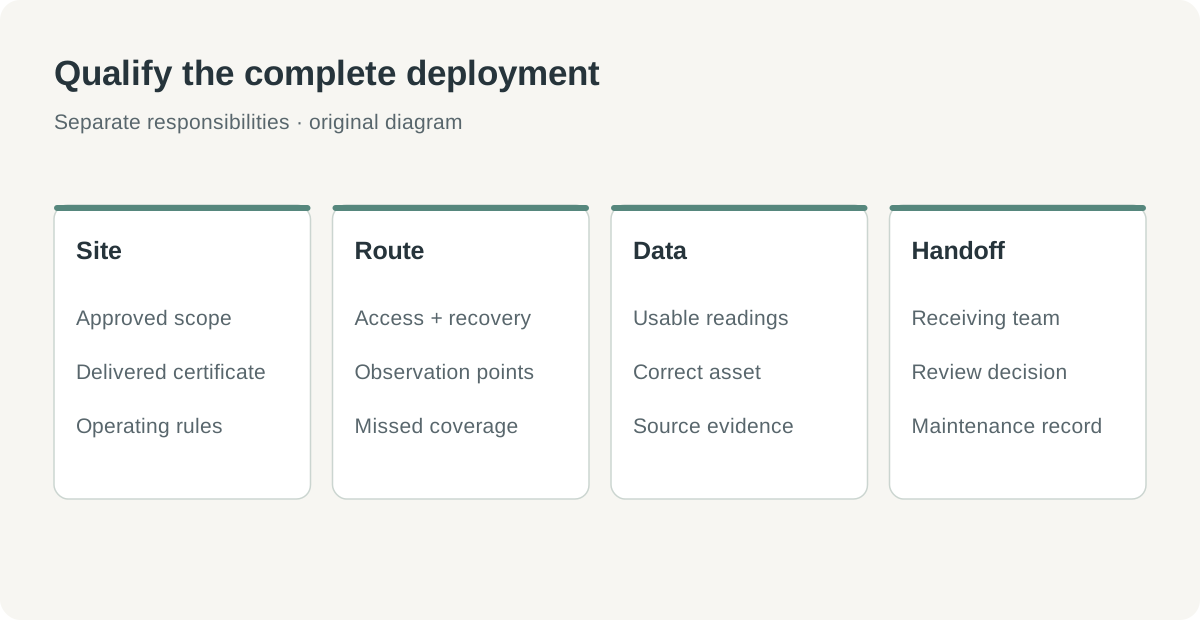 Original deployment diagram: qualify the site and route before judging the complete inspection-to-maintenance handoff. Certification is a specific eligibility boundary, not a general performance score.
Begin with one route whose value is already understood
The ANYmal X page directs prospective customers toward a site discussion, a Business Value Assessment or an on-site demonstration. That fits the nature of the product: the first meaningful question concerns a real route and its requirements. ANYbotics product page, checked November 2, 2026.
- Select a routine route with known assets, observation requirements and a responsible reliability team. Document its current completion and follow-up process.
- Have the site's qualified personnel review area classification, the delivered equipment's documentation and the proposed operating conditions. Resolve certification and configuration questions before planning live operation.
- Define observation positions and acceptance criteria for each asset. Include examples of usable readings, missed observations and findings that require a human response.
- Agree on docking, servicing, connectivity and recovery procedures. Name the person or team responsible when a mission cannot continue.
- Run the agreed qualification with the vendor and inspect the retained data. Verify asset identity, timestamps, source observations and the visibility of incomplete coverage.
- Exercise one maintenance handoff from finding to review task and, where appropriate, work order. Confirm the receiving team can understand and act on the evidence.
- Compare the pilot with its baseline before expanding routes. Record support effort and unresolved limitations alongside the useful results.
A good pilot also includes a change in the environment. Industrial sites are not frozen scenes: passages close, equipment moves and operating conditions vary. The system should make those differences visible and support a controlled update to the route. That is a more useful test of readiness than repeating a carefully prepared path under identical conditions.
Define who may edit a route and who approves the revised mission. A small change in an observation position can affect comparison with previous data, while a change in access can affect operating procedures. Keeping those decisions recorded helps the team maintain both a dependable route and an interpretable history.
Include the receiving shift in the review. The people who planned the pilot already know why each observation matters, while the next shift may only see an alert and an asset record. Ask them to locate the source observation, understand its time and identify the required response without a live explanation from the pilot team. That is a practical test of whether the data handoff works.
The same exercise can expose unnecessary notifications. A large volume of low-value alerts can consume the attention that the inspection program was supposed to protect. Tune the review process with the responsible specialists and retain the observations needed to explain those choices.
Physical AI becomes useful when the next shift trusts the evidence
ANYmal X's customer-delivery milestone is interesting because it brings mobile sensing into a tightly constrained operational setting. The engineering challenge includes movement and protection, while the customer's challenge includes evidence, ownership and maintenance follow-through. Both have to work for the deployment to matter.
Our expectation is that the strongest early deployments will define success around a small set of valuable observations and a complete response process. They will know what the robot can inspect, what it missed and what a person decided afterward. That is a foundation a site can expand deliberately.
The robot's most useful output is a record the next shift can trust. A completed inspection is the combination of a visit, a usable observation and an understood next action.
Sources
- ANYbotics: customer deliveries of ANYmal X, October 27, 2026; checked November 2, 2026. Customer and operating-scale statements are vendor-reported.
- ANYmal X: product specifications and certification FAQ, checked November 2, 2026. Approved use must follow the current certificate, delivered configuration and manual.
- Cvoellmy: ANYmal X offshore inspection photograph, 2022, CC BY-SA 4.0; checked November 2, 2026.
Keep an operational decision connected to its source
Telli.sh is one option for retaining authorized source material and the notes behind an operational decision. Create a note workspace.