Why did people leave the signup flow? What Amplitude Wave can help you test
Amplitude Wave turns analytics, session replays and feedback into product experiment proposals. A DigitalOcean payment-banner test shows what the agent surfaced and what the team still had to measure.
A developer has just created a cloud account. She opens the page to start a virtual machine, fills in the easy parts, then leaves. The analytics funnel shows a drop near the payment step. A recording of an eligible session might show that she never scrolled far enough to see what was required. Neither observation tells the team whether putting that requirement at the top of the page will get more people to start a server.
On November 12, 2026, Amplitude made Wave available as a paid offering for organizations on its Growth and Enterprise plans. Amplitude, a product analytics and experimentation company, built Wave to connect behavioral data, session replays, customer feedback and other configured sources. Wave organizes its findings into proposed improvements, called Opportunities, with supporting evidence and target metrics. Teams can review a proposal, send it to a tool such as Jira, Linear or GitHub, and evaluate approved changes using a feature flag or experiment. Amplitude November 12 launch · Wave product documentation
A DigitalOcean customer account tells us how this can work in a real onboarding flow. It also shows why the analyst's judgment is still useful after the recommendation arrives. The goal is to explain why an experiment is worth running, what its result permits a team to claim, and which questions a stronger product brief should leave open.
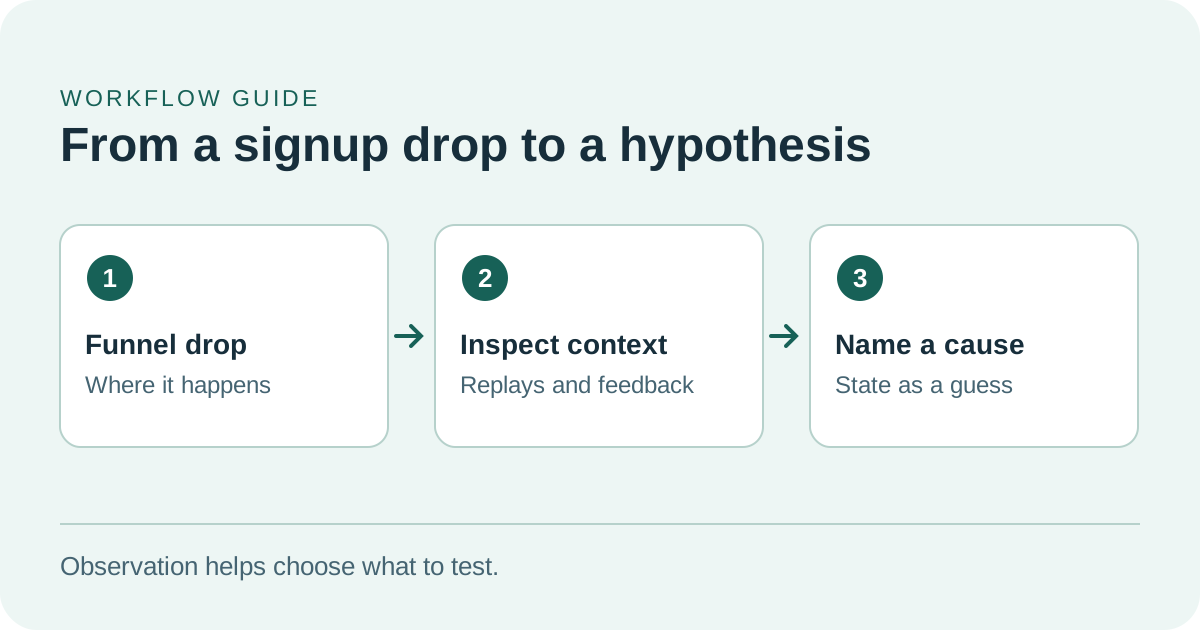
Use replays and feedback to choose a hypothesis about the drop.
A funnel identifies where to look for a problem
A signup funnel is a defined sequence of tracked actions. In a developer cloud, it could begin with account verification, continue with opening the first-resource page and adding an eligible payment method, and end when the first resource is created. The team has to decide who counts at each stage and how long they have to move to the next one. In one example, a developer may sign up today and start a server with a teammate tomorrow. If the funnel counts individuals while billing happens at the team level, a real success can look like a loss.
Wave's Product Area is where a team gives the system a place to look, a goal and a set of sources. Its current documentation says a Product Area can reflect a screen, a journey or a customer outcome. It also lets teams scope a source with particular dashboards, relevant events for replay searches or a lookback window for feedback. The developer cloud could choose one Product Area for first-resource creation and focus on new teams that reached the setup page without a payment method. That goal points to a segment and a decision the team can judge. Wave documentation on Product Areas · Wave source configuration
Once the team has a usable denominator, the aggregate data can show where eligible teams tend to stop. Replays can show that some users pause, scroll back or never reach a particular part of the page. Feedback could reveal a different obstacle, such as being unable to proceed without a billing administrator. The proposal becomes stronger when those sources agree and much easier to question when they point in different directions.
| Evidence source | Useful question | What a reviewer checks |
|---|---|---|
| Funnel events | At which step do eligible new teams stop, and how often? | Event definitions, missing events, conversion window and the unit being counted |
| Session replays | What did some users encounter on the page just before leaving? | Whether the sampled sessions reflect the target segment and what the replay can actually show |
| Feedback and support themes | Which confusion or constraint can customers describe in their own words? | Date, cohort and whether a frequently submitted complaint represents the broader group |
| A controlled experiment | Did the proposed change affect the prespecified outcome? | Assignment, exposure, denominators, uncertainty and effects on other important metrics |
Amplitude documents how Wave groups findings and looks for corroboration before it creates prioritized opportunities. Look at the evidence linked from an Opportunity before accepting its score. If several observations all came from the same five sessions, they offer less breadth than matching evidence across multiple segments and a separate set of support requests. The score helps decide what to review first. The reviewer still has to decide which evidence is relevant and what would count against the hypothesis. Wave discovery documentation
DigitalOcean's payment banner was one experiment with a specific outcome
In a November 9 account on Amplitude's blog, DigitalOcean product manager Haley Eidem said adding a payment method was the largest observed point of drop-off in the team's existing onboarding analysis. Wave proposed making the payment requirement more visible on the Droplet creation page. A Droplet is DigitalOcean's virtual machine. The team tested putting the existing prompt into a banner at the top of the page, where users would see it sooner. The downside they considered was clutter on a page already asking new users to make configuration choices. DigitalOcean customer account on Amplitude's blog, November 9
Eidem reported that teams shown the banner were 3.3% more likely than the control group to add a payment method. She said the result met the test's configured 80% confidence threshold and the company decided to roll out the banner. That reported figure concerns adding a payment method. The same account does not give a rate for first Droplet creation from this experiment. If your product needs the later outcome, define it in your own test and measure it through to completion. DigitalOcean customer account
The same customer account gives a useful second example. For Harness Runtime, DigitalOcean tried adding pricing information to a landing page on the hypothesis that missing information was keeping customers from creating an environment. Eidem reported slightly lower environment creation with the added information, said the team could not conclude that the extra information caused a decline, and explained that the change was not rolled out. It led to a narrower next question about whether clarifying the recommended path would help. For a team considering Wave, that decision is as informative as the banner rollout. A proposal can be worth testing even when the resulting change stays off. DigitalOcean customer account
Eidem also reported 55 opportunities over six weeks across five beta Product Areas. That number tells you the volume of proposals one customer reviewed across several products. For your own adoption decision, count how many opportunities cited evidence your product owner could validate, how many duplicated existing work, and how many resulted in a decision you would find useful after the pilot. Set a weekly review time and record how much work the team spends checking proposals. If the review time absorbs the savings from drafting fewer briefs, start with a narrower Product Area. DigitalOcean customer account
Session recordings help build hypotheses when collection is scoped
For the signup example, look at eligible sessions around the transition the team is trying to understand. A recording that shows the banner below the fold can support a theory about visibility. Another that shows an error before the payment step can suggest a different fix. A third might start after the action you are trying to explain. Look at sessions where people completed the task as well as sessions where they left. A pattern that occurs equally in both groups is a weak reason to redesign the page.
Replay also changes what data the team handles. Amplitude's browser guidance says replay masking covers page text and form inputs according to the chosen configuration, while HTML attribute values remain outside that masking mechanism. That matters when an app embeds user data in placeholder text, accessibility labels or custom attributes. For a first review, use a test account and a known sequence of actions. Confirm the replay links to the intended analytics session and shows only the approved content before using production replays in the Product Area. Amplitude replay privacy controls · Amplitude replay verification guide
Time spent setting boundaries early can make reviews faster. Decide which people can open supporting evidence and which information belongs in an engineering ticket. A team can link to an access-controlled chart from its own tracker and describe a reproducible issue using a test account. That gives the implementer a way to check the issue without transferring a customer's recording, login details or billing information to another system. Review the workspace-wide scope of any connected repositories separately from the source filters you give one Product Area. Wave Product Areas and connection scope
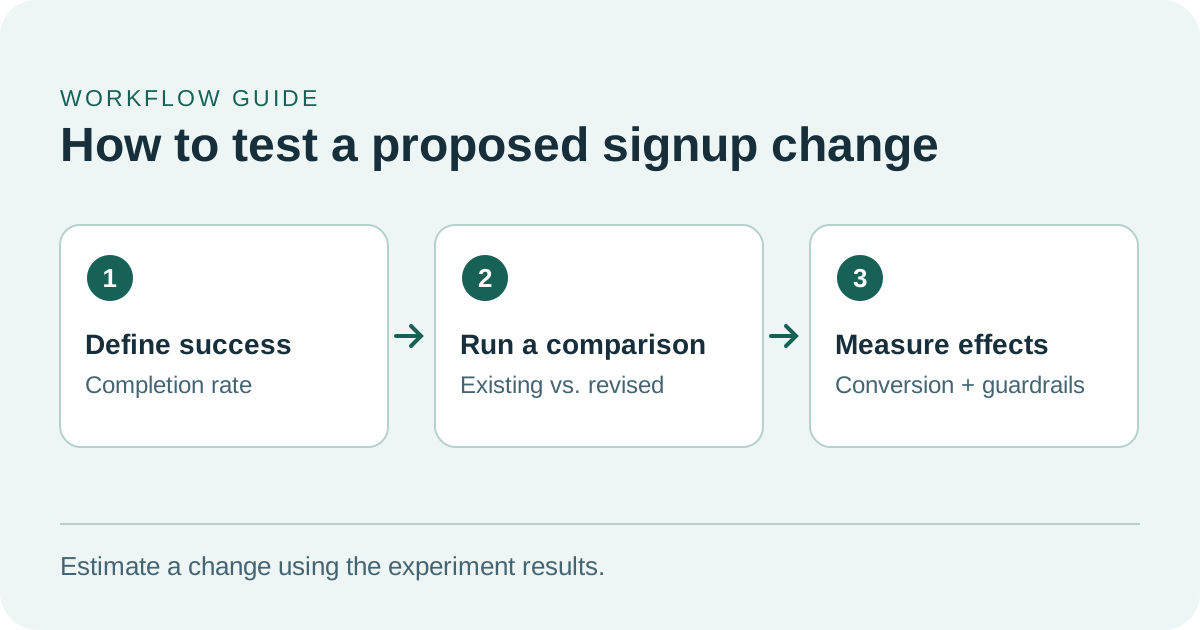
Decide what counts as improvement and track what could get worse.
Give the first approved experiment a clear decision rule
- Pick one step and a stable denominator. In a first-resource funnel, select new teams that reached the resource setup screen without an eligible payment method. Set a defined observation window and document how duplicate accounts or team invitations are handled. Have a product owner and an analytics owner agree on the definition.
- Review one Opportunity against its sources. Open the linked chart, a small set of approved replays where available, and the related feedback. Record both supporting evidence and objections. If the underlying issue may be a permissions problem, confirm that it affects the target audience before suggesting a more prominent banner.
- Change one element you can describe. For an illustrative pilot, preserve the original page for the control group and move the same payment guidance into a visible banner for the treatment group. Put the exact change, expected outcome and acceptance criteria in an approved ticket. Keep review, merge and rollout with the people who own the product.
- Choose the primary measure, follow-through and guardrails. Use the share of eligible teams adding a payment method in the preselected window as the primary measure if discoverability is the question. Track first-resource creation as a separate outcome, and watch for error rates or support contacts to see whether the banner shifts friction somewhere else. Set allocation, decision thresholds and the stopping rule before launch. Check that exposure and analysis use the same unit. Amplitude's experimentation documentation explains why a material sample ratio mismatch can make the comparison unreliable. Sample ratio mismatch guidance
- Save the decision with the evidence. Record both group sizes, both conversion rates, uncertainty and any guardrail change. Suppose an illustrative test found more payment methods added while first-resource creation stayed inconclusive. That result can support reporting a change at the measured step while leaving follow-through as an open question. Decide whether that is enough for a reversible rollout or a reason to collect more evidence.
There is a practical reason to run that loop once before widening a paid deployment. If your organization already has reliable funnels, a reviewable replay setup and a working experiment process, the value of Wave may be the time between a question and an evidence-linked brief. If an event changes its meaning mid-funnel or the product lacks an outcome metric, the first useful work may be fixing that measurement. Bring one real business goal to the available product and compare a Wave proposal with the brief the team would have produced anyway. Wave availability and getting-started documentation
The most valuable recommendation helps a team make a decision
A product team rarely needs another list of plausible changes. It needs a record of what it thought was happening, what it could safely change, and how it decided what to keep. Wave can help assemble that record while evidence is fresh. The practical test is whether a teammate can open an Opportunity later and explain why the team shipped a banner, kept a page unchanged, or went back to check its measurement.
Sources
- Amplitude Wave availability announcement, November 12, 2026
- Haley Eidem's DigitalOcean customer account, November 9, 2026, published by Amplitude
- Amplitude Wave product documentation
- Wave Product Areas and configuration
- Amplitude Wave source context and source configuration
- Amplitude Session Replay privacy settings
- Amplitude guide to verifying Session Replay capture
- Amplitude Experiment guide to sample ratio mismatches
To keep experiment notes, customer feedback themes and product decisions in a searchable record, create a Telli.sh account.