Why keeping the GPUs online isn't enough under Australia's 30 MW grid rule
Australia's AEMC set grid ride-through standards for large inverter-based loads. See what the 30 MW threshold measures, what a UPS can hide from servers, and what remains under consultation.
Imagine an AI service generating a response when the voltage supplying its data centre briefly dips. At the rack, the uninterruptible power supply keeps the servers running and the user notices nothing. At the connection point, the network may see the site draw less power or drop away entirely. The same event can look routine to a cloud operator and consequential to the power system.
On November 12, 2026, the Australian Energy Market Commission (AEMC) issued a final rule on access standards for the National Electricity Market (NEM), with immediate commencement and transitional arrangements for certain projects. It classifies an inverter-based load as large at 30 MW or more of nameplate rating and sets technical requirements for how relevant loads ride through grid disturbances. That same day, a separate AEMC paper opened consultation on registration and operating information. Final determination, ERC0394 · Consultation information sheet, ERC0455
Both developments make more sense once you separate three measurements: a site's rated load, the power it draws from the grid during a disturbance, and the power the servers use inside. Here is how those measurements change the way to read a new AI campus announcement, even before a single GPU has been installed.
The 30 MW threshold measures equipment covered by a connection agreement
For these rules, an inverter-based load is an electricity consumer with a power-electronic grid interface whose controls could become unstable. A data centre with a grid-facing converter that adjusts current as grid conditions change is a useful example. AEMC's determination distinguishes equipment with active controls from equipment with passive electrical components. The relevant question is how the load presents itself to the network. AEMC final determination, chapter 3
Under the final rule, the nameplate rating aggregates the consumption ratings of relevant elements or equipment when they are covered by one connection agreement. Imagine an illustrative campus with two qualifying inverter-based sections rated at 18 MW each under that agreement. That gives a combined rating of 36 MW even during a period when only one section serves customers. A reading taken during a quiet hour answers how much power the site uses then. The nameplate number answers which connection framework applies to the equipment.
That distinction matters whenever a data centre announcement says a site will be built in phases. The figure could describe the eventual connection, one phase of IT equipment, or expected demand after tenants arrive. The Australian Energy Market Operator (AEMO) draws the same distinction at market scale in its August 2026 forecast. Its methodology accounts for projects that fall out of the connection pipeline, differences between connection capacity and usage, and the time facilities take to reach planned demand. AEMO 2026 Electricity Statement of Opportunities
Schedule 5.3 access standards apply automatically to large inverter-based loads, with the connection negotiation process still determining applicable performance standards. Below 30 MW, a network service provider can apply standards where a smaller inverter-based load could adversely affect the quality or security of service to other users. Network providers also have to consider collective effects where the electrical configuration, connection arrangements and planned operation make it reasonable to assess loads together. That means separate facilities can raise a common assessment question even when their rating and agreement are recorded separately. AEMC final determination, sections 3.1 and 3.2
Server uptime and grid ride-through measure different outcomes
An uninterruptible power supply, or UPS, maintains a stable supply for connected equipment. During a disturbance, it can draw on stored energy while the equipment it protects continues its work. Grid ride-through concerns the performance of the load at the point where the facility connects to the power system. The final rule sets expectations for remaining connected during specified voltage and frequency disturbances and for how applicable loads behave during or after those events. AEMC final determination, chapter 5
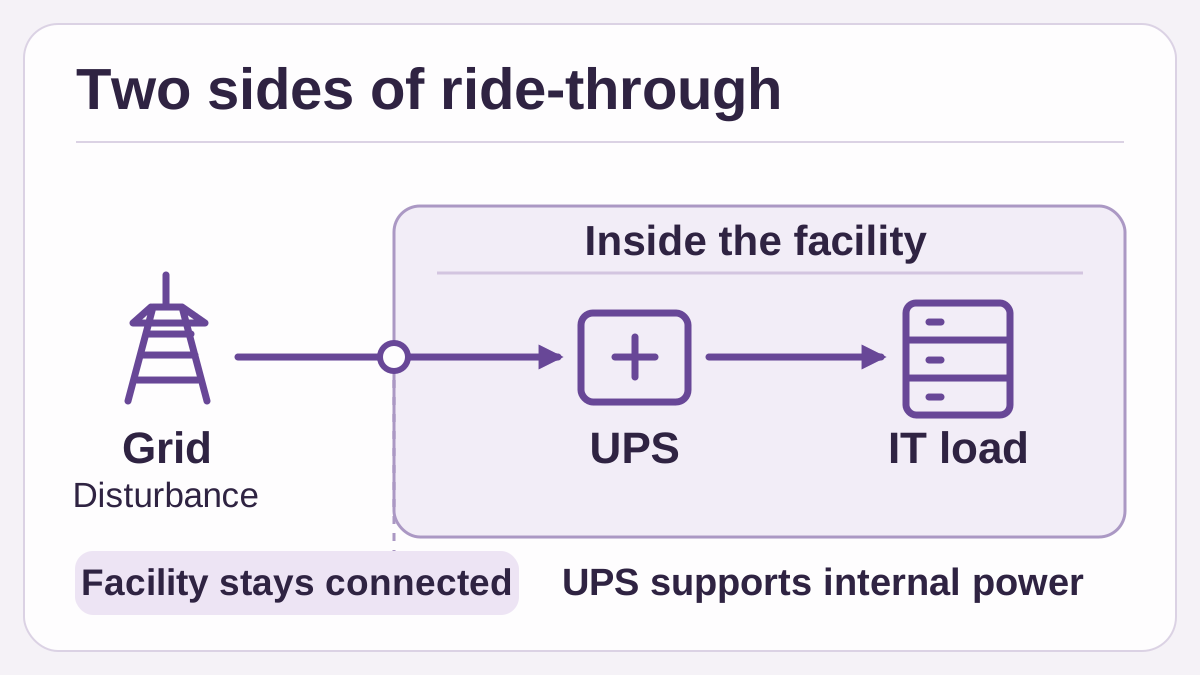
Original conceptual diagram. A UPS can maintain power to server racks while the grid sees a change in the facility's draw at the connection point.
A voltage disturbance changes the electrical supply level for a short period. A frequency disturbance changes the rate at which the alternating current cycles. Both can affect equipment in a shared system, and the characteristics and duration of the event matter. On the facility side, recovery introduces another question because grid-side demand can return on a different time course from the workload, which may have continued throughout. A server uptime dashboard has limited value in explaining that return; the connection record is where the facility's external response becomes visible.
Consider two hypothetical sites whose racks both stay online. At one site the grid continues supplying part of the power during a brief disturbance and the UPS supplies the balance. At the other, the entire protected load transfers away from the grid. Both IT teams can record uninterrupted work. The network sees very different changes in demand, particularly if several similarly configured sites react to the same event. The connection assessment examines the facility's response from the network's side. AEMC final determination, section 5.2
The determination also clarifies the treatment of a UPS meant primarily to maintain power to connected loads and designed without active-power export through the grid connection point. Such equipment can be considered as part of the load under Schedule 5.3. A battery designed for export has a different role and can fall under the framework for bidirectional equipment. For buyers comparing a backup-power system and a grid-services battery, the intended function at the connection point makes that distinction concrete. AEMC final determination, section 3.2.4
The final rule also addresses instability detection and response where a large load could contribute to instability. The relevant assessment involves monitoring, information exchange with the network service provider and AEMO, and a coordinated response. The requirements are tied to the characteristics and impact of the connection. Two sites ordering similar server hardware may face different study work when the surrounding network and nearby connections differ. AEMC final determination, chapter 6
AI inference introduces a different question about power changes
In the grid-disturbance example, something outside the data centre changes and the facility responds. In an inference workload example, the facility's own work changes and its electricity draw can follow. Both affect the shared connection, but the direction of cause and effect matters when interpreting a power trace. It also explains why a document on responding to disturbances and a document on routine operating visibility came out on the same day.
In an ASPLOS 2024 paper, Pratyush Patel and colleagues measured GPU power during inference across five models, including GPT-NeoX-20B, OPT-30B and Llama2-70B. The tested runs showed an early spike while processing prompts and a generally lower, more stable phase while generating tokens. Their comparison across prompt lengths and batch sizes found that both could change peak draw under the tested configurations. The study's Figure 6 is the source of the GPU traces cited as Figure 2.3 in the AEMC consultation. ASPLOS paper, section 4.2 · AEMC consultation, Figure 2.3
Picture an illustrative inference operator that serves interactive requests alongside document jobs. Interactive requests arrive independently, while a batch of long documents can enter processing together. Even if two schedules finish the same number of documents during the day, the pattern seen by the GPUs can differ. The paper gives a reason to study that difference. How much of it appears at the facility connection depends on which equipment changes in step, on the other workloads running at the same time, and on the rest of the facility's electrical demand, including cooling.
Scale changes what you can conclude. A GPU trace shows what the measured hardware did. A server trace includes more of the equipment. A reading at the connection measures the facility's interaction with the external grid. In a separate planning frame, AEMO's August 2026 outlook forecasts that annual data centre electricity consumption in the NEM will rise from about 5 TWh in 2025–26 to 34 TWh in 2035–36. That forecast describes annual energy. It cannot tell you how quickly one site's draw changes over a short interval. ASPLOS paper · AEMO 2026 forecast
The final rule and the consultation answer different questions
The November 12 determination sets the technical framework for connection, including capabilities that can be discussed, modelled and tested. The separate consultation asks what market operators need to know as facilities operate and what tools could help manage rapid changes in demand. It considers registration, real-time information and forecasts, and possible limits on the rate of change of active power. The consultation paper requested submissions by December 17, 2026. AEMC final determination · AEMC consultation paper
| Question for an AI campus | AEMC work | Status on November 14, 2026 |
|---|---|---|
| Which inverter-based loads automatically come under Schedule 5.3? | Large-load classification at 30 MW or more of nameplate rating | Final rule commenced November 12 |
| How does applicable equipment respond to disturbances and recover? | Technical access standards including ride-through and, where applicable, instability detection and response | Final rule commenced November 12, with transition provisions |
| How should large operators register, report demand or manage changes in draw in ordinary operation? | Options for registration, real-time and forecast information, and demand ramp rates | Separate consultation with submissions due December 17 |
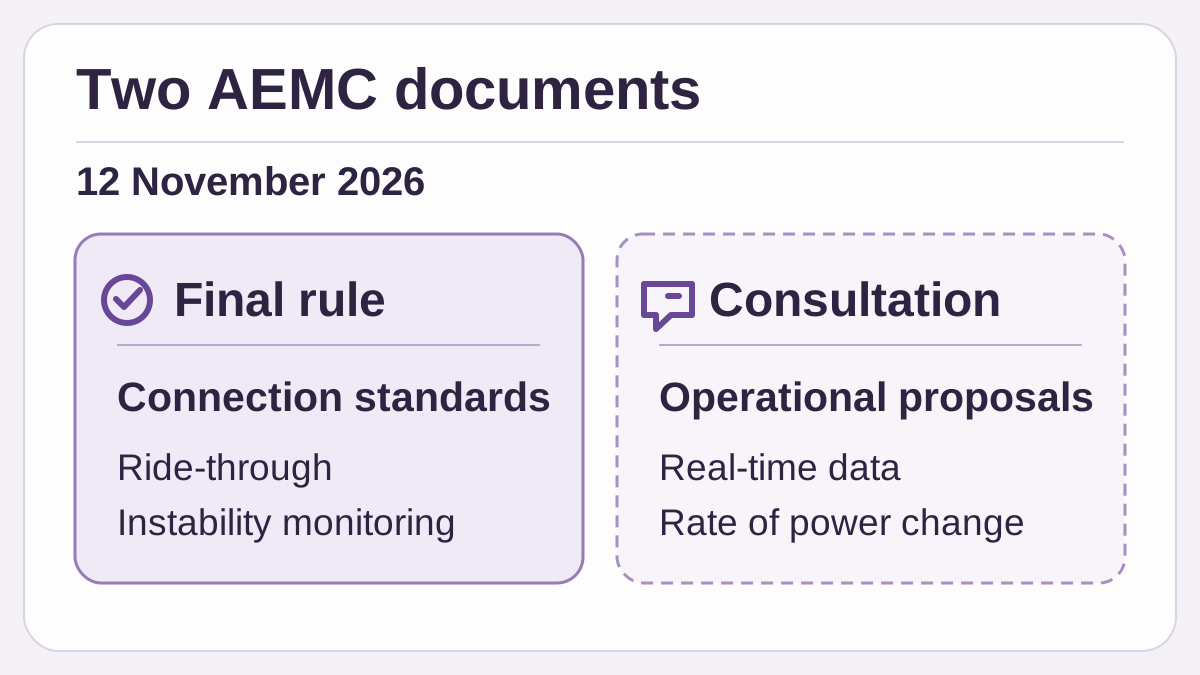
Original diagram based on the two AEMC publications. One sets connection requirements, and the other seeks views on options for operating large loads as part of the market.
The rule's start date is also different from the date on which every project in the pipeline moves to the new access standards. Some advanced applications qualify for a six-month grace period. In the determination's example of an in-progress application, the applicant already has a valid application and acceptance of any proposed negotiated access standards but is still awaiting an offer to connect. If the offer has yet to be made when the relevant grace period expires on May 12, 2027, the new standards apply to the application. The official transition figure distinguishes that situation from an earlier application and from a site with an existing offer or agreement. AEMC final determination, chapter 9 and Figure 9.1
A power plan now tells you more than a capacity announcement
The immediate benefit is a more predictable question for builders and network providers to work on together. If a proposed inference campus is above the threshold, the application has an explicit technical framework to work from, and procurement teams can ask vendors for relevant evidence before the equipment is locked in. The burden is that evidence has to describe the assembled facility and its behaviour, across normal operation as well as the disturbances in scope for its performance standards. A successful component test is one input into that larger assessment. AEMC final determination, chapters 5 and 8
For readers evaluating a new project announcement, three questions make the power claim easier to interpret:
- Read the capacity figure in context. Find out whether it refers to rated load covered by the agreement, IT capacity or planned demand at a certain phase. Keep annual energy in a separate column.
- Ask what was actually observed. A design statement, an equipment qualification test and a facility-level commissioning result each answer a different question. Identify where the measurement was taken and what it describes.
- Check the status of any policy claim. Look for the determination or consultation by project reference. A plan to provide forecasts or manage ordinary demand ramps can be a relevant operating choice while those options are still being debated.
The expectation worth tracking is whether new campuses can explain how their power use changes as workloads and grid conditions change. More clearly specified requirements can improve what gets measured and discussed late in a project, when assumptions about server demand, backup power and network performance have to agree. A simple capacity number says how large the project could be. Evidence about its response tells you how that capacity might become useful on a shared grid.
Sources
- Australian Energy Market Commission, Access Standards Package 2 final determination (ERC0394), November 12, 2026
- Australian Energy Market Commission, Operational Integration and Visibility consultation paper (ERC0455), November 12, 2026
- Australian Energy Market Commission, ERC0455 information sheet, November 12, 2026
- Australian Energy Market Operator, 2026 Electricity Statement of Opportunities, August 25, 2026
- Patel and colleagues, Characterizing Power Management Opportunities for LLMs in the Cloud, ASPLOS, April 2024
To keep public determinations, diagrams and project notes together, create a Telli.sh account.